September 26, 2025
Dear Interested Readers,
“Dr.” Trump Is a Quack
What do the following individuals have in common?
Sir Anthony Hopkins – Actor
Dan Aykroyd – Comedic actor
Susan Boyle – Singer
Tim Burton – Movie director
Alexis Wineman – Miss America and model
Daryl Hannah – Actress & environmental activist
Stephen Fry – Actor
Chris Packham – Naturalist, TV presenter
Elon Musk – Entrepreneur and business magnate
Dr. Michael Burry – Physician, investor and hedge fund manager. The movie “The Big Short” is based on him.
Liane Holliday Willey – Author of “Pretending to be Normal, Asperger Syndrome in the Family”
Travis Meeks – lead singer, guitarist and songwriter for acoustic rock band Days of the New
Satoshi Tajiri – Creator of Nintendo’s Pokémon
Dr. Vernon Smith – Nobel Prize Winner, Professor of Economics, Chapman University, essentially invented the field of experimental economics — an achievement for which he won the Nobel Prize in 2002.
Donna Williams – Author and speaker
Alix Generous – Professional speaker, neuroscientist, author, artist, comedian, and media producer
Carly Fulgham – Technology project lead for National Bank and is President of Autism Society of America
Paddy Considine – Actor
Clay Marzo – Professional surfer
Bill Gross – Successful investment manager
Barry Humphries – Actor
Dan Harmon – Writer and creator of the hit show Community
Heather Kuzmich – Model
Courtney Love – Actor, musician, and was the wife of Kurt Cobain
Temple Grandin – Animal scientist
Greta Thunberg – Environmental activist
You are correct if you guessed or knew that their commonality is that they have been diagnosed as being on the autism spectrum, or, as is becoming a more acceptable and informative descriptive term, they are neurodiverse.
Other notable individuals who are VERY LIKELY to have been or are on the spectrum:
Albert Einstein – Scientist & Mathematician
Charles Darwin – Naturalist, Geologist, and Biologist
Bobby Fischer – Chess Grandmaster
Bill Gates – Co-founder of the Microsoft Corporation
Thomas Jefferson – Early American politician
Nikola Tesla – Inventor, electrical engineer, mechanical engineer, and futurist
Andy Warhol – Artist, film director, and producer
Steve Jobs – Founder and former CEO of Apple
Sir Isaac Newton – Mathematician, physicist, astronomer, theologian, and author
Michelangelo – Sculptor, painter, architect, poet
Henry Ford – Founder of Ford Motor Company
Marie-Curie – Scientist who pioneered research on radioactivity
James Joyce – Novelist, short story writer, poet, teacher, and literary critic
Alfred Kinsey – Sexologist & Biologist
Mark Zuckerberg – Co-founder of Facebook, media magnate, internet entrepreneur, and philanthropist
Stanley Kubrick – Film director
Wolfgang Amadeus Mozart – Classical composer
Hans Christian Andersen – Children’s author
Benjamin Banneker – African American Almanac author, surveyor, naturalist, and agrarian
Lewis Carroll (Charles Lutwidge Dodgson) – writer of children’s fiction, notably Alice’s Adventures in Wonderland and its sequel Through the Looking-Glass
Henry Cavendish – Natural philosopher, scientist, and an important experimental and theoretical chemist and physicist
Emily Dickinson – Poet
Paul Dirac – Theoretical physicist who is regarded as one of the most significant physicists of the 20th century
Dawn Prince-Hughes – PhD, primate anthropologist, ethologist, and author of Songs for the Gorilla Nation
Jerry Newport – American author and mathematical savant, basis of the film Mozart and the Whale
John Elder Robison – author of Look Me in the Eye
Judy Singer – Australian disability rights activist, sociologist who coined the term “Neurodiversity”
Alan Turing – Father of modern computing, mathematician and logician, code breaker in WW2
Barbara McClintock – Scientist and cytogeneticist who was awarded the 1983 Nobel Prize in Physiology or Medicine
Francis Galton – Statistician, sociologist, psychologist, anthropologist, tropical explorer, geographer, inventor, meteorologist, proto-geneticist, psychometrician
Daniel Tammet – Essayist, novelist, poet, translator, and savant
Gary Numan – Musician, singer, songwriter, composer, and record producer
Ludwig Wittgenstein – Philosopher who worked primarily in logic, the philosophy of mathematics, the philosophy of mind, and the philosophy of language
William Butler Yeats – Poet, dramatist, prose writer and one of the foremost figures of 20th-century literature
James Durbin – Musician
Lizzy Clark – Actress and activist
Jerry Seinfeld – Comedian
Adam Young – Singer and songwriter behind Owl City
There is never certainty when formal testing has not been done, as is the case for many of the living and deceased, such as Steve Jobs, Bill Gates, Thomas Jefferson, and Michelangelo, who are on the lists of “likely.” They have been observed to exhibit many of the characteristics of a person who may be neurodiverse and on the autism spectrum, or, by older terminology, has characteristics of Asperger’s Syndrome. Many authorities also suggest that Thomas Edison should be on the list of historical figures thought to have been neurodiverse.
Those neurodiverse characteristics that make it likely that a person lies somewhere on the spectrum of human variation, which is loosely defined as “on the spectrum,” include:
- Social challenges
- Difficulty communicating
- Repetitive behaviours and interests
- Sensory sensitivities
- Focus and attention variability
- Learning challenges
- Motor skill difficulties
- Preference for routine and resistance to change
- Innovative and creative thinking
Like the signs and symptoms of many diagnostic entities, there is great variation in presentation. Depending on other factors in the individual’s support system and environment, the characteristics are quite variable, and it appears to me that what is a disability for one individual could be a competitive or life advantage for another. I like the 50,000-foot generalization of neurodiversity presented on the patient information site of the Cleveland Clinic. I have condensed their presentation, but you can click on the link to get the full article.
The term “neurodivergent” describes people whose brain differences affect how their brain works…The possible differences include medical disorders, learning disabilities and other conditions. The possible strengths include better memory, being able to mentally picture three-dimensional (3D) objects easily, the ability to solve complex mathematical calculations in their head, and many more.
Neurodivergent isn’t a medical term. Instead, it’s a way to describe people using words other than “normal” and “abnormal.” That’s important because there’s no single definition of “normal” for how the human brain works…
Why does this term exist?
The term “neurodivergent” came from the related term “neurodiversity.” Judy Singer, an Australian sociologist, coined the word “neurodiversity” in 1998 to recognize that everyone’s brain develops in a unique way.
Like a person’s fingerprints, no two brains — not even those of identical twins — are exactly the same. Because of that, there’s no definition of “normal” capabilities for the human brain.
For most areas of modern medicine, defining what’s normal is critical. In many circumstances, healthcare providers determine a person’s health based on the yes-or-no question, “Is this normal?” Depending on the answer, a person is either sick or well based on symptoms they do or don’t have or things they can or can’t do.
…autism spectrum disorder is a condition that can take many different forms, many of which happen in people who don’t have ASD…
Is being neurodivergent a disability?
Some neurodivergent people struggle because of systems or processes that don’t give them a chance to show off their strengths or that create new or more intense challenges for them.
…For someone with a disability, an accommodation is a way to accept that they’re different or have challenges, and then give them a tool or a way to succeed…Accommodations for people with disabilities isn’t a new idea…
Why use the term neurodivergent to describe people?
Some people oppose the idea of neurodiversity as being about differences instead of deficits. Many who take that stance say they’re against it because some who are neurodivergent have true medical conditions that need treatment.
However, research shows that knowing about the idea of neurodiversity doesn’t mean people who are neurodivergent ignore or deny that they have struggles. Instead, the research shows people who know about the idea of being neurodivergent use that knowledge to adapt and help them succeed.
Experts’ research also shows words and language related to neurodiversity make a difference in how people live. People who are neurodivergent and learn that it means they’re different — not sick or defective — are more likely to be happier and aim higher in their careers.
An example of this is someone who has dyslexia. People with that condition struggle to read because their brain doesn’t process written language like the brain of someone without dyslexia. However, people with dyslexia usually have brains that are better at processing or mentally picturing 3D objects. That makes them much faster at identifying optical illusions, and they have a natural talent for jobs like graphic design and arts, engineering and more.
What are the symptoms of being neurodivergent?
“Neurodivergent” isn’t a medical term, condition or diagnosis. People who are neurodivergent have differences in the way their brain works. This is still true even for people with the same medical diagnosis. That means people with very different signs and symptoms can still have the same diagnosis.
Is it possible to prevent, treat or cure being neurodivergent?
Neurodiversity refers to the unique way that each person’s brain develops. That means it’s not preventable, treatable or curable.
Some of the conditions that cause a person to be neurodivergent are manageable. If a specialist or other healthcare provider diagnoses you (or someone you care for) with a condition like those mentioned above, they can also talk to you about resources for people with that condition. There’s a wide range of possible management options, therapy programs and more.
For some people, such as those with ADHD, behavioral therapy and medication can positively affect their quality of life. For others, therapy programs can help you “play to your strengths,” meaning they show you how to make the most out of your abilities. They can also show you how to adapt to your challenges, minimizing their interference in your life.
Can people who are neurodivergent be successful?
Yes, many people who are neurodivergent are accomplished and successful.
[ I won’t repeat the previous list of current and past successful people who are alive and on the autism spectrum, or those now dead who were presumed to be, except that they added a few more names to the list
- Olympic gold medalist Simone Biles.
- Artist Vincent Van Gogh
- Author F. Scott Fitzgerald.]
Business leaders also have a growing understanding of the value of being neurodivergent. In 2017, the magazine Harvard Business Review published “Neurodiversity as a competitive advantage.” The article details the benefits of hiring people who are neurodivergent and why more businesses are doing so…
Where can I learn more about what it means to be neurodivergent?
People who are neurodivergent often excel at communicating in online spaces. That’s because nonverbal communication — such as eye contact, facial expressions and body language — doesn’t have to be a part of online interaction. Experts often compare computers and other digital devices to prosthetics for those with difficulties in social communication…
What are some things I can do to support someone who is neurodivergent?
There are many things people can do to be supportive of neurodivergent individuals. Some of the most important things you should keep in mind include:
- Listen. People who are neurodivergent may feel misunderstood or left out. Be willing to listen to them. Let them know you hear them and respect them and their choices.
- Communicate in ways that help them. Sometimes, people who are neurodivergent prefer written communication such as instant messaging, texting or emails over a phone call or face-to-face conversation. Give them the time and tools they need to communicate.
- Avoid value-based labels. Experts recommend against using the terms “high-functioning” and “low-functioning” to describe conditions like autism. They often assume a person’s level of function based on how much they behave like someone who’s neurotypical.
- No two neurodivergent people are the same. The personalities and preferences of neurodivergent people can be widely different, even when they have the same underlying condition.
- Don’t assume that anyone is incapable or unintelligent. People who are neurodivergent often have conditions or preferences that make them stand out or appear different.
- Treat everyone with respect. You can “normalize” and provide others with accommodations in a way that honors their human dignity.
One of the most concrete examples of Robert F. Kennedy, Jr. being unqualified to be our Secretary of Health and Human Services is his attachment to the idea that we are in the midst of an epidemic of Autism. Until the press conference last Monday evening, when the president announced that Tylenol was a major cause of Autism, RFK, Jr. had primarily focused on childhood vaccines as a cause of Autism.
Most physicians are sophisticated enough to come up with a logical explanation for the remarkable increase in the number of children thought to be “on the spectrum.” The apparent “epidemic” is the result of several factors. One is that we are looking more diligently for children who display symptoms of neurodiversity that were previously ignored or attributed to different causes. Criteria for diagnosis have become more inclusive and insightful. The good news is that this is evidence of a search for more children who might benefit from what we are learning, which can help them move from categories of “disruptive” or withdrawn behavior with poor academic performance to greater academic achievement when their academic environment supports their optimal learning. It is also true that even though many genes are known to be associated with the Autism Spectrum, there is also evidence that environmental toxins or even climate change may also play a role in the increased number of children found to be on the spectrum of Autism, or, if you prefer, to exhibit neurodiversity.
It is an absolute fact that part of the increase in diagnosis is due to the broadening of diagnostic criteria. It is likely that when many people hear that there is an “epidemic” of autism, what comes to their mind may be an individual with savant-like characteristics as demonstrated by Dustin Hoffman in his Oscar-winning performance in “Rainman.” Others may have known a nonverbal child at some moment in the past who ultimately required long-term institutional care. Those disabled individuals are on the autism spectrum. Still, it is highly unlikely that the increased number of children diagnosed as being on the autism spectrum is because of a marked increase in severely impacted children. A recent (June) podcast from the Bloomberg School of Public Health at Johns Hopkins effectively examines alternative explanations for the apparent increase in the number of children who are “diagnosed” as having “Autism Spectrum Disorder.” The last question asked, and the answer given provides a succinct answer to the controversy.
We sometimes hear the phrase “epidemic of autism.” How do you feel about that term?
When I hear the word epidemic, I think of a quick, immediate increase in many individuals who have a certain condition. We’re not seeing that with autism. What we are seeing is a gradual rise over the past 20 years due to broadened diagnostic definitions, better screening, and increased awareness.
There are still a large number of people in our community with autism, and our focus should be on getting them the services they need to lead healthy lives and reach their full potential.
Merriam-Webster’s dictionary defines a quack as a person who makes false claims to special knowledge or ability, especially one who pretends to have medical skill. In the Wikipedia discussion of quackery, we read:
Quackery, often synonymous with health fraud, is the promotion of fraudulent or ignorant medical practices. A quack is a “fraudulent or ignorant pretender to medical skill” or “a person who pretends, professionally or publicly, to have skill, knowledge, qualification or credentials they do not possess; a charlatan or snake oil salesman”.
On Tuesday, the day after “Dr.”Trump joined his Secretary of Quackery, “Dr.” Robert F. Kennedy, Jr., for a press conference where they advised pregnant women to protect their unborn children from autism by avoiding Tylenol and being tough in the face of pain and fevers, “The Daily,” the informative podcast from the New York Times about recent events, offered an excellent overview of President Trump’s false announcement about the danger of Tylenol being an important causal agent in the “epidemic” of autism. I wrote most of this letter before I found the podcast yesterday morning. Since it lasts about 30 minutes and you may not have time to listen to it, let me lift a few excellent statements from it. The first is a comment about the observational study that is the source of the conclusion that Tylenol causes autism:
…the problem with the observational studies is that there can be lots of other things going on that might be underlying the relationships that we end up seeing in the results. In fact, I had a really interesting conversation with an epidemiologist who was lead author on a study that RFK actually cited multiple times in this press conference because he did find a positive correlation between Tylenol use in pregnancy and autism.
And he actually warned very explicitly against drawing any sort of causal conclusions here. He brought up the example of rising ice cream sales and rising violent crime in the summertime. And he said that it would be a mistake to assume that ice cream sales are causing violent crime, that actually, the thing that’s causing both of those things is the heat.
Indeed, a follow-up study using mothers who had two pregnancies, one during which they took Tylenol, and one when they did not take Tylenol, showed no differences in rates of autism between the pregnancies.
…we know that autism, ADHD, other neurodevelopmental disorders, have a big genetic component. So there have been some researchers who have attempted to account for that in these observational studies and actually do what’s called a sibling-matched control. So they compare siblings born from the same mother. And when they do that, they see that the relationship that the correlation between Tylenol use and autism actually goes away. So that suggests that the genetics might be the heat in this scenario.
Later in the conversation, we hear (or read, there is a transcript):
…over time, we have broadened the diagnosis of autism to include people with much less severe impairments, and we folded other diagnoses, including something called Asperger’s, under one umbrella that we now refer to as autism spectrum disorder. So it’s a spectrum from, on the one end, people who really have these profound disabilities to, on the other end, people who maybe have some social and communication challenges, but might be even highly intelligent. Elon Musk is always brought up as an example of someone who has spoken about having an Asperger’s diagnosis.
I expect that RFK, Jr. and the president are aligned in their distribution of misinformation about the causes of autism for different reasons. RFK, Jr. has a lifelong attachment to concerns about environmental toxins that is coupled with a demonstrated proclivity to explain disease as the manifestation of industrial conspiracies and greed. The president just thrives on and has benefited from stoking fear in the MAGA community and anger in the rest of us with misinformation and distorted partial truths. An unsurpassed ability to capitalize on fear and anger generated from misinformation is his only “world-class” talent.
There is a powerful quote near the end of the podcast conversation:
…our colleague, Christina Jewett, got an email from the head of Medical Ethics at NYU’s Medical School, a pretty prestigious medical school here in New York. And after watching this news conference, this is what he wrote to her — quote, “The announcement on autism was the saddest display of a lack of evidence, rumors, recycling old myths, outright lies, and dangerous advice I have ever witnessed by anyone in authority in the world claiming to know anything about science.”
RFK, Jr. is exposing all Americans to his lack of understanding of science, and, in particular, the complexities of establishing an accurate diagnosis of any condition or its causes and appropriate approaches to treatment. He is a conspiracy theorist whose methods remind me of the way witchcraft was often “diagnosed” before the “enlightenment.” One particularly useful “test” of the era was to bind the limbs of the suspect and then throw them into water. If the suspect sank with the likelihood of drowning, they were innocent. If the accused floated, that was evidence of guilt and a conspiracy with the devil, and she/he was burned at the stake or eliminated as a threat to the community by some other mechanism.
One obvious recurrent tendency of our very strange president is his proclivity to offer unusual recommendations for medical treatment. During the COVID-19 pandemic, he offered or advised the use of several creative treatments, such as injecting disinfectants and taking hydroxychloroquine or ivermectin. What surpassed “Dr.” Trump’s lack of medical understanding in his recommendations for the treatment of COVID was his public and farcical endorsement on Monday evening of Robert Kennedy’s pronouncement of Tylenol as the cause for many cases of autism. If you somehow missed hearing or seeing his important declaration, click here. If you look at the clip, you might notice that our “Quack-in-Chief” is surrounded by his august medical advisors:
- Robert F. Kennedy Jr.: Health and Human Services (HHS) Secretary
- Marty Makary: Food and Drug Administration (FDA) Commissioner
- Mehmet Oz: Centers for Medicare and Medicaid Services (CMS) Administrator
- Jay Bhattacharya: Director of the National Institutes of Health (NIH)
RFK, Jr. aside, it disturbs me greatly that the appointed leaders of the NIH, FDA, and CMS would find some way to put aside their medical training and self-esteem to stand with the president in his quackery with such a ludicrous demonstration of their mindless loyalty to ignorance. Indeed, if their presence represents their endorsement of the misguided concepts of Kennedy or the president’s willingness to feed misinformation to the country, what you see is a manifestation of a very dark future for our healthcare and medical science.
And The Rains Finally Came
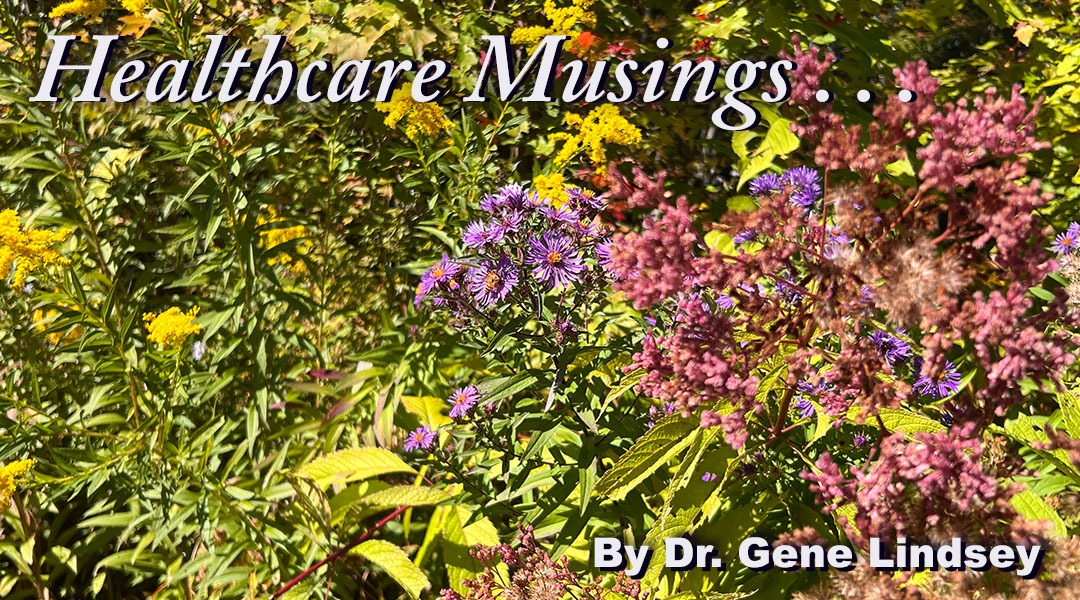
This week’s header shows some of the persistent wildflowers at the interface of my front yard and the surrounding woods. When we purchased our property seventeen years ago, the woods covered most of the area around the house, and the yard was very small. A landscape architect helped us bring the property to its current status with a new driveway and a much enlarged front yard, which was originally conceptualized as largely composed of a mix of wild flowers. In time, we opted for more yard, which would be good for games with the grandchildren, and fewer wildflowers, but there is still a small neglected interface between the yard and the woods where the wildflowers seem to thrive. In this one cluster, you see a natural bouquet of Goldenrod, Spotted Joe-Pye Weed, and beautiful purple New England Asters.
This has been a very dry summer here, and a few weeks ago, an official drought was proclaimed since most of New Hampshire is down about eight to ten inches of rain from the usual experience over the last few months. In recent posts, I have described how the lake is low, the creeks are dry, and many people with shallow wells have had them run dry. As I write, I am delighted that for most of the past two days we have enjoyed soaking rains. I love to hear rain on the roof as I go to sleep at night. I actually like walking in a steady drizzle, so the change in the weather is a welcome relief. It is also nice to know that sunny fall weather is predicted for the weekend.
Another big downside to our drought is that it mutes the fall colors. The leaves are already beginning to turn, and many will just go from green to brown, denying us the pleasure of spectacular fall colors. I hope this week’s rain may save a little of the usual color extravaganza that I anticipate each year.
I hope that where you are, there are persistent wildflowers into the fall, and that the colors of your fall won’t be muted. It seems unfair that we must simultaneously consider the loss of reason in our government and the loss of color in our fall. Take a walk and enjoy whatever wildflowers and color might be available to you this weekend.
Be well,
Gene