10 October 2025
Dear Interested Readers,
The Shutdown Is An Exercise in the Political Determinants of Health
In this week’s issue of the New England Journal of Medicine, a poignant essay can be found at the end of the “Perspectives” section. It was written by Dr. Eric Shapiro, a physician in Cleveland, who is grappling with the decision about when to retire. He begins with a question that patients have started asking him. They want to know whether he will still be in practice when they are scheduled for their next colonoscopy. He understands and appreciates their concerns. From that question, he uses his short piece to review his career journey.
We learn that there was a delay in his decision to go to medical school, but once there, he experienced much of what I experienced, and I am sure many others can also resonate with his story. He writes:
Whether it was thanks to luck, sound reasoning, some resolution of my cognitive dissonance, or (least likely) an easy disposition, I mostly enjoyed the ride. Medical school flew by, with its initially theoretical frameworks of science and professionalism followed by the excitement of the wards, every rotation opening a new world and a new culture, with its own specialty-specific attitudes and mores. Along the way, I unconsciously transformed from bystander and observer to active participant in critical moments of the lives of others. As a resident, then a fellow, I learned the delicate balance between personal responsibility and teamwork required in caring for patients facing the range of problems — from rashes to cardiopulmonary arrest, from earaches to incurable cancers.
In the past, I have mentioned in these notes the personal stress that I experienced during the transition from being a house officer and fellow in the nurturing environment of a teaching hospital to the realization after I began to practice that I was frequently on my own in the office and at the bedside, and that might be a bigger problem for my patients than for me. Dr. Shapiro writes:
Then all the training, that long journey, came to an end. I still remember clearly the first time I signed a consult, separated the carbon copies, put it in the chart, and realized that my opinion — no discussion with the team, no attending cosignature, just mine alone — would guide this patient’s care. So clinical practice began. Some months, I was accompanied by fellows, residents, and students; other times I, my patients, and maybe their family members were the only ones in the room. So many lives shared, some with laughter, less often with tears. Many of them I helped, and some I probably didn’t.
There is a lot hidden in that paragraph, like Dr. Shapiro, several times a year in my early years of practice, I wore the new hat of a service attending. For a few years, I felt like a “rookie.” One year, you are a fellow working with house staff, but supported by an experienced “attending physician,” and then with the flip of the calendar from June to July, you become the “attending physician,” and there is no higher medical authority to easily access in the moment.
Dr. Shapiro’s account accurately represents how I felt throughout the seventies. My focus was on developing confidence in the various components of my role as a practitioner in the office and at the bedside, as well as in my junior faculty member responsibilities, teaching interns, residents, and medical students. And then we both made a career stabilizing discovery that Dr. Francis Peabody eloquently described in 1927, in his famous article about the care of the patient, when he said:
“. . . For the secret of the care of the patient is in caring for the patient.”
As Dr. Shapiro says:
Almost all patients seemed to find it gratifying, often even a relief, to have a physician who wanted to know more about them than just their symptoms, and I’ve always wanted that. Stories — the ways in which characters, real or imagined, experience and recount the events of their lives — have always entranced and intrigued me. That love had led me to study literature, and it made me eager to know more about what my patients did, where they came from, what kind of family they had. I believe nearly all people harbor a desire to be known and find satisfaction in meeting someone who wants to know them. [The bolding is my addition for emphasis.]
I enjoyed reading about how Dr. Shapiro has accommodated to the onerous aspects of current practice. He says that he is not “burned out,” but he often “feels singed.” He continues:
…when I go into the exam room [despite feeling “singed”], close the door, greet the patient, and begin our visit, none of those structural irritants matter. We explore their situation and try to figure out how to move forward. The challenge and respect of that task never really pale. I know I’ll miss that.
I know that, from my perspective as someone who has already retired, he is right to anticipate a sense of loss when he no longer practices medicine. I enjoyed my years as a CEO, but there is much about them I don’t miss. I always identified as “somebody’s doctor.” When I reflect on what I miss now that I am retired, I usually think about the joys of patient care and collaborating with colleagues.
Dr. Shapiro’s essay on practice enables me to connect my personal experiences in practice to our current concerns about the political, structural, and social determinants of health, which have been exacerbated during the first eight months of President Trump’s second term. There is a journey in which your concerns expand from caring only about the patient in front of you to realizing that the patient you are seeing is part of a population that also deserves your consideration, care, and attention.
By the end of the seventies, I was more confident in my professional roles. I began to realize that my ability to help my patients was more at risk from issues beyond my immediate control than from any deficiencies in my attention or fund of knowledge. The organization of our practice was sometimes a barrier to the care I wanted my patients to receive. By the early eighties, tensions were developing between the Harvard Community Health Plan’s management and its physicians, which were beginning to compromise the quality of care. Some of my colleagues seemed to shrug their shoulders and say, “Whatever.” There were others to whom I was attracted, like Don Berwick, who contended that we could do better if we demanded more effective “supports to the practice” and paid attention to the quality and safety in our work. I was drawn to those colleagues and eventually became one of the leaders of their perspective.
Eventually, as we rolled through the late eighties into the early nineties, I was negotiating with management as one of two physicians on the board of HCHP, the Chairman of the Physician Compensation Committee, and eventually, the Chairman of the Physician Council, which had underutilized options that were granted to physicians in HCHP’s bylaws, and as the physician’s representative on the senior management group of HCHP. I discovered that the HCHP bylaws granted approval “powers” to the physicians, which had been largely ignored or underutilized because using them would lead to confrontations. The task at hand was to align the organization’s insurance function with the clinical values of the majority of my colleagues. At that time in my life, I relished confrontations that I imagined would improve the quality of care in our practice. Perhaps there is an element of that willingness to be confrontational in the service of values that makes me supportive of a government shutdown aimed at better healthcare, enabled by a willingness to exercise an infrequently used procedural option.
By the mid-1990s, it became evident to me and others that the best interests of patients and physicians could not be realized if physicians were employed in an exclusive relationship with a single insurance company. It was most apparent to me when I realized that many of the patients I had cared for for years could no longer see me because their employer had signed an exclusive contract with another insurer. I remember a few “good-bye” patient encounters where both the patient and I were close to tears because it was our last visit, because their employer had entered into a “sole provider insurance contract ” with Blue Cross or another insurance company.
Unwinding a twenty-five-year corporate relationship between a practice and the insurance company that controlled it was a negotiation and corporate divorce process that took several years. By the end of the nineties, as Harvard Vanguard Medical Associates, we were a semi-independent 501 (c) (3) nonprofit professional group. I was chairman of the Harvard Vanguard board, but still a member of the Harvard Pilgrim Board, and the chair of its “Corporate Medical Council,” which was advisory only and had no bylaw-driven responsibilities. Harvard Pilgrim remained the insurer for the majority of our patients. Still, we were developing contracts with Blue Cross, Aetna, Tufts, and other insurers that would eventually sustain us when Harvard Pilgrim went into receivership. All formal relationships between us and Harvard Pilgrim ended when Harvard Pilgrim entered receivership in 2000. I left their board when the state’s attorney general named a new board.
The challenges to our practice did not end in 2000. In the years that followed Harvard Pilgrim’s financial collapse, I often said we were forced to burn a lot of furniture to get through the winter. We had escaped at the last possible moment. When talking to my colleagues, I used the metaphor that we had gotten into a lifeboat and were rowing away as fast as we could to avoid being sucked down by the swirling vortex of Harvard Pilgrim’s decline. Eventually, under the capable leadership of Charlie Baker, who would later become governor of Massachusetts, Harvard Pilgrim emerged from receivership. Still, the affiliated practices in Rhode Island did not separate from Harvard Pilgrim before the receivership, as Harvard Vanguard had, and they did not survive Harvard Pilgrim’s reorganization.
But by 2005, Harvard Vanguard had created alliances with suburban practices to form Atrius Health, and we were secure and eager participants in the political efforts in Massachusetts to improve the quality of care and lower its cost. From 2006 through my retirement at the end of 2013, I had great hopes with “Romney Care” that the political determinants of health in our state were aligned with our mission. Then, under President Obama, our nation’s political efforts in healthcare aligned with our organization’s efforts to advance the Triple Aim. After the contentious passage of the ACA, there was great hope, even though much remained to be done. Then came the backlash.
Successful attempts by those who opposed the ACA to undermine the “mandate” for coverage in the ACA at the Supreme Court, the continuing resistance to the Medicaid expansion in ten states, and the current efforts by President Trump and his minions to defund and derail much of the ACA’s progress toward universal coverage are evidence that the pendulum of progress toward universal access is being sorely tested. The content of Project 2025, the projected impact of the One Big Beautiful Bill on Medicaid, and the Republican opposition to the renewal of Biden’s support for the ACA marketplace give evidence of the continuing impact of the negative manefestations of the Political Determinants of Health on healthcare costs, the numbers of Americans with access to care, the likely increase in the cost of care to those satisfied with the insurance costs through their employer, and the financial health of many provider organizations and hospitals. The tide has turned from the heady days of 2010 when President Obama signed the ACA. Now, those who do not share the concerns of many providers of care about equity in care, the cost and quality of care, the Social Determinants of Health, and the future of medical science and public health have a lock on the Political Determinants of Care.
In his last book, Where Do We Go From Here: Chaos or Community, published in 1967, a few months before his assassination, Dr. King complained that many of the white liberal supporters who had helped achieve the Civil Rights Act of 1964 and the Voting Rights Act of 1965 considered the struggle for Civil Rights to have been won and were no longer actively engaged in the Civil Rights movement just when progress was at risk because of a political “backlash” from well organized conservative Republican efforts. Similarly, it seems to me that once over 90 percent of Americans were comfortable with their care and no longer worried about their access and costs, they lost any political interest in healthcare.
That theory of political disinterest is supported by an article in the Wednesday issue of the New York Times that was written by their “chief political analyst,” Nate Cohn, entitled “Democrats Play the Hits on Health Care. But Fewer People Are Listening: The basic political conflict in America has changed to something very different than the one putting health care to the fore.” He writes:
Health care hasn’t been front and center for years. In the final New York Times/Siena poll of the 2024 campaign, less than 1 percent of voters said health care was the most important issue to their vote. To the extent there’s a political battle over health care today, it’s mostly because Democrats forced a government shutdown over it.
That’s not to say there haven’t been major developments in health policy. The Republicans’ spending bill this summer derived most of its savings through health care cuts. And an expiration of Obamacare subsidies will affect millions of people.
These developments have laid the groundwork for the Democrats to force a shutdown over health care, and they may ultimately benefit from it politically. But if you want to understand the depth of the challenge facing them in the Trump era, it’s telling that the party needed to use its leverage and force a shutdown in order for health care to capture any significant attention.
It is a sad reality that since Republicans control Congress, the presidency, and apparently the Supreme Court, and our president is effectively moving toward increasing the powers of his office far beyond anything ever described in the Constitution or experienced under previous presidents, the only option available to Democrats to slow the accumulating healthcare losses before the 2026 midterm elections, assuming fair elections will occur, was to use their ability in the Senate to withhold their votes for a continuing resolution that requires 60 votes to pass.
There are many ironies in the shutdown. Seventy percent of those likely to be unable to afford a policy through the ACA marketplace, unless the Democrats are successful in their efforts, live in states like Texas, Florida, Georgia, and South Carolina that have refused to expand Medicaid. Many red state voters who support the president will experience the loss of social services that will be precipitated by the “One Big Beautiful Bill” to finance tax cuts for “those who have enough.” Ironically, if all of the shutdown objectives of the Democrats are achieved, many MAGA enthusiasts will benefit.
I am not naive. I know that many people will suffer significantly as the shutdown continues. Through the charitable organizations with which I am affiliated, I have already seen suffering. One of our disabled clients called to say he can’t complete his SNAP renewal due to the shutdown, and he is not sure how his family will get by. Another client, a single mother who works for the VA in a clerical position, is “furloughed.” She doesn’t know how she will pay her rent, electric bill, or car payments. She was already behind on all of these bills. I am sure that across the country, millions of people will suffer. I am also sure that unless the demands of the Democrats are quickly met, many more will suffer when the intents of the Republican cutbacks are fully implemented. In the interim, I hope our local philanthropic organizations can ease the pain of many who will suffer from the shutdown.
For the immediate future, most healthcare professionals will be financially safe. That will not be true for many of those who depend on our practices and hospitals for their care. We are facing a dilemma: pain now versus long-term reversals of decades of progress toward equitable universal care. Earlier in this letter, following the example of Dr. Shapiro, I described my personal journey of several decades of increasing awareness and scope of vision, from a focus on self and professional achievement, through concerns about my colleagues and our practice, toward a larger vision of how we can serve our patients, our community, our nation, and own professional lives by a focus on the larger issues of the community, state and country.
I know that many of you have been on the same journey. We have known many successes and more than enough temporary setbacks. At this moment, it feels like there are few options available other than the shutdown that will offer relief from immediate losses with long-term consequences.
The Democratic hope during the shutdown is that healthcare will be reclaimed as an issue of concern for all Americans. The political determinants of health determine many of the structural determinants of health, and both are drivers of the social determinants of health. The current administration’s political policies undermine both the structural and social determinants of health. The Democrats’ demands as we entered the shutdown are a political attempt to address the current erosions of the structural and social determinants that will be key to a better healthcare future for all Americans.
If you would like to explore the subject in greater depth, I have two suggestions. First is an excellent “Substack” post by Paul Krugman from September 29, before the shutdown began. It is entitled, “Understanding the Coming Premium Apocalypse: Why health insurance is about to become unaffordable.” The second piece is a podcast conversation between Ezra Klein and Neera Tanden, the president and CEO of the Center for American Progress, a Democratic think tank, and a former member of the Obama and Biden administrations. The podcast is entitled “What the Shutdown Is Really About.” I found it to be a realistic presentation of the risks and potential benefits of the shutdown.
Burr!!! It Is Cold
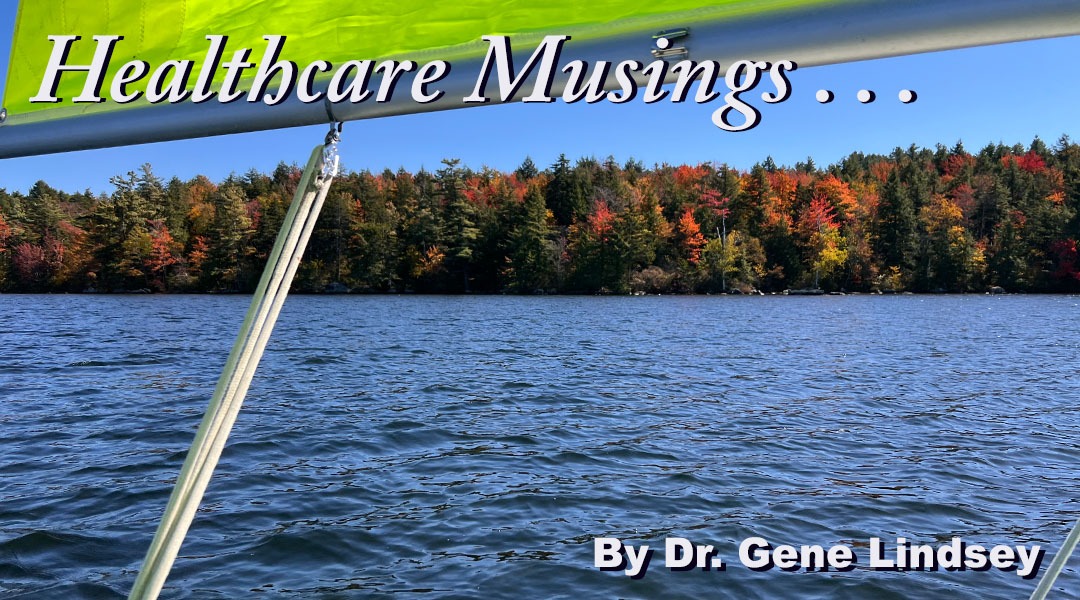
Over the last weekend and early this week, we enjoyed some of the most beautiful weather of the year. I pulled out my wetsuit, which I had stored prematurely, and returned to the water, enjoying several comfortable swims. As today’s header suggests, conditions were perfect for a few end-of-season sailing adventures. The sky had no clouds or only a few light, puffy ones. Then midweek, we got some much-needed rain and the thermometer bottomed out. Yesterday, I tried walking in a light jacket, but I conceded that I needed a down coat and gloves when I took my bike ride in the late afternoon. Last night, the temperature bottomed out at 26 degrees. We should have brought in some of our sensitive plants.
Perhaps we will enjoy some “Indian Summer” before winter arrives early. There are many definitions for Indian Summer. My definition of an Indian Summer day is a day after the first frost, which was last night, with a temperature above 70. If you clicked on “Indian Summer” and read the Wikipedia article, you would have noticed the reference to the first known use of the term:
The earliest known reference to Indian summer in its current sense occurs in an essay written in the United States around 1778 by J. Hector St. John de Crevecœur, describing the character of autumn and implying the common usage of the expression.
Great rains at last replenish the springs, the brooks, the swamp and impregnate the earth. Then a severe frost succeeds which prepares it to receive the voluminous coat of snow which is soon to follow; though it is often preceded by a short interval of smoke and mildness, called the Indian Summer. This is in general the invariable rule: winter is not said properly to begin until those few moderate days & the raising of the water has announced it to Man.
Perhaps, as the reference suggests, there is a chance for some much-needed rains that at last replenish the springs, the brooks, the swamp and impregnate the earth. Along with a few more warm days, I hope for much-needed rain over the weekend. One of my disabled “clients” has a shallow well that has been dry for three weeks. He is getting by with bottled water, which Kearsarge Neighborhood Partners delivers in 35-gallon batches, for flushing his toilet, taking his baths, washing his dishes, and drinking. We must care about our neighbors who are in need.
I am holding my breath as it appears there may be a release of hostages and an end to hostilities in Gaza. I am hoping for the best over the weekend. It has been too long, and there has been terrible suffering on both sides of the conflict. If peace is achieved, I would be the first to give President Trump and his team well-deserved praise and thanks. If peace can be achieved after eight decades of conflict in the Middle East, there may be hope for resolving our domestic tensions. Maybe, if President Trump can end the war in Ukraine while restoring all of its territory before the Russian invasion of Crimea in 2014 and its larger invasion in February 2022, he will get and deserve the Nobel Prize that he covets.
Whatever you call this federal holiday that we will observe on Monday, I hope it is part of a long and pleasant weekend for you. Our leaf colors are muted and not the best we’ve ever seen, but they are still pretty. I expect there will be plenty of “leaf peepers” on our roads, so if you come this way, be patient, slow down, and enjoy the moment.
Be well,
Gene