June 27, 2025
Dear Interested Readers,
Reflections On A Lifetime Of Practice And The Importance of DEI To Our Health
This coming Tuesday will be the fiftieth anniversary of my first day of post-training medical practice. I was quite nervous as I walked into the offices of Harvard Community Health Plan at 690 Beacon Street in the heart of Kenmore Square near Fenway Park in Boston. I was a week short of my thirtieth birthday and had no idea what to expect or if I had made the right choice.
Going back to when I was in my third year as a medical student, I was aware that Dr. Robert Ebert, our dean, had started this “model practice” as a way of exploring innovations in care delivery. On the first day of my internship, June 20, 1971, at the Peter Bent Brigham Hospital, I was assigned to the team on the men’s public ward service on “F-Main,” and my attending physician was the dynamic young medical director of this grand experiment, Dr. Joe Dorsey. I did not know it at the time, but the part-time PCP and first cardiologist at HCHP, Dr. Marshall Wolf, would become a mentor and an important influence in my life.
I could have opted to have my outpatient experience as an intern and resident at HCHP, and looking back, I can’t remember why I did not. Perhaps, some of the resistance that the program met from the Boston medical establishment of the day encouraged me to take the safer route and have my outpatient “clinic” within the comfortable surroundings of the Brigham.
As I have recounted in previous posts when I was writing about my career, I was surprised to find that my poorly controlled hypertension prevented me from qualifying for a “Berry Plan.” After I had flunked my induction physical at the South Boston Naval Annex in the fall of 1972 with blood pressures as high as 240/120, I was made 4F, which meant that the Army didn’t want to risk having me as a post stroke or dialysis liability, and I was free to continue my medical education without the need for the protection the Berry Plan would have offered me. At the time, neither I nor the Army knew that the simple combination of hydrochlorothiazide and the FDA approval of captopril in 1981 (followed by a host of other ACE inhibitors, including lisinopril) plus lots of exercise and reasonable diet would lower my BP below 120/ 70 and allow me to live to 80 without developing renal failure or having a stroke. I used the extra time I got from becoming 4F to do a senior residency at the Brigham and then begin my fellowship in cardiology.
This is not the first time the government has reduced its investments in medical research and medical education. In 1974, as a first-year cardiology fellow, I earned $14,000 a year. The salaries of fellows were, in part, a pass-through from government funds. I was notified that there was likely not to be money for my salary in 1975 because of a government cutback in funding, since I was interested in medical practice and not research. The second year of fellowship at that time was a 50-50 combination of work in the hospital and work on a research project in a lab.
My life can be described as a series of misfortunes followed by episodes of grace and good fortune. It was a misfortune to have severe essential hypertension for God knows what set of causes. It was good fortune or grace to be given a pass from military service. It was a misfortune to have government funding cut to the training programs at the Brigham, but it was a great good fortune to have Marshall Wolf come to me with a plan to save my training and to almost double my income. With a wife and two small sons, I did need money and had been “moonlighting” in local emergency rooms during my residency and the first year of my cardiology fellowship.
Marshall’s solution was good for him and good for me. He had been offered the position of House Staff Director at the Brigham, which meant that he needed to leave his position as a PCP and the cardiologist at HCHP, which had grown to over 50,000 patients since it had opened in October of 1969. He suggested that I continue my fellowship training in the mornings in the cath lab and on rounds at the Brigham, primarily, but not exclusively, on HCHP patients, and every afternoon assume his outpatient primary care/cardiology practice at HCHP. I would earn $27,000 a year for my afternoon practice and reading all of the EKGs for the practice. I would also get full credit for a second fellowship year, which at the time would make me eligible to take the cardiology boards.
I was swept away. I had a brief interview with the chief of medicine at Kenmore, Dr. Lee Youger, a hematologist. All that I remember was that he told me that it was the philosophy of HCHP that all “medical specialists” also have primary care patients. That was strange, but I liked primary care and had long said facetiously that I opted for a cardiology fellowship in order to be a better internist. His only other comments were that he did not like the idea of my moonlighting, which I continued to do for a couple of more years despite his objection, and that he hoped I would stay at least two years and not quit after my fellowship was completed since it would take that long to come a realistic considered opinion about whether I wanted to stay longer, and it would be very disruptive for them if I left sooner.
I had not had much personal interaction with Joe Dorsey over the previous four years since my first rotation as an intern. I had a brief interview with him a few days before I joined the practice, during which he assumed that I would take the job, and presented me with a large cardboard box from a wine store that contained copies of all the organizational memos and the agreements the group had made about their common approach to most of the issues of practice since 1969. I took the box, but never read any of the memos.
That was my “onboarding” process for a job that would last for my entire career, and for which I never applied, but was directed to take either by divine intervention or driven by luck and the concern of others who cared about my future. On July 1, 1975, I just showed up and took over the work that Marshall Wolf assigned to me.
Marshal left me a handwritten note with the names and current issues for ten patients for whom he had great concern. He suggested that I get to know each one soon. It did not take me long to discover that his concerns were quite valid. I felt honored that he entrusted their care to me. Over the years since Marshall helped me, I have tried to repay his concern forward to other young physicians. I realized then and have often reflected since, on the very good fortune to have had caring people watch over my best interests when I had no clue what to do.
Even before I started working at HCHP on July 1, 1975, I was getting some pushback from family and friends. I think that some family members couldn’t understand why I wanted to stay in New England, which for them was the equivalent of a foreign country. Their concept of a successful practice and desirable future was to return to the South, and open or join a respected private practice and parlay my Harvard education into some leadership role in the local medical community. In the mid-seventies and later, the vast majority of American physicians were in private practice. (Click on the link to get an interesting contrast between practice fifty years ago and now.) If I wasn’t going to return “home” to private practice, then surely I would become an academic physician somewhere nearer to where I had roots.
Even after I was at HCHP for a couple of years, it was hard for most of the people who cared about me to understand why I would want to work in an organization that, from the outside, looked a lot like “socialized” medicine. Even in the Boston area, I met skeptics who questioned my choice of practice. Not long before I was to begin work, my wife and I were attending a party where we didn’t know many people. I remember a conversation with a somewhat older woman who asked what I did. I responded that I was a doctor. She then asked where I worked, probably expecting me to name one of the many fine hospitals in the area. When I told her that I was about to start work at HCHP, she frowned and repeated a local joke of the time. She said something like, “Doesn’t HCHP stand for Horrible Care for Healthy People?”
I had no idea what to expect when I showed up at the original HCHP office for my first practice session. I realized that I would not be in the reassuring environment of the Brigham, where any moment of doubt could be quickly resolved by a casual request for help from some easily available expert. I did have the foresight to show up an hour early to “get my bearings” and meet a few of the support staff in the office. They would become my real “onboarding process.” It was a good thing that I showed up a little early because I discovered that there had been a late “add-on” to my schedule. A 52-year-old man with no known medical issues had come to see his PCP earlier in the morning. He was feeling weak and easily fatigued. An EKG was taken, which showed complete heart block with an escape rhythm and a heart rate in the thirties. I quickly learned that I would be quite busy managing the cardiology problems and concerns from a population of fifty thousand “healthy working people and their families.”
What I must admit that I did not really fully understand fifty years ago was that I was becoming part of a “pilot” practice dedicated to the improvement of healthcare delivery. Maybe if I had bothered to read all the loose papers in the big box that Joe Dorsety gave me, I would have caught on sooner and would have been able to give those who questioned my ill-considered, easy option of joining the practice as a matter of personal expediency a better answer. In my defense, I trusted that anything Joe Dorsey was doing at the behest of Dean Ebert and that Marshall Wolf had done for five years was something that might be interesting and worth the two years of experience that Lee Younger requested that I invest before going elsewhere.
In the vernacular of the day, what we were doing has been referred to as a “moonshot.” Dr. Ebert was convinced that practice needed to change. Heavy reliance on hospital-based specialty practice in a fee-for-service environment was expensive beyond its true value and did not provide care for many who were uninsured and had no access to care. He reasoned, based on some experience with the Kaiser model, that care should be focused on prevention, be mostly delivered in the ambulatory environment, and be financed by prepayments that would stimulate the development of efficiencies that would save valuable resources and allow more people access to affordable care. We were in the heady days shortly after the passage of Medicare, Medicaid, and the HMO Act of 1973. You can read the whole story in a document we produced in 2009 to celebrate the tenth anniversary of Harvard Vanguard and the fortieth anniversary of the founding of HCHP.
When I reflect on fifty years of professional satisfaction, trying to be an effective contributor to the improvements in healthcare quality, delivery, and finance, I am both proud and sad. I remember a conversation that I had with Dr. Paul Batalden, one of the founders of the Institute for Healthcare Improvement (IHI), not long after becoming our CEO. I was attending a recurring meeting of five institutions, of which Harvard Vanguard was one, that had accepted grants from Massachusetts Blue Cross to do projects that would improve the quality of care and reduce costs. The project was a prelude to what would become the Blue Cross “Alternative Quality Contract.” This meeting of the conference was held in Hanover, New Hampshire, near the Dartmouth Medical School, so that we could learn from academics, including Dr. Betalden, at the Dartmouth Institute.
I had the privilege of sitting next to Dr. Batalden for an entire day. As the afternoon wore on, through several presentations of projects to improve healthcare delivery, I began to have the sense that he might be sad or in deep reflection on something important. So I asked him if he was OK. I was surprised by his response to my question. He related that he was concerned by the possibility that all of the improvements we were discussing, including all of the positive work of his career, could be easily lost in less than a generation.
As we witness what President Trump has already done to damage our medical research community, DEI efforts, education, and Global Warming mitigation efforts, which are core to the efforts to improve the social determinants of health (SDH), I am beginning to think that Dr. Betalden’s concerns were prescient. Adding Robert Kennedy, Jr.’s appointment and his controversial service so far as the Secretary of Health and Human Services to what Trump has done in the short time to create chaos, the future of the healthcare improvement that Dr. Ebert and others were advocating sixty years ago begins to look like a dying effort. In retrospect, Dr. Batalden becomes a modern-day prophet like Jeremiah.
As I was writing these thoughts about my concerns for the future, my wife made the daily pilgrimage to our post office. She returned with this week’s New England Journal of Medicine. Like a bandage for an open wound, I immediately began to read an article entitled:
“The Health Equity, Medical, and Scientific Costs of Dismantling DEI,” written by Crystal W. Cené, M.D., M.P.H. The article is incredible, and I will highlight and occasionally “bold” many of the points that Dr. Cené so skillfully makes. She knows what is happening and why. She also provides some advice about the importance of effective resistance now. She begins:
Current attacks by the Trump administration on diversity, equity, and inclusion (DEI) initiatives — in the form of executive orders and administrative actions — reveal a critical misunderstanding of the relationship between DEI and health equity.
DEI initiatives are structured efforts within organizations designed to create inclusive educational and work environments, redress discriminatory policies, and mitigate the effects of systemic inequities. In medicine, these initiatives influence the recruitment, retention, and support of the workforce that delivers care, generates knowledge, and translates evidence into practice. DEI initiatives in health care include pathway programs for first-generation students, mentorship and research training programs for faculty and trainees, pay-equity and parental leave policies, and accessibility programs.
That is a very succinct description of efforts that are laudable. It is hard to understand why Trump would object to efforts that should lead to such benefits. Dr. Cené has an explanation:
Today, DEI is being misrepresented as divisive, exclusionary, or a form of indoctrination that undermines meritocracy. Such mischaracterizations fuel a harmful “zero sum” narrative. In reality, DEI initiatives challenge the myth of a level playing field and promote policies that help make true meritocracy possible. Talent is evenly distributed across populations, but opportunity is not. DEI efforts aim to expand access to opportunity so that all talented people can contribute to society.
She comes to a quick conclusion:
Anti-DEI actions will reverse decades of progress toward building a more inclusive health workforce and improving patient outcomes — distinct but related goals. Greater racial and ethnic workforce diversity has been shown to improve patient health by enhancing communication, satisfaction, trust, and treatment adherence; increasing culturally and linguistically sensitive care; expanding access to care in underserved and sicker communities, where non-White clinicians are more likely to practice than their White counterparts; and broadening research questions and methods, including participation of patients from racially and ethnically minoritized groups in clinical and biomedical studies.
She is not satisfied with her own explanation:
However, diversity alone is not enough. Realizing its benefits requires inclusive policies, equitable practices, courageous leadership, and accountability.
Health equity is an aspirational goal: ensuring that everyone has a fair and just opportunity to be healthy. Achieving health equity requires removing structural and social barriers, such as discrimination and limitations on access to care, education, employment, housing, and safe environments. Health equity initiatives target health care disparities affecting groups defined by race, ethnicity, age, language, gender, sexual orientation, ability, insurance status, or geography, by increasing access to and quality of care.
I am sure that most of my readers understand and agree with her analysis. I would even suggest that you share her sense of outrage. I hope that you will read the whole article. She includes a brief history of DEI initiatives that began forty years ago in 1985 with the Heckler Report. Margaret Heckler was Ronald Reagan’s Secretary of Health and Human Services. She initiated the study after she came to understand the evidence of a shorter life expectancy for African Americans. Secretary Heckler, a former moderate Republican member of Congress from Massachusetts, considered the discovery of and confirmation of healthcare disparities as an “affront to our ideals and to the genius of American medicine.”
Perhaps it was that “liberal” attitude that led to her dismissal from HHS and reassignment as Ambassador to Ireland. We haven’t made much progress in establishing health equity through DEI initiatives over the last forty years, despite intermittent episodes of increased effort and the identification of “equity” as one of the six “domains” of quality as published in Crossing The Quality Chasm in 2001. Dr. Cené points out that “equity” is foundational to the other five aspects of quality: safety, timeliness, efficiency, effectiveness, and patient-centered care. Our lack of equity has hampered our efforts in pursuit of the Triple Aim and perpetuates the burden of health disparities for the disadvantaged population. Disparities persist in part because of our on-again on off-again pursuit of DEI initiatives. Our failures have been costly.
In 2022 alone, health disparities cost the United States $320 billion in excess medical spending and lost productivity. The figure is projected to increase to $1 trillion by 2040 because of demographic shifts and rising per capita costs. …When segments of the population are excluded from the benefits of health care’s triple aim — better experience, improved health, and lower costs — the health of the entire population suffers. For example, during the Covid-19 pandemic, rural areas of the United States with fewer medical professionals and health care facilities had substantially lower vaccination rates than nonrural areas. These access disparities led to lower vaccination coverage and higher Covid-19 transmission rates, resulting in higher overall mortality.
It is unlikely that either RFK, Jr., or the president understands or agrees with her conclusion:
Ultimately, within health care, health equity is the goal; DEI is a strategy for achieving that goal. Recent federal actions conflate DEI and health equity, placing both at risk. Examples include the removal of public health websites and data sets that track population health disparities; removal of guidance on diversity in clinical trials; disbanding of critical health equity advisory committees; withdrawal of funding from low-income countries; termination of millions of dollars in research grants, including those focused on environmental justice health disparities and minoritized populations and those focused on training of groups that are underrepresented in the science workforce; and massive layoffs at health-related federal agencies. These sweeping actions are dismantling the infrastructure needed to eliminate health disparities and improve patient outcomes.
Much of her remaining verbiage catalogs the damage that has already been done and anticipates further losses. Toward the end of the report, she asks the critical question:
How should the health care and scientific community respond?
She answers her own question. I have converted her recommendations into bullet points:
- Clinicians and researchers working to achieve health equity must clearly communicate the goals and evidence for DEI as a strategy to advance health equity, which benefits everyone.
- DEI initiatives should be intentionally designed to effect meaningful changes in outcomes, not just meet process metrics (e.g., participation rates or numbers of trainings). These changes should be measured and tracked, and strategies should be adjusted to ensure accountability.
- We must highlight the danger to the health of the nation of defunding and divesting from health equity and DEI research, programs, and offices.
- Academic leaders must also be sensitive to the psychological toll on faculty, staff, clinicians, and trainees navigating the current environment — many of whom are experiencing a profound sense of loss — and seek creative ways to support them.
- Institutions and individuals committed to science, freedom, and justice must vehemently resist efforts to censor scientific inquiry, revise history, and erect barriers to health and opportunity.
Her conclusion:
The stakes for science, medicine, and the nation’s health are simply too high for us to stand by and watch the destruction.
I am sure that Dr. Batalden would agree that progress has been slow, and losses of precious gains can occur quickly. I know from personal experience over the last fifty years that progress toward health equity and the abolition of healthcare disparities has been hard work. There is much left to be done. Perhaps progress has been slowed because we go back and forth between presidents with administrations that demonstrate variable interests in the efforts and investments required to make progress toward the Triple Aim. I agree with Dr. Cené. The stakes for science, medicine, and the nation’s health are simply too high for us to stand by and watch the destruction.
It Was Hot, And Now It Is Cold
It has been a difficult week. On our two hottest days of our three days of temps over 90, I decided not to walk. I had walked on day one of the blast, but discovered that two miles felt like ten. My usual summer time routine is a two to three-mile walk followed by swimming about a quarter mile. On days two and three, I limited myself to the swim. It is amazing how fast the water can warm up. With each day, the temp rose. And then it was over. Yesterday was overcast and almost twenty-five degrees cooler than Wednesday. The prediction is for the cooler weather with overcast skies to persist through the weekend before it heats up again. Is global warming real?
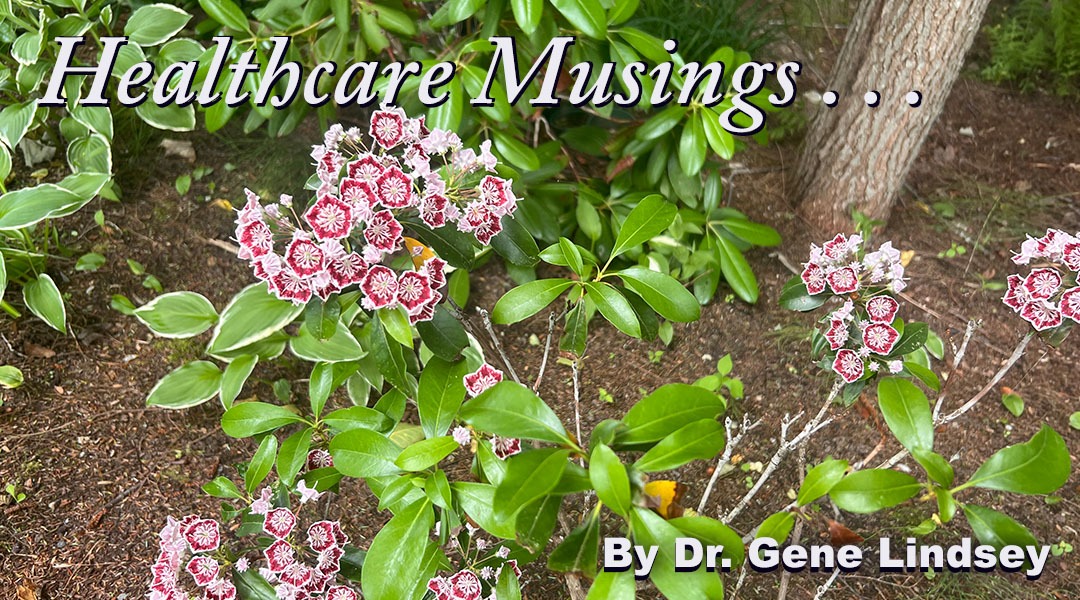
Our copious rain has been good for the plants. There are wild flowers along the roadways, and things are blooming brightly in our yard. The rhododendron splash of two weeks ago has been replaced by blooms of Mountain Laurel. Their little buds are gorgeous. See for yourself in today’s header. If domestic events, politics, international conflicts, or global warming have you worried this weekend, put it all aside and seek refuge and recovery in the beauty around us.
Be well,
Gene