
December 26, 2025
Dear Interested Readers,
What Are The Attributes of A Good Doctor?
Many doctors are very good writers. This time of year, I see articles talking about the best books of the last year. Usually, on a list of a dozen or more, I might have read two. In that vein, and as an introduction to my current “favorite medical writer,” whom I will reveal in several paragraphs, I asked Google for a list of ten physicians who were currently or recently writing notable fiction or non-fiction. I wasn’t satisfied with the first answer I got, so I rephrased my question and asked for the names of ten physicians currently writing non-fiction books or articles published as pieces in the national press like the New York Times, the Washington Post, the New Yorker, or the Atlantic, about current medical practice or issues in healthcare policy.
That second list from the better question added new names, but not all the names I was looking for, like Dr. Danielle Ofri (NYT/ Bellevue) or Dr. Robert Wachter from UCSF. It also failed to identify Dr. Ezekiel Emanuel of the University of Pennsylvania. Below is the expanded list, minus Drs. Ofri, Wachter, and Emanuel. Atul Gawande was on every list I tried. Google answered:
Here are ten physicians who actively write nonfiction books or articles for national press outlets such as The New York Times, Washington Post, The New Yorker, or The Atlantic regarding current medical practice and healthcare policy:
- Dr. Atul Gawande: A surgeon and public health researcher, Dr. Gawande is a staff writer for The New Yorker and has published several influential nonfiction books including Being Mortal and Complications.
- Dr. Elisabeth Rosenthal: A physician and former New York Times healthcare reporter, she is currently the Editor-in-Chief of Kaiser Health News and a regular contributor to opinion pages on healthcare system issues. Her book is titled An American Sickness: How Healthcare Became Big Business and How You Can Take It Back.
- Dr. Siddhartha Mukherjee: An oncologist and Pulitzer Prize-winning author, he writes about the history and future of medicine. His prominent books include The Emperor of All Maladies and The Gene.
- Dr. Jerome Groopman: A professor at Harvard Medical School and Chief of Experimental Medicine at Beth Israel Deaconess Medical Center, he is a long-standing staff writer for The New Yorker, focusing on medicine and biology. He is the author of How Doctors Think.
- Dr. Dhruv Khullar: A physician and assistant professor of health policy and economics at Weill Cornell Medicine, he frequently writes for publications like The New Yorker and The New York Times about healthcare policy and the challenges faced by doctors.
- Dr. Uché Blackstock: A former associate professor of emergency medicine, she is a health equity advocate and author of the recent book Legacy: A Black Physician Reckons with Racism in Medicine, and contributes to national discussions on race in medicine through major press outlets.
- Dr. Marty Makary: A public health researcher and surgeon at Johns Hopkins, he is a frequent commentator and author on healthcare transparency and reform, with a book titled The Price We Pay: What Broke American Health Care–and How to Fix It. [He is now Trump’s Commissioner of Food and Drugs]
- Dr. Vivian Lee: A physician, professor, and healthcare executive, she wrote The Long Fix: Solving America’s Health Care Crisis with Strategies That Work for Everyone, which explores practical solutions to the U.S. healthcare crisis.
- Dr. E. Wesley Ely: A critical care physician and professor of medicine, he authored Every Deep-Drawn Breath, a book focusing on the long-term effects of critical illness and transforming ICU practices.
- Dr. Abdul El-Sayed: A public health expert, political commentator at CNN, and contributing writer at The New Republic, he writes about public health, politics, and social determinants of health.
I tried a few other questions looking for others whom I have enjoyed reading like Dr. Robert Pearl, the author of ChatGPT, MD: How AI-Empowered Patients & Doctors Can Take Back Control of American Medicine, Uncaring, How the Culture of Medicine Kills Doctors & Patients, and Mistreated: Why We Think We’re Getting Good Healthcare—and Why We’re Usually Wrong.
I was not surprised to see Atul Gawande on every list I tried, and Abraham Vergesse of Stanford on many lists. I was relieved when Elisabeth Rosenthal’s name finally came up. Dr. Rosenthal’s 2017 book, An American Sickness: How Healthcare Became Big Business and How You Can Take It Back, is even more pertinent now than it was when she published it shortly after becoming the editor-in- chief of the KFF Health News, where she continues now as a senior contributing editor.
For completeness sake, I decided to ask for a list of physicians who have written novels that are literary classics. Google’s answer was interesting:
Here is a list of some prominent physician-novelists and their classic works:
- Anton Chekhov (1860–1904) A practicing physician, Chekhov is primarily known for his short stories (e.g., The Lady with the Dog) and plays (e.g., The Cherry Orchard, Three Sisters) that are foundational to modern literature and theater. He famously described medicine as his “lawful wife” and literature as his “mistress”.
- Sir Arthur Conan Doyle (1859–1930) A medical doctor by training, Conan Doyle created the iconic detective Sherlock Holmes, a character inspired by his diagnostic-focused medical professor, Dr. Joseph Bell. His most famous works include the novels A Study in Scarlet and The Hound of the Baskervilles.
- Mikhail Bulgakov (1891–1940) A Russian physician who served as an army doctor before becoming a full-time writer, Bulgakov is best known for his posthumously published novel The Master and Margarita, a satirical masterpiece of 20th-century Russian literature.
- W. Somerset Maugham (1874–1965) Maugham qualified as a doctor from St. Thomas’ Medical School but abandoned the profession after the success of his early novels and plays. His semi-autobiographical novel Of Human Bondage is considered a modern classic and has never gone out of print.
- François Rabelais (c. 1483–1553) A French Renaissance humanist, physician, and monk, Rabelais is known for his satirical picaresque novels, such as Gargantua and Pantagruel, which are notable for their bawdy humor and social commentary.
- Oliver Wendell Holmes Sr. (1809–1894) The father of the Supreme Court Justice, Holmes was a prominent 19th-century physician, poet, and essayist. His works include the novel Elsie Venner and the essay collection The Autocrat at the Breakfast Table, which were highly popular in their time.
- A.J. Cronin (1896–1981) A Scottish physician whose novel The Citadel brought attention to inequities in the British medical system and is credited with having prompted the creation of Britain’s National Health Service. His other notable novels include The Stars Look Down and The Keys of the Kingdom.
- Walker Percy (1916–1990) After earning his medical degree, Percy contracted tuberculosis during his residency and turned to writing while convalescing. His novel The Moviegoer won the National Book Award and is a respected work of Southern literature and existential philosophy.
- Michael Crichton (1942–2008) While not always classified strictly as “literary classics” in the traditional sense, Crichton’s techno-thrillers like The Andromeda Strain and Jurassic Park became international bestsellers and cultural phenomena, defining a genre and selling over 200 million copies worldwide. He was a Harvard Medical School graduate who chose a writing career over medical practice.
I was surprised and delighted to see Michael Crichton on the list. He graduated from Harvard Medical School three years before I did, but he never did any postgraduate training and never practiced any specialty. But, as a medical student, he wrote a book that had a profound effect on me. He wrote about what he saw during his medicine rotation at the Mass General. The book, Five Patients: The Hospital Explained, was published in 1970, but it can still be found on Amazon.
I am not surprised that my inquiries about influential physician writers did not surface the name Dr. Lisa Rosenbaum. Still, careful readers of these notes know that over the last six months, I have frequently referenced both her writing as a “national correspondent” in the New England Journal and the podcasts titled Not Otherwise Specified, produced in conjunction with the Journal. Click on the title to review the titles of some of those podcasts. She has produced several “opinion” pieces for the NEJM. If she continues on her current pace, I would not be surprised to eventually find her name on the list of the most influential physician writers.
The title of her most recent thought-provoking piece in the NEJM is “Immeasurable Excellence — What Happens to Medicine without the ‘Good Doctor’?” The piece was published online on November 12, 2025, and appeared in the December 11, 2025, edition of the Journal in a section entitled “Medicine and Society.” Dr. Rosenbaum is a philosopher/storyteller whose daytime job is as a hospital-based clinical cardiologist. I sense from what she says about herself that she is essentially a cardiologist “hospitalist” with little or no current outpatient practice. What she does as a doctor is part of what intrigues me, because much of her recent writing and podcasting has focused on the current problems of primary care and the possibility that it will fade away as we have known it in clinical practice. I sense that her deep dives into the pressures on primary care practitioners have convinced her of its neglected value and worried her about the current abuses it suffers. She seems convinced of its key role in the health of the nation. Although I don’t remember hearing or reading her say it, I think she has concluded that we will all suffer immensely if we can’t find solutions that ensure the future of primary care practice. She seems particularly worried about the healthcare plight in small towns and rural America without primary care.
Her worries are not unfounded, and what she fears is possible. Concerns about the role of primary care are not new. I remember being in a meeting of healthcare executives in Massachusetts, called to develop ideas for reducing the cost of care, not long after “Romney Care” was adopted as the state’s attempt at universal access, and well before the passage of the ACA. I was startled when a physician leader from a competitor system, who would later become its CEO, bluntly stated that he saw no reason for the existence of primary care since most of the patients who came to his hospital knew what they needed and could “order up” the care they needed from a menu of specialists.
Maybe he was right for the patients whom he saw. He was a surgeon, and there was usually not much doubt about the needs of the people who ended up on his operating table. Many years later, during President Trump’s first term, and before John McCain “saved” the ACA with his downturned thumb, I saw a picture of this surgeon who saw no need for primary care standing along with other healthcare executives in the sunshine of the Rose Garden where there is now a Trump Patio, all smiles for a photo after the group had contemplated the demise of the ACA.
Dr. Rosenbaum, as usual, begins her piece with a story about a woman who was an economist. The woman’s grandmother had a close relationship with her PCP over many years. When her PCP died, she could not easily find a replacement, so she was distressed but was left with no other alternative than choosing various specialists to fill her “care gaps.” The observation of her grandmother’s distress moved the economist to try to quantify the magnitude of the loss of one’s PCP as the subject of her dissertation for her doctorate. The findings were:
…After a PCP loss, patients who have relationships with specialists see them more, often relying on them to meet primary care needs. Nevertheless, among patients who have lost their PCP, mortality, emergency department visits, and hospitalizations increase in the year following the PCP’s exit, probably contributing to about $46,000 in additional Medicare spending for each exiting PCP. Furthermore, the frequency of adverse events in patients who have lost their PCP increases in proportion to the relationship’s duration, suggesting that the relationship itself conferred health benefits.
Losing a PCP is similar to losing a friend that you see frequently for some special activity, like a friend with whom you walk or a friend with whom you enjoy dining. Many older people don’t replace such a friend when the relationship ends. Often they give up the activity that they enjoyed with the friend they lost. She continues:
Similarly, after a PCP’s exit, only 23% of patients form a new relationship with a PCP. Though some observers might blame the negative outcomes on poor access to primary care rather than the relationship loss itself, adverse event rates were actually higher in more PCP-dense locales, suggesting that poor access wasn’t solely responsible.
After some conjecture about what all this data may mean, Dr. Rosenthal begins a subtle shift to a more interesting question. She continues:
That this question in another context could trigger years of psychoanalysis hints at one of modern medicine’s tendencies: attaching disproportionate meaning to things we can count…But can’t some things in life, like a relationship with a trusted physician, be worth sustaining even if the benefits aren’t measurable? If everyone believed such relationships mattered, however, there would be less tolerance for the constraints placed on PCPs. Because medicine has imbued the measurable with so much power, I loved Sabety’s study for assigning a value to this connection.
If there is value in measuring what we can, is there hidden value that we ignore in what we can’t measure? Could the hidden value of your relationship with your PCP, or the value of patients’ relationship to you as a physician, be even more important than what can be measured? That line of reasoning led Dr. Rosenthal to perhaps what has been missing as we contemplate the future of primary care. My CEO acquaintance, who wanted to replace primary care with a menu of specialists, would have never thought to consider the rhetorical question that Dr. Rosenthal asked next:
How much has primary care suffered because the worth of the unquantifiable goes unrecognized?
While we ponder that question, she moves on to a story from her own practice experience that adds clarity to her question. She tells us that she recently cared for an old man with a deteriorating cardiac status and multiple other problems. In a teaching hospital, like the one where she works, such a person is seen by many specialists and rarely “known” by anyone. She reports that on her rounds one morning, the old man’s PCP, who still followed his patients in the hospital, annoyed her by “cornering her” to discuss the old fellow’s care. Fortunately for the old fellow, she was enlightened by what the PCP knew about him that she or none of the other specialists had appreciated. She asked herself:
Was Mr. T.’s care changed in some measurable way by the PCP’s involvement? Was my other patients’ care worse because I focused more on their cardiovascular outcomes than the arc of their lives? If these questions can’t be answered empirically, that’s exactly the point. Most physicians recognize good care when we see it. Rather than building a culture around this implicit knowledge, however, medicine is increasingly shaped by the assumption that what’s good can be captured in what’s measurable — with particularly stark consequences for primary care.
She points out that PCPs are subjected mostly to what can be measured rather than what patients care about or those difficult to measure qualities that constitute the skills and approach of a “good doctor.”
But insofar as primary care has been shaped by a conceptualization of excellence favoring the measurable over the unquantifiable, it’s worth asking whether the field is better off for it.
While I was writing this letter, one of my sons who lives far away from me called to wish me a Merry Christmas. Since he knew I was probably writing this letter, he asked me about my subject. I explained that I was writing about what makes a good doctor. He has seen many doctors over the years and was quick to say that a good doctor was one who focused on the patient’s concerns even in a brief ten-minute visit. He knows that doctors work under an incredible “time crunch,” but some are better at giving you their attention and focusing on trying to know you and your concerns, even if they have never seen you before and are unlikely to see you again.
At this point, Dr. Rosenthal injects some more data:
Proponents of primary care, for instance, often emphasize that it confers greater population-health benefits than specialty care. One commonly mentioned analysis found that for every 10 additional PCPs per 100,000 people, life expectancy increased by about 51 days, as compared with 19 days from a similar increase in specialist density.
She follows up with another interesting thought about the unfair metrics imposed on primary care.
We don’t look to other specialties to reduce health care costs; why should that be a metric in primary care? Ultimately, though, my skepticism toward this approach may be mostly philosophical: I don’t believe that population-health metrics can determine the moral valence of a social good.
By now, she has established that there are many components in the profile of a good doctor. She traces the debate back to Flexner and Osler more than a hundred years ago and gives the nod to Osler:
William Osler described his fear that the profession would evolve into a group of “clinical prigs,” more interested in research than “the wider claims of a clinical professor as a trainer of the young,…an interpreter of science to his generation, and a counselor in public of the people in whose interests after all the school exists.”
The benefits of this transition to research-oriented enterprises can’t be overstated; where would human health be without the discoveries of U.S. academic medical centers? But reading Osler’s words today makes me wonder whether medicine got only half the equation right. Did Osler somehow foresee that as science neared its transformational peak, people would stop believing in it? Certain phenomena are readily blamed for this crisis of faith: social media, disinformation, the resulting lack of a shared reality. Yet to interrogate any one person’s impulse to seek answers outside medicine is often to confront a relational void created by our health care system. Primary care alone can’t fill this void. But without a more robust, accessible primary care system, it’s hard to imagine any substantive restoration of institutional trust. In that sense, primary care’s problems belong to all of us.
A few sentences later she sums things up nicely long before the end of her essay.
…creating a primary care system that better serves society also requires grappling with problems money can’t fix and questions science can’t answer.
She has much more to say, and I hope that what I have lifted from her will encourage you to read the piece for yourself. If you do, I know it will be time well spent. She tells more stories to build on the importance of “the good doctor.” Obviously, a specialist can also be a good doctor, but they don’t face the same threats as primary care doctors do. Before we leave her, I want to pass on a few more pithy quotes from her. Near the end of the article, she writes:
At some point, however, everyone needs a “doctor.” But if the pragmatic consequences of bare-bones primary care are obvious, the cultural implications are less so. And as a version of medicine centered around the generalist role dwindles, signs of cultural decay are everywhere — in patients’ voices when they say, “My doctors never talk to each other”; in massive clinician chat chains where everyone’s waiting for someone else to take responsibility; in discharge summaries where patients with complex conditions and low health literacy receive boilerplate instructions to follow up with doctors they don’t even have. And I sense it sometimes in my own bare-minimum approach — when I enter a patient’s room after having cared for them for a few days and they look up and say, “I’m sorry, who are you?” and I have to say, knowing I haven’t earned it, “I’m your doctor.”
Another quote worth noting is:
We seem to be a profession in decline, facing increasing skepticism of our expertise, widespread agreement about the failures of the system to which we’re intimately bound, and a pervasive disaffection driving many physicians to seek a way out. It’s thus become more difficult to separate the structural problems from the resultant contagious sense of powerlessness. Yet that sense of powerlessness can become a self-fulfilling prophecy.
And finally, the importance of the concept of the “good doctor”:
I think it’s our professional responsibility to distinguish the health care system and its constraints from the culture every physician has a role in creating. A culture without a vision of the good doctor is a profession without a soul. Though much of physicians’ impact arises from tending to the problems of the patients in front of us, some of medicine’s problems can only be solved collectively. The disintegration of primary care has been decades in the making. It seems high time to ask, “Who do ‘we,’ as a profession, want to be?”
I Am Missing a Very White Christmas In New London
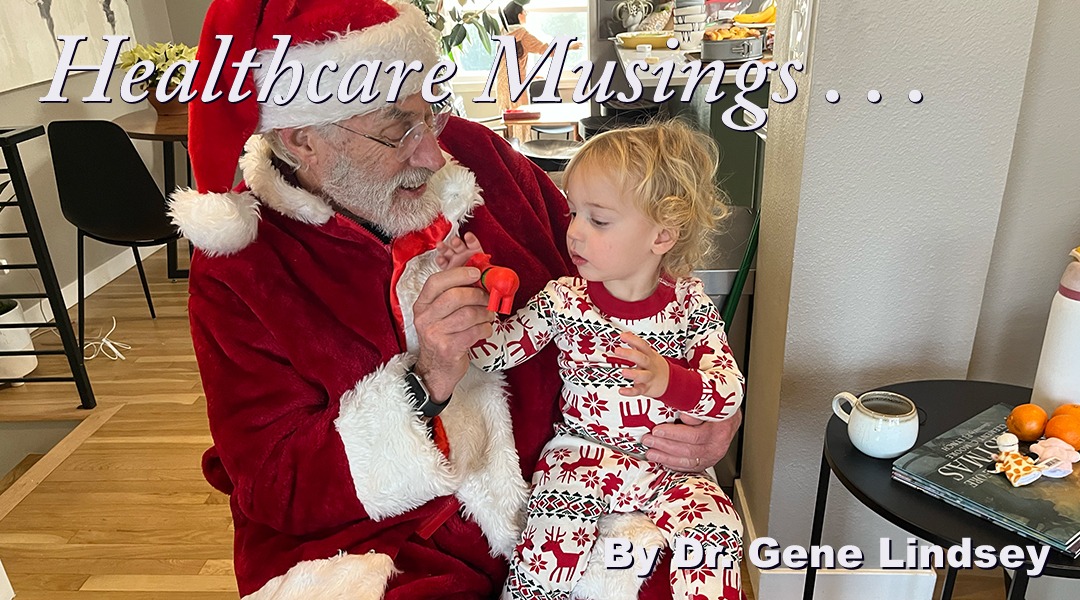
My wife and I are in Boulder, Colorado, to enjoy Christmas with our daughter-in-law’s family. She and our youngest son live in Gray, Maine, with our youngest grandson, who will be two in less than a month and speaks in sentences about airplanes, trucks, animals of all sorts, and can distinctly say Colorado, where his “Campa” ( a name derived by his Colorado cousins) lives. I am not jealous, since he can also articulate a pretty good “Gindahe” as well. That’s him in today’s header with me as Santa on Christmas morning. I was chosen for the obvious reasons of my white beard and advanced years. My grandson is a smart boy. He can carry his end of a conversation, count to ten, knows his colors pretty well, and he can also talk about his baby brother, who will be arriving in early May.
To my surprise, the weather here has not been what I expected. The daytime temps approach 70, and it is clear to me that if I wanted a White Christmas, I should have stayed in New Hampshire, where there was a pretty good dump of snow late on Tuesday after we had made our escape. I am happy for all my friends and neighbors who will be enjoying the skiing at Mount Sunapee and the pleasure of an “oldtime” Christmas environment when the residents of my little town would arrive at Christmas Eve services in sleighs with sleighbells jingling.
As we approach a new year, my hope is for multiple “resets.” My New Year’s prayer is that 2025 will be a “nadir” or trough, and that as we move through 2026, we will be climbing out of the hole we have been in toward all that we are capable of doing.
I have avoided Logan Airport in Boston for the past eleven years, except for a couple of brief visits to pick up family or once to fly to France. I am a small-town kind of guy who has never been entirely comfortable in the crush of any city or the sprawling suburbs of places like Boston, Atlanta, LA, Miami, Chicago, or Denver.
We spent the night at a friend’s home in South Natick before venturing to Logan on Tuesday. He let us leave our car at his home to avoid a king’s ransom in parking fees, and he generously offered to drive us to Logan to meet our Maine family for a non-stop flight to Denver. As we rode with him through dense traffic toward Logan late Tuesday morning, I had plenty of time to marvel at all the changes. The western suburbs of Boston felt more crowded than I remembered. Traffic moved at a snail’s pace. There were many new “McMansions” that had replaced the little Capes and smaller colonials that I remembered making up the neighborhoods. As we sped through Boston on the turnpike, there were many new buildings along the way. Even the turnpike was the scene of much new construction.
The entire scene made me very happy that I was no longer required to spend much of my day going somewhere. I remembered how surprised I had been back in 1967, when I first moved to Boston, realizing how much more difficult the “activities of daily living” were in a large city than in the towns where I had lived “down South.” All went mainly well after arriving at Logan airport, if you don’t count almost an hour delay in our departure, but not well enough to choose going there instead of the obligatory transfers usually required when we fly from the comfortable environment of our much smaller airport in Manchester, NH, which advertises itself as a “Boston regional airport.”
Over the years, I have flown to Denver many times. Thirty years ago, Stapleton Airport was “In town.” I remember looking out the plane window and seeing the smog against the background of the Rockies. President Nixon’s clean air legislation eliminated smog, and 30 years ago, the new airport was built on an empty prairie, many miles east of downtown Denver. I remember flying to Denver for the first time around 2004, not too many years after the new airport was opened. My joke then was that the airport was halfway between Kansas City and Denver. These days, urban sprawl has filled much of the prairie between the airport and the city. Given its location, it is only forty miles from Boulder. We landed after dark, but it was easy to see from all the lights along the road, as far as the eye could see, that over the last few years, much of the empty space is gone.
My description of the changes in greater Boston and suburban Denver are part of my case that we are a very wealthy and prosperous country. The president wants to continuously make the false case that we are a failing society that needs him to correct devastating problems. I don’t buy it. What I see is that our problem is not scarcity; it is managing our abundance to enable everyone to have a decent chance to prosper to the greatest extent of their skill and desire. If we need to return to any idea of the past, it is a reaffirmation of the expansion of our founding principle:
“We hold these truths to be self-evident, that all men are created equal, that they are endowed, by their Creator, with certain unalienable rights, that among these are life, liberty, and the pursuit of happiness.”
It took a few amendments, one of which is still not ratified, to get it right by making “all men” include everyone, without exception for gender, race, or wealth. That was the growing consensus before the president attacked all aspects of the march toward Diversity, Equity, and Inclusion (DEI). My hope and prayer for 2026 is that we have found the bottom of our decline or detour from that journey in 2025, and in 2026, we will begin the process of climbing out of the abyss we are in and get back on the road toward where our wealth and creativity can allow us to go. There is no question in my mind that if we could re-embrace the principles of DEI with great passion, we would find a way to ensure that everyone has the healthcare that optimizes their health, and that we would all be better off for the effort.
Happy New Year!
Be well in 2026,
Gene
It’s time to write a book!
Michael📖