February 20, 2026
Dear Interested Readers,
Looking For The Most Effective Approach To A Better Future
I keep hoping that my reading will help me better understand our times and reassure me that we will eventually return to our efforts to improve the health of our nation. My approach to searching others’ thoughts, integrating what I learn with personal experience, and what I see in the moment as I try to understand complex issues, was shaped by my medical education. One moment in particular stands out in my memory.
I have some memories that I frequently revisit for orientation. I often return to the memory of the morning of June 20, 1971, when I find myself frustrated or frightened by uncertainty. It was the first day of my internship in medicine at the Peter Bent Brigham Hospital in Boston. There were fourteen of us gathered for orientation in the “House Staff Lounge,” which was on the top floor of the historic old main building of the Brigham. The lounge was surrounded by on-call rooms. We had been gathered to meet one another and to hear welcoming words from many of the senior staff, who would be our teachers in the next step of our lifelong journey of learning.
I remember the big room as very old “Ivy League” in its decor. There were large windows at the rear of the room which faced “Building A” of Harvard Medical School just across Shattuck Street, which was essentially an alley with the Countway Library to the far right where Shattuck ended. Memory may fail me, but I think that a painting of Henry Asbury Christian, the Brigham’s first chief of medicine, hung over the mantle of a huge fireplace that was opposite the large windows. Paintings of famous doctors were everywhere in the halls of the old Brigham. The biggest collection was in the amphitheater, and the stories about the heroics of the old docs have probably been embellished over time, but I am pretty sure there was a fireplace in the House Staff Lounge with a portrait of one of these “greats” hanging over it. If my memory is accurate and there really was a fireplace, it probably hadn’t seen a log in decades. Everything was a little dusty and musty, like the living room of an elderly couple who had not redecorated in decades.
As I remember, we were fourteen nervous souls seated in a tight semicircle on well-worn red leather lounging chairs or on similarly upholstered couches facing the fireplace and Dr. Christian’s portrait, as a variety of faculty members who would theoretically be our mentors and supervisors for the next year imparted bits of welcome and wisdom. If you clicked on Dr. Christian’s name, you discovered that he trained at Johns Hopkins under Sir William Osler. Dr. Christian became the Hersey Professor of the Theory and Practice of Physic and Dean of Harvard Medical School in 1908 at the age of 32. At the time, the Peter Bent Brigham Hospital was under construction, using a design with multiple buildings connected by underground passages. The hospital’s buildings won an award for innovative design in the pre-antibiotic era. When the weather allowed, people went outdoors, moving from building to building, hoping that exposure to UV light might reduce the spread of infections.
I think that the portrait of the second chief of medicine at the Brigham, Dr. Soma Weiss, a Hungarian immigrant, was also hanging somewhere in the House Staff lounge. Dr. Weiss’s tenure was short. He was the Hersey Professor and Chief of Medicine from 1938 until his untimely death in 1942. He is famously remembered because he made his last diagnosis on himself when he announced to startled underlings that he would die within hours because he had just suffered the sudden onset of a severe headache, which he diagnosed as a ruptured cerebral aneurysm.
My class of medical interns was the last group selected during Dr. George Thorne’s long service as the Hersey Professor and Chief of Medicine. You will discover that, if you click on his name, he, like Dr. Christian, was also a Hopkins product and was still in his thirties when he was recruited after the untimely death of Dr. Weiss in 1942 to become only the third chief of medicine at the Brigham. Before my junior residency, Dr. Thorne retired. He was followed in 1972 by Dr. Eugene Braunwald, often called the father of modern cardiology. Dr. Branwald is still alive and in his late nineties.
Like Dr. Weiss, Dr. Braunwald was an immigrant. It is an interesting observation, given our president’s current resistance to immigrants despite a long history of their contributions to our society. Dr. Braunwald was born in Vienna in 1928. His family escaped the Holocaust. He attended medical school at NYU and was also a resident at Hopkins. Along the way, he led the Heart Lung Institute at the NIH and served as Chief of Medicine at UC San Diego before coming to the Brigham. He is credited with more than 1,000 medical papers and is the editor of leading textbooks in Medicine and Cardiology. Given the multiple connections to Hopkins, and there are more than I have mentioned so far, I have often wondered whether the every-other-night on-call responsibility during most of my internship was related to the even more onerous “five out of seven” call responsibility that had long existed at Hopkins. Those were the days when “resident” meant a young doctor who literally lived at the hospital.
I believe that “professional genealogies” can be both interesting and enlightening. During this long introduction, I have been working my way toward Dr. Lewis Dexter, a young colleague of Weiss and, during Dr. Thorne’s long tenure, a pioneer of cardiac catheterization and one of the most respected physicians at the Brigham and in the wider world of medicine and cardiology. As a first-year medical student, I had the privilege of “making rounds” with Dr. Dexter one afternoon. There were three or four of us. By the end of the rounds, he had made sure that all of us had heard the difference between the systolic murmurs of aortic stenosis and mitral regurgitation. I did not know at the time that I would meet my wife several years later in Dr. Dexter’s cath lab, where she had become the lab’s nurse and a monitor of hemodynamic measurements central to his research and patient care.
One of Dr. Dexter’s most prominent trainees was Dr. Richard Gorlin. When I was a cardiology fellow at the Brigham, there was not one but three cardiology services led by Dr. Dexter, Dr. Gorlin, and Dr. Bernard Lown. Each service had its own fellows; I was a Gorlin fellow, but the first-year fellows rotated through the three unique services, so I was exposed to some of the most remarkable cardiologists of the twentieth century.
I assume that Dr. Thorne welcomed us to the next adventure of our lives. I don’t remember his words or those of any of the other speakers except the advice Dr. Dexter offered us, which I will never forget. Simply put, Dr. Dexter said that the practice of medicine was dependent on knowing the diagnosis. He encouraged us to always try to understand the real reason behind the patient’s symptoms. He told us that the first step in successfully helping a patient was to pursue the correct diagnosis. If we knew the true diagnosis, we would usually know what we should do. After there was a certain diagnosis, management was almost “cookbook,” based on knowledge of the current “best practices.” Until we had a certain diagnosis and hopefully understood the pathophysiology, we would be “treading water” at best, and at risk of inducing harm to the patient at worst. What I later learned from experience was “what to do” when I didn’t know what to do, without causing harm, until I was certain of the diagnosis.
Selecting a treatment option when you don’t understand the problem is fraught with risk. Primum non nocere, Latin for “first do no harm,” has to be our greatest concern until we find the diagnosis that leads us to our beneficial therapeutic options. Since I first heard this succinct approach to medical practice from Dr. Dexter, there are more than 50 years in the rearview mirror, and I have heard Dr. Dexter’s words in my mind thousands of times. On most occasions, I have followed his advice, which brings me to the chief concern of this letter.
I have read and heard several pundits who suggest that Trump, even with all of his negative impact on healthcare, human rights, and outrageous focus on acquiring more power by violating all the political norms that have evolved during the 250 years of our democracy, is the expression of a deeper problem in our society that began long before he descended his gilded escalator to announce his candidacy for president in 2015. I think that it is important for the future of healthcare and for the future of our democracy to give deep consideration to the question of whether Trump is our disease or a symptom of problems that will not vanish when he finally goes away.
Google’s AI agrees with the concept but then adds evidence that, once enabled, the president has capitalized on the issues that made his presidency possible and accelerated our decline. In response to my statement, “Trump is the result of and not the cause of a change in American culture,” the bot writes:
The perspective that Donald Trump is a result (or symptom) of a changing American culture, rather than its primary cause, is a prominent argument among political scientists, sociologists, and analysts. This viewpoint suggests that the cultural, economic, and political shifts that enabled his rise were already in motion before his 2016 election.
Here is an analysis of that argument based on the provided search results:
Arguments for Trump as a “Result/Symptom”
- A “Fever” of Deeper Malaise: Analysts argue that Trump is the consequence of long-simmering divisions in American society, including, disillusionment with institutions, fatigue with globalization, and anxieties about America’s changing role in the world. He is often described as a “fever” or a “symptom” of a deeper, pre-existing cultural sickness.
- Reaction to Cultural Shifts: Supporters of this view argue that the populist movement behind Trump is a reaction to shifting communication norms and a desire to return to a previous, “lost” vision of national greatness.
- Long-Term Trends: The rise of Trumpism is viewed by some as rooted in long-standing American cultural traditions, such as nativism. Others trace the origins of these sentiments to right-wing media trends in the 1970s through the 1990s, which were further amplified by social media.
- Not a “Detour”: Many analysts contend that viewing Trump as an aberration from the American trajectory is incorrect. Instead, his presidency was enabled by a “cultural displacement” and anxiety among voters who felt they were losing status in a changing demographic landscape.
Arguments for Trump as a “Cause” of Cultural Change
While many see him as a result, he is simultaneously viewed as an accelerator of these changes.
- Shifting Political Norms: Trump’s rhetoric and actions, such as challenging traditional norms of the presidency, have reshaped political discourse. Studies indicate that his presidency coincided with a change in the “topography of prejudice” in the U.S., with explicit prejudices increasing among his supporters.
- Cultural Reshaping: In his second term, Trump has actively aimed to reshape American culture, focusing on “reclaiming” cultural symbols, impacting arts funding, and pushing back against “woke” culture in institutions like the Kennedy Center and the Smithsonian.
- Weaponizing Culture War: Trump has used his platform to focus on cultural issues, such as transgender rights and the redefinition of American history, which has influenced the broader culture.
Conclusion
The research suggests a dual role: Donald Trump is a symptom of underlying, long-term shifts in American society, but he has also served as a powerful accelerator and agent of change, pushing those cultural shifts further into the mainstream.
I don’t disagree with the bot, but I would add more depth to the understanding of what gave Trump his opportunity. I think there are even deeper causes than cultural tensions, a deep general malaise, concerns about the cost of living, and the periodic resurgence of nativism. Trump did exploit these realities to his advantage. In deference to Dr. Dexter’s admonition, these issues may still be symptoms, and it may behoove us to look beyond them for an even deeper pathological process we all share that might guide our “treatment” and eventual recovery. We need to look for our contributions to the forces and circumstances that created the divisions in our society that made Trump possible.
I have been giving the idea of what was necessary for a leader like Trump to emerge a lot of thought and some in-depth reading that was initiated by one of the last columns that David Brooks wrote for the New York Times, which I referenced in my letter to you two weeks ago, on February 6. Brooks published the piece that got me thinking on January 9th, titled “The Sins of the Moderates.”
Brooks begins by discussing George Packer’s latest novel, titled Emergency. [Click on the link to get a very good synopsis of the book’s themes. Better yet, read it.] Brooks gives us a shorter description of the book:
It’s written in a manner akin to George Orwell’s “1984,” about our own day. It’s set in some faraway empire in an uncertain time period, but the parallels to our own circumstances are clear. There’s a discredited establishment. There are enraged and resentful rural populists and urban wokesters canceling their elders. Some people are addicted to screens and others are entranced by the idea that artificial intelligence will produce better humans. I was astonished by how much more clearly I could understand our own times when seeing them reflected back in a fictional parable.
As you might guess, I have now read the book, and I enjoyed it even though the construct was not initially interesting to me. I could easily see the connection Packer was making between his story and you, me, and our “times.”
Brooks provides a little more background to the story:
The main character, Hugo Rustin, is a moderate, humane surgeon who pushes back against the extremes of left and right. He believes in cooperation, not domination, and that we can build a decent society if we talk to one another as human beings.
I could connect with Hugo. We are both bewildered by what is happening around us. Hugo’s healthcare job and his future as the chief of surgery and the hospital director-in-waiting fall apart under the strain of external forces he doesn’t understand and that conflict with his core values. After a thorough review of why Hugo wasn’t able to adapt to the changes going on around him, Brooks writes:
Many of us are in Rustin’s shoes in real life today. If you were born between World War II and 1990, it’s fair to say you were born in the era when the postwar liberal international order went largely unquestioned. That order consisted not only of obvious things like NATO, but also a whole system of restraints to make democracies function; not only codes of civility, but also respect for truth, norms of self-restraint, a commitment to dialogue and faith in institutions.
That analysis may lead us to a partial diagnosis of our problem, of which Trump is a symptom. Could it be that the problem lies with those of us who were doing quite well and have an affection for our position in the status quo? We know the world isn’t perfect, but we often think that most of the problems that distress us daily lie with the “basket of deplorables” who just don’t understand that we have the expertise to solve their problems. And, there is a profit to be made doing it. Like Hugo, we become frustrated with how things are falling apart, which leads us to say and do regrettable things or avoid necessary ones. Either way, our actions and inactions just seem to make things worse.
I hate to tell you this, but the issues don’t really get resolved by the end of the book. Hugo does learn some lessons, but at great cost, and good times don’t roll just because he gains a little insight. The book is dystopian. We live in dystopian times of our own construction.
Brooks is trying to give us a message, but before being explicit about his recommendation or the observations we might use to develop our own way forward, he turns to another book, one written in 1944, The Children of Light and the Children of Darkness: A Vindication of Democracy and a Critique of Its Traditional Defense, written by the philosopher/sociologist/ theologian Reinhild Niebuhr. Yes, I bought that book also. I admit that Neibuhr is not an easy read, and like Packer, he has no interest in happy endings. The quote that Brooks lifted from the book is:
An ideal democratic order seeks unity within the conditions of freedom; and maintains freedom within the framework of order.
What does that mean? It is easy to say that those of us who are currently concerned that our Democracy and the world order, including healthcare, are at risk are the “Children of Light.” At the time Niebuhr was writing, the “Children of Darkness” were fascists and communists. Now you might argue that there are several “darkness” camps, including our President and his MAGA supporters, or autocrats the world over. The book is dense, but I agree with Brooks that it has a message for us. Google’s AI helped me cut through Niebuhr’s heavy prose and what seemed like arguments with himself. I asked it to help me outline Niebuhr’s message. I’ll shorten the answer, but try to give you the essence of what I got. [The bolding is my addition.]
Reinhold Niebuhr provides a “vindication of democracy” by critiquing both its naive defenders and its cynical enemies. Written during World War II, the book argues that democracy is not just a luxury for stable societies but a necessity for managing the persistent reality of human self-interest.
I should add here that Niebuhr spends a lot of words impressing on the reader that both the Children of Light and the Children of Darkness have self-interests. Both also understand that political power is required to defend one’s self-interest. The dark side is very comfortable trying to grab power; the children of light, not so much. Niebuhr recognizes that self-interest is a natural human tendency. I think one of the root causes of Trump’s rise is the willingness of many among us to defend their self-interest by any means, or latch on to someone who will do it for us. The key to my argument is that self-interest was trumping concern for neighbors and community before Trump promised that he alone could solve all problems. Google’s AI describes the difference as the Central Dichotomy:
The Central Dichotomy
Niebuhr divides political actors into two primary groups based on their understanding of power and morality:
- The Children of Light: These are the idealists (often liberals, secular rationalists, or religious universalists) who believe that human reason and “higher laws” can eventually overcome self-interest to create a harmonious society. Niebuhr considers them virtuous but foolish because they underestimate the “tenacity of self-interest” and the “peril of anarchy”. [That is me and many other “progressives.” It may have been us more than MAGA enthusiasts that gave Trump his chance.]
- The Children of Darkness: These are the moral cynics (such as fascists or totalitarians) who recognize no law beyond their own will and self-interest. They are evil but wise in a worldly sense, as they understand the power of collective egoism and use it ruthlessly to seize and maintain control. [Think Stephen Millar and Steve Bannon.]
Here comes the hard part for today’s Democrats. It is why Brooks titled the piece, “The Sins of the Moderates.” Niebuhr says that to be successful, the Children of Light must be “harmless as doves” and “wise as serpents,” recognizing “the power of self-interest in social life.” We are neither harmless nor wise. I can’t name any Democrat since Obama who consistently demonstrates the attributes that Niebuhr thought would be required of the Children of Light. Dr. King referenced Niebuhr’s ideas and the need for the Civil Rights movement to have power in his last book, Where Do We Go From Here, Chaos or Community? I will let Google speak for itself, but will bold a few phrases. Pardon the repetition, but the point to be made is important.
Key Arguments
- The Need for Realism: Niebuhr argues that for democracy to survive, the Children of Light must “absorb some of the wisdom” of the Children of Darkness. They must remain “harmless as doves” in their moral intent but become “wise as serpents” by recognizing the power of self-interest in social life.
- Democracy as a Necessity: His most famous thesis, stated in the foreword, encapsulates the book’s logic: “Man’s capacity for justice makes democracy possible; but man’s inclination to injustice makes democracy necessary”. Democracy provides the checks and balances required to prevent any one individual’s or group’s self-interest from becoming tyrannical.
- Critique of Individualism: He criticizes traditional “bourgeois” democratic theory for its reliance on an “atomic” view of individuals. He argues instead that humans are inherently social and that communities are organic entities, not just artificial contracts created by human will. [Here “atomic” means “of or forming a single irreducible unit or component in a larger system, a society made up of atomic individuals pursuing private interests.”
- The Problem of Property and Community: The book examines how economic power and property rights must be balanced to serve both individual freedom and the common good, rejecting both pure laissez-faire capitalism and total state control.
I think all of those points are important to consider when we try to explain how we got stuck with Trump. The sin of the moderates is that we are not very skilled or comfortable with balancing self-interest, which may simply be a cause for which we are passionate, and the broader needs of the community in the moment, with the need for unified power.
What we end up with is controversy among our progressive selves over many inconsequential things, frequent scapegoating, and a regulatory mess when we try to govern. This is a central theme of Ezra Klein’s and Derek Thompson’s book, Abundance. The link is to the New York Times review of the book, appropriately titled “Can Democrats Learn to Dream Big Again?” And I would add that the inability to make progress due to conflicting self-interests among progressives may well be the true reason we have Trump. If self-interest had not been in conflict with concerns for the community, and political realism had been coupled with the laudable progressive ideals, would Trump ever have been much more than a joke?
We reassure ourselves by saying that the arc of history is long and it bends toward freedom. What we often fail to realize is that bending the arc takes power derived from working together toward negotiated goals. This is absolutely true in healthcare: if we are ever going to address the challenges of the Social determinants of Health, where our performance is miserable for about half of our population.
Self-interest is natural and important, but if we are enlightened and strategic, whether in foreign policy, domestic policy, or even in healthcare, we must recognize that it is a “sin” for our self-interest not to be balanced by concern for the community. It will be hard, but to succeed, we will need to be tolerant, practice inclusion, and perhaps show some respect for those whose worldview and personal opinions have led them to those who sell darkness. Unless we recognize how we got to where we are, we will not easily get to where we want to go. We may see the root cause problem that made Trump a symptom by looking in the mirror.
California Is Now Wet and Green
I have traveled to California on average a couple of times a year over the last forty years or more. One of my sons, his wife, and two boys live in Felton, a small town just northeast of Santa Cruz. My daughter-in-law is responsible for digital subscriptions at UC Santa Cruz library, and my son works for a nonprofit in the area that seeks to give disadvantaged people, primarily young people working in the vast agricultural operations of the area, an opportunity to gain IT skills, which will give them opportunities they would otherwise not have.
This week, my daughter-in-law is visiting her mother in Alabama. My grandsons are out of school for the February school week vacation, and we volunteered to come west to be with the boys, ages eleven and eight, while their dad was at work. When we volunteered, I imagined warm weather, trips to the nearby beaches, and hikes in the mountains around Santa Cruz. I did not imagine a monsoon season. It has poured for most of every day since we arrived last Saturday evening. Over the last few days, there have been moments of sunshine that have tempted us to get out of the house for a walk. Invariably, it has been a bait-and-switch operation of nature, and we are drenched before we return home.
I do enjoy walking here. Our family lives about a quarter mile up the hillside from the Henry Cowell Redwoods State Park (click to see scenes from the park and read its history), which is just across Highway 9 and on the other side of the San Lorenzo River. As we cross the bridge over the river and into the park, we can look down and see that, with all the rain, the river has become a raging brown flood, carrying a lot of detritus down the canyon toward Santa Cruz. Once we are in the park, a little more than a half mile from the entrance, we come to the main attraction: a magnificent grove of Coastal Redwoods, the tallest trees on earth, with a circular one-mile walk through the oldest and tallest trees. Walking through the redwoods has been a highlight of every trip to California.
My usual path from the entrance to the grove is through the woods and along the river, on paths shared with others walking dogs, riding horses, or trail bikes. The park is huge, and on weekends, hundreds of fit people negotiate steep trails on their bikes. With all the rain, the trails are out of bounds for my grandsons and me. My grandsons and I have watched for breaks in the rain and headed for the park whenever the pelting slows to a drizzle. Invariably, some time during our walk, the downpour returns, and we are drenched. The only positive side to all of this is that California has gone from its usual golden brown to a lush green, and all the lakes and reservoirs are full.
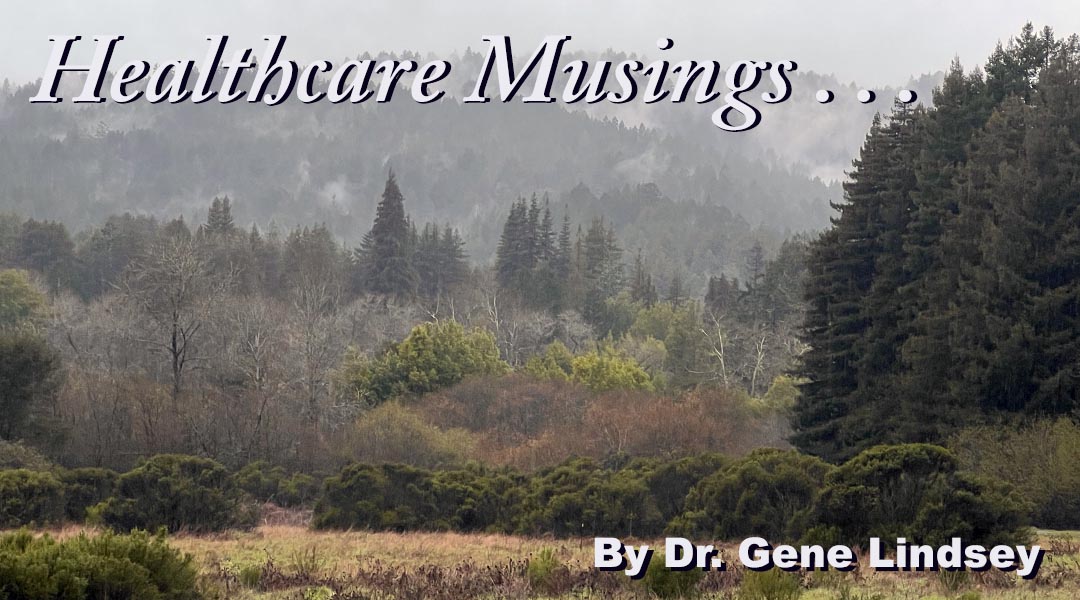
Once in the park, we have needed to avoid our usual path through the woods. We stay on the road that leads to the parking lot next to the main redwood grove. The road passes through a large meadow that I have never fully appreciated. On our first pass through the meadow, we saw a herd of deer, but they were too far away to get a good picture. Nature has also given the deer coats that blend into the landscape so that the camera doesn’t easily capture what the eye can see. What the camera does capture nicely, and that you can see in today’s header, is the overcast day, the meadow, and the hillside where my family lives, which is covered with coastal redwoods and Douglas firs.
The same weather has produced 6 to 8 feet of snow in the Sierra Mountains. Unfortunately, an avalanche there this week killed eight skiers. The snowpack in the mountains is an important water source for California. There should be plenty of water when all the snow melts this summer. I hope the weatherman is right and we enjoy clear skies today and tomorrow. Unfortunately, the weather moves west to east, and the rain we have had in California will arrive in New Hampshire this weekend as more snow.
I hope that wherever you are, you will have a pleasant weekend. Perhaps you will take a walk, and while walking, think about how our country got to where we are and what changes in attitudes and actions are necessary to enable us all to travel toward a better destination.
Be well,
Gene