February 6, 2026
Dear Interested Readers,
Things Change
I was surprised, shocked, and briefly in despair last weekend when I followed my routine of reviewing the opinion pieces in the New York Times and discovered that, after 22 years, David Brooks had announced he was moving on. My immediate reaction to his column was like I had lost a good friend. I remembered that he had not appeared on Friday evening on the PBS NewsHour in the weekly conversation about recent events, as he usually does with Jonathan Capehart, formerly of the Washington Post and now of MS Now.
I immediately became concerned that perhaps he had a fatal illness (there have been rumors that he has medical problems, perhaps Parkinson’s Disease), or was he being squelched by the Trump administration with a threat of some “trumped up” legal challenges? I quickly scanned the article for the answer and was relieved to read the last few lines, which offered vague reassurance that both of my quick explanations were wrong. He ended the piece by saying:
I’ll miss a lot of things about being a Times columnist — the readers, the colleagues, the endless learning that the job involves. The job title alone is good for my ego! But I think I’ve found a project and a cause that are worth devoting the final chapter of my career to.
Thanks a million, everybody.
So, what was the project, and what was the cause? My next step was to ask Google. “Why is David Brooks leaving the New York Times? What is he going to do?”
The answer popped up immediately in the first few paragraphs of an article dated January 30, from The Yale Daily News. The article begins:
David Brooks, a long-time political columnist, is leaving The New York Times to join the Jackson School of Global Affairs as the University’s first presidential senior fellow.
Brooks, who has had two previous stints as a fellow at the Jackson School, will begin his new role on Feb. 1, according to a YaleNews release. Brooks is also joining The Atlantic as a staff writer, and he will also host a weekly podcast “made possible by support from Yale,” according to a press release in The Atlantic. Brooks is slated to host lectures and conversations at Yale throughout the spring.
“One of the hallmarks of David’s career has been his ability to gather ideas from a broad swath of disciplines to enable people to grapple with the complexities of politics and society,” University President Maurie McInnis said in the news release.
Well, that was a relief. It did not tell me whether he will continue on the Friday evening PBS spot where he has been a fixture since 2001, but Google did suggest that he would continue:
Based on reports surrounding his career move in early 2026, David Brooks is expected to continue as a political commentator on the PBS NewsHour. While leaving The New York Times for The Atlantic and a fellowship at Yale University, he remains a long-time contributor to the program, which is expected to continue.
I was relieved to learn that my access to David Brooks’s wisdom, writing, and opinions would continue, at least for a while. Nothing lasts forever, as I learned when my long-time devotion to the wisdom and humor of Garrison Keillor took a big hit back during the #MeToo era. Click on the link to hear Keillor discuss the question of his bad behavior. I realized that although I wouldn’t get to read a Brooks column most weeks, I would still see him on PBS, read him in The Atlantic (I am a long-time subscriber), buy his books, and hear him on his new podcast, which will be produced by Yale and The Atlantic. I listen to a lot of podcasts on my daily walks. One of my favorites is the weekly “Radio Atlantic” with Hanna Rosin, which is also produced by The Atlantic.
You might be asking, “Isn’t Lindsey a self-described progressive liberal? What is his attraction to the thoughts and opinions of David Brooks?” The answer is deeper than today’s politics. The answer requires a review of the history of political philosophies and the evolution of culture in our time. Those considerations form much of the explanation for the current state of American healthcare.
I think the line between conservatives and liberals has always been blurred. As with most things, we prefer clear-cut differences, even when most of us see reasons for hope in common ground. Perhaps some of the confusion between my label of liberal progressive and Brooks’s self-description of his conservatism lies in the reality that those who label themselves as true conservatives today retain only vestigial bits of the thought of the original conservative thinkers like Thomas Hobbes and Edmund Burke. Likewise, the worldview of those who would like to call themselves liberal is not fully consistent with the principles articulated by liberal thinkers such as John Locke, John Stuart Mill, or Jean-Jacques Rousseau.
Since I never took a course in philosophy and in college as a chemistry major had only one course in civics and one course in economics, I asked Google’s AI to compare the philosophies of Burke and Locke, since Burke is considered to be the father of modern conservative thought and Locke, a physician, is credited by many as the father of liberalism. The comparison may surprise you and is foundational to my explanation of why I feel there is common ground in our complicated world between David Brooks’s conservatism and my somewhat instinctual orientation toward liberal ideals. Google’s response was:
To understand the modern political landscape, there is perhaps no more important comparison than that between John Locke (the father of Liberalism) and Edmund Burke (the father of modern Conservatism).
While both men valued liberty and the rule of law, they disagreed fundamentally on where rights come from and how society should change.
Core Philosophical Differences
- The Origin of Society
- Locke (Social Contract): He viewed society as a conscious “deal” made between individuals. In his Second Treatise of Government, he argued that humans are born in a state of nature with inherent rights, and we form governments solely to protect those rights.
- Burke (Organic Growth): He rejected the idea that society is a simple contract like a business partnership. To Burke, society is an organic organism—a partnership between “those who are living, those who are dead, and those who are to be born.” It evolves over centuries, not by a single agreement.
- Human Rights: Natural vs. Prescriptive
| Feature | John Locke (Liberalism) | Edmund Burke (Conservatism) |
| Source of Rights | Natural Law: Rights are universal, God-given, and exist before government. | Inheritance: Rights are “prescriptive”—they are specific privileges handed down by ancestors. |
| Key Concept | Life, Liberty, and Property. | The “Rights of Englishmen” (specific legal traditions). |
| Universalism | Rights apply to all humans everywhere at all times. | Rights depend on the specific culture and history of a nation. |
- Change and Revolution
- Locke’s Radicalism: Because government exists only to protect natural rights, the people have a moral right to overthrow a ruler who fails to do so. This provided the intellectual fuel for the American Revolution.
- Burke’s Reform: Burke famously critiqued the French Revolution. He believed that destroying old institutions (like the Monarchy or Church) based on “abstract theories” would lead to chaos and tyranny. He preferred “reform to preserve”—making small, gradual changes while keeping the foundation intact.
View on Human Reason
The Individual vs. The Collective
John Locke had high confidence in individual reason. He believed that if you give people the right information and freedom, they can figure out how to govern themselves rationally.
Edmund Burke was skeptical of individual reason. He believed the “individual is foolish, but the species is wise.” He argued that we should rely on Prejudice (by which he meant “pre-judgment” or accumulated wisdom) and Tradition, because these represent the successful survival strategies of thousands of ancestors.
Summary of their “Ideal State”
- Locke’s Ideal: A limited government that stays out of the way, protecting a person’s right to pursue their own interests. (Focus: Liberty)
- Burke’s Ideal: A stable society where order is maintained through established institutions, religion, and social hierarchies. (Focus: Stability)
The Tension: Modern Western democracies are essentially a marriage of these two. We use Lockean principles to protect our individual rights, but we often rely on Burkean institutions (like the courts, the constitution, and cultural norms) to ensure those rights don’t lead to social collapse.
It is interesting to me that the Trumpian form of conservatism trashes the separation of powers and limitations of the executive described in the Constitution, defies the courts, and defies common courtesies and political norms, but still calls itself “conservative.” One wonders whether our president, or even some of his cabinet members, like Robert F. Kennedy, Jr., Pete Hegseth, or Kristy Noem, give any thought to the principles that, theoretically, are the foundation of the “conservative movement” they claim to support. I would suspect that the vice president is well aware of the philosophical inconsistencies of the administration and its efforts to push us back to something like the feudal realities that existed when Thomas Hobbes, considered by some to be “one of the founders of modern political philosophy,” described in his book Leviathan (1651), the natural state of human existence to be:
“Whatsoever therefore is consequent to a time of war, where every man is enemy to every man, the same consequent to the time wherein men live without other security than what their own strength and their own invention shall furnish them withal. In such condition, there is no place for industry… no knowledge of the face of the earth; no account of time; no arts; no letters; no society; and which is worst of all, continual fear, and danger of violent death; and the life of man, solitary, poor, nasty, brutish, and short.”
Vance might be capable of writing such thoughts; Stephen Miller probably couldn’t, but his actions and statements seem to support the use of force to shape our society, and his speech is consistent with Hobbes’s pre-1651 view of the world. In an interview with Jake Tapper, he said:
“We live in a world, in the real world, Jake, that is governed by strength, that is governed by force, that is governed by power,” he said. “These are the iron laws of the world since the beginning of time.”
Having established that the line between conservatism and liberalism is blurred and that many who see themselves as conservative aren’t, I see some small flicker of possibility for the return of reason and a return to our journey toward the great aspirations expressed at our founding, if we can ever free ourselves from the reign of MAGA, which is more a call for some new neo-feudalism though the exercise of raw power. I should also add that the far left is just as capable of demolishing what we have struggled to accomplish over the last 250 years. Efforts to improve our healthcare seem likely to be on hold and to slide backward until our current political disharmony is more effectively addressed. In my effort to return to a saner approach to the pursuit of the positive, I feel almost completely aligned with David Brooks’s thoughts, which he eloquently summarized in his “Time to Say Goodbye” column. He begins with a reference to his grandfather’s values, and then moves on to discuss how things were when he first joined the Times. As is my usual habit, I will bold the points that resonate with me as I annotate his more interesting points.
When I came to The Times, I set out to promote a moderate conservative political philosophy informed by thinkers like Edmund Burke and Alexander Hamilton. I have been so fantastically successful in bringing people to my point of view that moderate Republicans are now the dominant force in American politics, holding power everywhere from the White House to Gracie Mansion. I figure my work here is done.
I’m kidding.
He points to American culture as the probable reason for his failure to bring more of those who call themselves “conservative” into alignment with traditional conservative philosophy. There may be some confusion when he uses the word “liberal,” because, from his perspective, a liberal education is a foundational component of a true conservative worldview, one that depends on attention to traditional principles rather than force and power.
In reality, I’ve long believed that there is a weird market failure in American culture. There are a lot of shows on politics, business and technology, but there are not enough on the fundamental questions of life that get addressed as part of a great liberal arts education: How do you become a better person? How do you find meaning in retirement? Does America still have a unifying national narrative? How do great nations recover from tyranny?
We are all potential victims of a great unraveling of a culture that enabled a strange form of stability during the “Cold War” and promoted the flourishing of democratic principles, improved health, and human rights around the world. There was a moment following the collapse of the USSR when the hopeful among us thought that everyone on the planet would soon have a life that was not “solitary, poor, nasty, brutish, and short.” Brooks sees that things have changed over the last twenty years while he has been at the Times. Brooks continues:
When I think about how the world has changed since I joined The Times, the master trend has been Americans’ collective loss of faith — not only religious faith but many other kinds. In 2003, we were still relatively fresh from our victory in the Cold War, and there was more faith that democracy was sweeping the globe, more faith in America’s goodness, more faith in technology and more in one another. As late as 2008, Barack Obama could run a presidential campaign soaring with hopeful idealism.
Things have changed since 2008.
We have become a sadder, meaner and more pessimistic country. One recent historical study of American newspapers finds that public discourse is more negative now than at any other time since the 1850s. Large majorities say our country is in decline, that experts are not to be trusted, that elites don’t care about regular people. Only 13 percent of young adults believe America is heading in the right direction. Sixty-nine percent of Americans say they do not believe in the American dream.
Loss of faith produces a belief in nothing. Trump is nihilism personified, with his assumption that morality is for suckers, that life is about power, force, bullying and cruelty. Global populists seek to create a world in which only the ruthless can thrive. America is becoming the rabid wolf of nations.
Brooks eloquently expands on that thought, and I hope that if you have not read the whole column, you will. If you have read it, I hope you will return to it as a foundational guide to the work needed to improve healthcare in general and to address the Trumpian policies that undermine the efforts to improve the Social Determinants of Health. Brooks sees a longer decline in our culture that produced Trump, more than a decline initiated by Trump. I agree, and if we eventually survive Trump, we will still need to seek the answer to the “why” of our national decline. Was it the emergence of “hyperindividualism”?
It’s tempting to say that Trump corrupted America. But the shredding of values from the top was preceded by a decades-long collapse of values from within. Four decades of hyperindividualism expanded individual choice but weakened the bonds between people…
We’re abandoning our humanistic core. The elements of our civilization that lift the spirit, nurture empathy and orient the soul now play a diminished role in national life: religious devotion, theology, literature, art, history, philosophy… [I would add humanity in medical practice to his list]…We have widened personal freedom but utterly failed to help people answer the question of what that freedom is for.
The most grievous cultural wound has been the loss of a shared moral order. We told multiple generations to come up with their own individual values…Without shared standards of right and wrong, it’s impossible to settle disputes; it’s impossible to maintain social cohesion and trust. Every healthy society rests on some shared conception of the sacred — sacred heroes, sacred texts, sacred ideals — and when that goes away, anxiety, atomization and a slow descent toward barbarism are the natural results.
Like all good writers, Brooks is a master at description. He surpasses many pundits in his ability to offer an analysis that becomes a hypothesis worth testing.
The crucial question facing America is: How can we reverse this pervasive loss of faith in one another, in our future and in our shared ideals?… I still believe we’re driven not only by the selfish motivations but also by the moral ones — the desire to pursue some good, the desire to cooperate, to care for one another and to belong…
I would add that the return of these shared ideals and desires must occur before we can produce a healthcare system that serves everyone equally. He continues:
Where do people and nations go to find new things to believe in, new values to orient their lives around? Where do they go to revive their humanistic core? They find these things in the realm of culture.
Brooks asks questions, then answers them himself. He continues:
By “culture,” I don’t just mean going to the opera and art museums. I mean “culture” in the broadest sense — a shared way of life, a set of habits and rituals, popular songs and stories, conversations about ideas big and small. When I use the word “culture,” I mean everything that forms the subjective parts of a person: perceptions, values, emotions, opinions, loves, enchantments, goals and desires. I mean everything that shapes the spirit of the age, the moral and intellectual moment, which constitutes the shared water in which we swim. In this definition, every member of society has a role in shaping the culture. We all create a moral ecology around ourselves, one that either elevates the people we touch or degrades them.
He doesn’t credit David Foster Wallace, but Wallace did use the same metaphor for culture, the water in which we swim, in his famous Kenyon College commencement speech. Brooks reaches back to Burke, the father of modern conservatism, for his expansion of the concept of culture:
Edmund Burke argued that culture, which he called “manners,” is more important than politics. Manners, he wrote, “are of more importance than laws. Upon them, in a great measure, the laws depend. The law touches us but here and there, and now and then. Manners are what vex or soothe, corrupt or purify, exalt or debase, barbarize or refine us, by a constant, steady, uniform, insensible operation, like that of the air we breathe in. They give their whole form and color to our lives. According to their quality, they aid morals, they supply them, or they totally destroy them.”
Norms are a form of manners, and one recurrent observation about our president is that he has destroyed our political norms. It is not that he doesn’t understand the power of culture. He does and he redefines it toward something that is ugly and brutish.
Trump is that rare creature, a philistine who understands the power of culture. He put professional wrestlers onstage at the last Republican convention for a reason: to lift up a certain masculine ideal. He’s taken over the Kennedy Center for a reason: to tell a certain national narrative. Unfortunately, the culture he champions, because it is built upon domination, is a dehumanizing culture.
True humanism, by contrast, is the antidote to nihilism. Humanism is anything that upholds the dignity of each person…Humanism comes in many flavors: secular humanism, Christian humanism, Jewish humanism and so on. It is any endeavor that deepens our understanding of the human heart, any effort to realize eternal spiritual values in our own time and circumstances, any gesture that makes other people feel seen, heard and respected. Sometimes it feels as if all of society is a vast battleground between the forces of dehumanization on the one side — rabid partisanship, social media, porn, bigotry — and the beleaguered forces of humanization on the other.
His advice to his readers as he departs the New York Times is for us to be involved in the resurgence of a more humane culture. Perhaps this is the area where I feel most aligned with Brooks.
If you want to jump in on the side of humanization, join the Great Conversation. This is the tradition of debate that stretches back millenniums, encompassing theology, philosophy, psychology, history, literature, music, the study of global civilizations and the arts. This conversation is a collective attempt to find a workable balance amid the eternal dialectics of the human condition — the tension between autonomy and belonging, equality and achievement, freedom and order, diversity and cohesion, security and exploration, tenderness and strength, intellect and passion. The Great Conversation never ends, because there is no permanent solution to these tensions, just a temporary resting place that works in this or that circumstance. Within the conversation, each participant learns something about how to think, how to feel, what to love, how to live up to his or her social role.
Brooks is excited about what is happening or could happen on our campuses. I assume that is the reason he is headed to Yale.
One of the most exciting things in American life today is that a humanistic renaissance is already happening on university campuses. Trump has been terrible for the universities, but also perversely wonderful. Amid all the destruction, he’s provoked university leaders into doing some rethinking…I look at these efforts with growing admiration and enthusiasm. My questions are: How can I get involved? Where do I go to enlist? (In my particular case, the answer turns out to be New Haven, Conn.) And of course, the forces of humanization are needed not just on campuses but also within every company, community and organization where people are engaged in the vital search for good conduct, ethical leadership and a greater wisdom about what is truly significant.
His column usually runs less than 1200 words. This farewell is over 2700. I am leaving out much of his lush expansion of ideas, which I hope you will be interested in reading for yourself. Near the end of his farewell message, he writes:
If America could once again restore its secure emotional, material and spiritual base, maybe we could recover a smidgen of our earlier audacity. Oscar Wilde joked that youth is America’s oldest tradition. Maybe it’s time the country matured, and combined youthful energy with the kind of humility and wisdom that Reinhold Niebuhr packed into one of his most famous passages:
Nothing that is worth doing can be achieved in our lifetime; therefore we must be saved by hope. Nothing which is true or beautiful or good makes complete sense in any immediate context of history; therefore we must be saved by faith. Nothing we do, however virtuous, can be accomplished alone; therefore we are saved by love. No virtuous act is quite as virtuous from the standpoint of our friend or foe as it is from our standpoint. Therefore we must be saved by the final form of love, which is forgiveness.
I say “Amen” to that farewell wish, and I will be looking for him in The Atlantic and checking for him in my podcast feed, because I am sure his comments will continue to offer insights and good practical advice to those of us who long to see improvement in the health and healthcare of everyone.
The Cold Persists and Will Increase As We Await the Super Bowl
I can’t remember when our temp was last higher than 32. On Sunday evening, as I sit by my fireplace, watching the Super Bowl, we will be in the low single digits. The temp may be below zero by the time Bad Bunny sings at halftime. The forecast for next week is for more of the same. I have never been to a Super Bowl, and there are many that I can’t remember, but I think I have watched every one of the previous Super Bowls and the NFL Championship Games that preceded it since Johnny Unitas and Alan Ameche won the NFL Championship Game for the Baltimore Colts in 1958, in “the greatest football game ever played.”
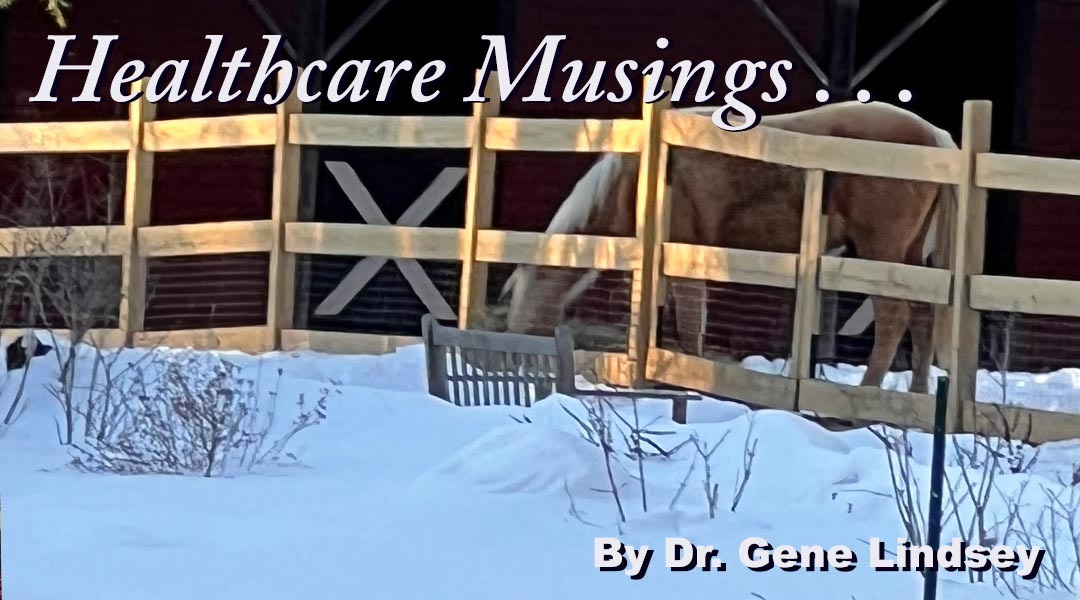
I have purchased a new stocking cap that extends into a face mask and heated gloves so I can keep walking despite the very cold weather. With my enhanced gear, I have walked in temperatures as low as 12 degrees with an even lower wind chill. On my walks, I often see a new neighbor who seems not to mind the cold. His name is Theo, and you can see him in today’s header. It isn’t a great picture because there is deep snow and woods between the road where I walk and his stable. I took the shot with my iPhone from about fifty yards away. This beautiful horse showed up in early fall, and the little girl who lives in the antique red colonial farmhouse with a connected barn, adjacent to Theo’s stable and paddock, told me his name. Before the snow made visits difficult, Theo would wander over to the fence to say hello. I am looking forward to getting to know him better when the snow melts in the spring.
This week’s Super Bowl will be a replay of the 2015 Super Bowl. I have fond memories of the dramatic end of that game. My wife and I watched the game in Loreto, Mexico. We had been invited down to Loreto for a week’s visit with physician friends from the Seattle area at their winter home. It seems that retired people in the Northwest go to the Baja Peninsula in the winter, the way New Yorkers and New Englanders go to Florida.
We had a great time. Our hosts were generous and had several activities planned. I had fun fishing for some big yellowfin tuna, and we had a great time crossing the Baja to the Pacific side for a whale-watching adventure, but as the big game approached, I sensed that there might be some tension, since we wouldn’t be rooting for the same team. We decided to watch the Super Bowl with a crowd of mostly Seattle fans at a local restaurant and bar with a big-screen TV.
Click here if you don’t remember how the game ended. With the worst play ever called, Seattle snatched defeat from the jaws of victory as Patriots defensive back Malcolm Butler became forever famous when he intercepted a pass that was meant to be a winning touchdown toss. No one could understand why the Seahawks passed rather than used their huge ball carrier to punch out the final few yards to victory. He had been running at will over a tired Patriot defense.
As Seattle’s defeat became immediately obvious, there was a loud collective sigh of despair from most of the room’s occupants, as my wife and I cheered our Patriots in amazed disbelief. Within less than a minute, we were the only two customers in the restaurant. Our hosts left us sitting there watching the Patriots get the trophy. We were happy, laughing with the joy of an unexpected victory, as we tried to find our way back to their house, walking together, alone on dark Mexican streets. When we finally found the house, our hosts had already retired for the night.
I don’t know what to expect on this Super Bowl Sunday. I do know that winners are often the team with the fewest unforced errors. The Patriots are underdogs. I also know from experience that miracles can occur. Can they occur twice? Will something unexpected happen? For sure. I’ll be tuning in to observe the answer to these cosmic questions.
Good luck to your team. Enjoy the game.
Be well,
Gene