January 23, 2026
Dear Interested Readers,
Searching For the Relationships That Provide Professional Fulfillment
My mother had many interests and was an “early adopter.” She had a “Tandy Computer” from Radio Shack in the early eighties before moving on to an early Mac. In her later life, she devoted much of her free time to her love of genealogy. Her efforts were substantial. She visited graveyards. She developed a network of contacts, including one of my patients who volunteered at the New England Historic Genealogical Society. He willed her his vast personal library of genealogical references upon his death, which she later donated to her public library.
Enabled by her computer skills, she plumbed public records. Most importantly, she reached out to and connected with a diverse group of people who shared her passion. Her “hobby” produced reams of documents and charts, which I have tried to preserve. Through all of this, there were stories to be told. The stories about my ancestors that I heard from my mother and her mother are among my most cherished memories.
A favorite memory of mine is of me sitting with my maternal grandmother on a comfortable glider or in rocking chairs on the very wide and covered front porch of her home and having her pull old photos out of a huge box and tell me the story of the people in the pictures, many of whom had died years to multiple decades before I was born. The front porch was itself a story, since my grandfather had built the house in 1924 from a kit purchased from a Sears, Roebuck & Co. catalog. In retrospect, my mother’s genealogical work, which long predated Ancestry.com or 23andMe, was perhaps an attempt to expand on the knowledge gleaned from her mother, who died in 1981.
Mom had the academic skills to do great genealogical work. Before earning a Master’s Degree in Religious Education at the Carver School of Missions and Social Work in Louisville, Kentucky which at the time was the “womens’ side” of the Southern Baptist Seminary, she taught math and science at her hometown high school in Lincolnton, North Carolina where family roots go back to Lutheran German Swiss ancestors who arrived in the late seventeen hundreds ands were joined by “immigrants” from New England and New York in the 1840s and 50s.
Similar to the situation at many Ivy League schools, such as Radcliffe and Harvard, the women at the Carver School attended classes with the men at Southern Seminary before the schools merged in the sixties. My father once told me that he first noticed my mother because she was the prettiest woman and the most brilliant student in one of his “Old Testament” classes. I was apparently an accident because my birth in July 1945 forced Dad to rush to finish his doctoral thesis on “The Problem of the Date and Authorship of the Book of Daniel,” which he completed in 1946, and start earning a living as a pastor rather than do what he really wanted to do which was to go to the University of Edinburgh to do post doctorate studies.
There was always a little tension between my maternal grandmother and my father. “Mema” let my dad know, in subtle ways, that she thought her daughter had “married down.” Dad was the first person in his family of mill workers and farmers to go to college. From her research, my mother was well aware that her father’s family, the Childs family, had been solidly middle class and community leaders for generations, with deep roots in both the Carolinas and colonial New England, going back to Brewster on Cape Cod in the mid-1620s. Later, they were present in Western Massachusetts for the Deerfield Massacre in 1704. The family moved South in about 1850, when Dr. Eben Childs contracted tuberculosis and took advantage of an offer of a cure and land in the mountains of North Carolina from a wealthy cousin, Lysander Childs, who had come from Massachusetts to help construct a cotton mill. Lincolnton, my mother’s hometown, is the site of the first cotton mill south of the Mason-Dixon Line. General William Childs Westmoreland is another product of the Childs family’s migration from New England to the Carolinas.
Mema’s maiden name was Wiseman. The first Wiseman in America landed in Boston as a teenage stowaway in the mid-1700s and was immediately sold to a furniture maker as an indentured servant to pay for his passage. He soon became a gifted craftsman, and in his free time, built a table with legs carved from single pieces of wood that looked like a lion’s legs, with the foot holding a ball. He sold his work, bought his freedom, and headed south. Click here to read the full story as recorded by another descendant.
By the time my grandmother was born in 1894, there were many Wisemas in Western, North Carolina. One of her cousins was the popular singer and songwriter of the 30s and 40s, Scotty Wiseman, who received wide radio attention, and his song “Remember Me” was made popular by Willie Nelson. Scotty Wiseman is in the Nashville Songwriters Hall of Fame. “Have I Told You Lately That I Love You?” is another hit he wrote.
The best stories were about my Mema’s father and mother. I never met my great-grandfather, who was born in 1868 in post-Civil War North Carolina and died when my mother was a year old in 1920. I did know “Mama Wiseman,” who was the force in the family until she died at age 91 in 1961. I am the product of a long line of strong women.
The best stories I ever heard were the ones about how “Mama” Wiseman transformed her husband, Cato Baxter Wiseman, know obviously as C.B. by friends and family and as Dr. Wiseman by most of Rutherford County, North Carolina, from a poorly educated but intelligent manager of the company store at High Shoals Mill into a hard working country doctor that optimised his practice and shortened his time making his house calls by becoming one of the first car owners in the county. While writing this post, I learned that Cato Baxter Wiseman’s father, William Davenport Wiseman (1836-1901), my great-great-grandfather, was also a doctor. I imagine that during the Reconstruction era, many young people in North Carolina, from what should have been privileged backgrounds in less turbulent times, lacked the opportunities their parents had enjoyed.
By the mid-1890s, when my grandmother was born, the Wisemans had several children. Some of her siblings would later die in childhood of diphtheria or in adulthood of rheumatic heart disease. I was shown their pictures and heard their stories. In the post-Civil War South, life was hard; children often worked in mills or helped on the farm rather than attend school. C.B. made it to the fourth grade, which, along with native intelligence, positioned him to manage the “company store” rather than work in the mill. In those days, in textile communities, the company owned all the houses and the store that everyone used.
My grandmother told me that in the late 1890s, there was no hospital or doctor in High Shoals. The company store did sell some over-the-counter meds and bandages, and probably had various antiseptic solutions of the day available for wound care. Mama Wiseman observed that C.B. had become very skilled at helping customers with their medical problems and proposed that he go to medical school and become a doctor.
As preposterous as it may sound today, for a married father of several children with a fourth-grade education to become a doctor, it was possible with great effort in the pre-Flexner days of the late 1890s. As Google’s AI describes:
Pre-Flexner medical education (before the 1910 Flexner Report) in the U.S. was chaotic and non-standardized, characterized by too many schools, often for profit, with low admission standards (some requiring no degree), inconsistent curricula (mixing apprenticeship with some science), weak links to universities, and poor facilities, leading to poorly trained, scientifically deficient physicians.
My great-grandmother got her way. She and C.B. moved to Baltimore, where she supported the family by running a boarding house while he attended the Baltimore Medical College. If you click on the link, you will learn that the University of Maryland eventually absorbed BMC. You will also read that the Flexner report was quite critical of the school.
Flexner lists an enrollment of 392 in 1909, taught by a faculty of 63. His report was highly critical of the admissions processes of the school. It noted that requirements were “much less than a four-year high school education.” The report was especially critical of the fact that the school had accepted and given advanced standing to students that had failed at other medical schools.
…In 1913 [After Flexner’s report], Baltimore Medical College merged with the University of Maryland Medical College…
I have an old photograph of my great-grandfather standing with some classmates behind a partially dissected cadaver. Initials and home state identify each classmate. He is C.B.W., N.C. The other students in the picture come from places like Pennsylvania, New York, Ohio, and Virginia. Several years ago, while in Baltimore, I drove by the downtown building that once housed the medical school. The building, which, in my great-grandfather’s day, stood adjacent to the Maryland General Hospital where many of the faculty worked, still stands, and you can see it in the link.
The best part of the saga occurred after his graduation. The family moved to Rutherford County, a few dozen miles toward the mountains from High Shoals. I was always told that the county, which these days includes vacation spots like Chimney Rock and Lake Lure, had no doctor. C.B. was basically “on call” for the next 20 years until he died of a massive stroke at age 51. After C.B. died, Moma Wiseman ran his office and kept the practice together until their son, Perry, who was studying medicine, graduated from UNC medical school in Chapel Hill. I don’t know exactly what Moma Wiseman did, but from the stories I was told on that front porch glider, I had the idea that she practiced medicine without a license until Perry returned to carry on the practice his father and mother had started. Perhaps old C.B. had trained Mama Wiseman as his own NP or PA. Over the last years of her life, she owned and managed a guest house, which we would call a B&B these days, in nearby Hendersonville, which had become, and still is, a popular mountain vacation area a little south of Asheville.
These days, when much of our conversation is about the “corporatization” of medicine, the future of primary care, and inadequate access to care, I often think about what practice must have been like in those first 20 years of the twentieth century when C.B. was making house calls in rural and small town North Carolina, while medical practice, medical research, and medical education were beginning the move into the tremendous accomplishments that I saw come to fruition in my life time, and now fear may substantially deteriorate by the time my grandchildren are adults.
My guess is that old Dr. Wiseman did it all, or all that could be done in a pre-antibiotic, pre-widely specialized medical world where hospitalizations were more about rudimentary surgical care and nursing care than bastions of subspecialty expertise and amazing diagnostic modalities. His education and native skills probably equipped him well to do anything a thoughtful professional with a black bag and a commitment to caring for the sick and injured could do. His practice of preventative care was likely to be more advice to avoid behaviors leading to syphilis and to eat a balanced diet to prevent pellagra, which was rampant in the South at the time. In his days, there were no meds to lower blood pressure and cholesterol. Google’s comments about pellagra match what I was taught in medical school, but fortunately, I never saw it in practice:
Pellagra was a devastating epidemic in the rural American South during the early 20th century, caused by a niacin (Vitamin B3) deficiency, rampant due to diets reliant on corn and poverty from systems like sharecropping. Characterized by the “Four Ds” (Dermatitis, Diarrhea, Dementia, Death), it struck poor farmers, mill workers, and African Americans, peaking around 1928 with thousands of deaths annually before being virtually eliminated by niacin fortification of foods in the 1940s.
It is amazing for me to reflect on the fact that we did not have accepted proof that cigarettes were a cause of cancer until the report of the Surgeon General in 1964. Again, Google AI comments:
Proof that cigarettes cause cancer emerged in the 1940s and 1950s from epidemiological studies, animal experiments, and chemical analysis, culminating in the definitive 1964 U.S. Surgeon General’s report which declared smoking a cause of lung cancer, leading to major public health action, though the tobacco industry denied the link for years.
Is it a wonder that there are still many deniers of global warming?
Much of office practice today concerns the management of hypertension, cholesterol, and diabetes, but did you realize there was no proof of the benefit of treatment for hypertension until the Fries report of the VA collaborative study in 1970? The Framingham studies of the mid-century showed that cholesterol was a factor in the origin of cardiovascular disease, but it was not until the statins were developed in the 80s that we had proven the benefit of treatment. Again from Google AI:
…the Framingham Heart Study (starting mid-century) established high cholesterol as a key risk factor for cardiovascular disease (CVD), but it was large clinical trials, particularly in the 1980s and 1990s with statin development, that provided definitive proof of treatment benefit, confirming the “lipid hypothesis” and shifting focus from just observational links to causal intervention.
In 1975, when I first began practicing at Harvard Community Health Plan and as an admitting physician and instructor in medicine and cardiology at the Brigham and Beth Israel, part of our mission and strategy was to reverse the growing trend, since the mid-forties, of overusing the hospital. Hospital use exceeded 900 days per thousand, in part because most testing was not covered by insurance unless performed in the hospital. We moved many tests and procedures out of the hospital and into the ambulatory environment. We diverted care from ERs to our offices and, over the next few years, reduced our hospitalization rates to under 300 hospital days per thousand. I believe one reason the cost of medical care is rising so rapidly now is that, as access to primary care is compromised, more people are ending up in the hospital. By 2023, the nation’s hospitalization rate had risen to almost 600 per thousand.
We were also leaders in the move to promote preventive health and measure the quality of care. We focused on the metrics of how successfully we lowered blood pressure, performed colonoscopies and mammograms, and a host of other quality metrics in our practice and helped organize the national measurement of quality metrics. All our efforts were facilitated by a consistent focus on efficiently caring for the sick in a personalized way while practicing preventive medicine. To enable our efforts, our PCPs practiced team-based care that was frequently integrated with behavioral health and easy-to-access “curb-side” specialty consults. As much as we focused on prevention and efficiency, we never gave up on the truth that “the secret to the care of the patient is caring for the patient. “
My practice, which was a mix of cardiology and primary care, differed most from my great-grandfather’s by my focus on chronic disease management for patients with cardiovascular disease. I approached my cardiac patients from the perspective of a primary care practitioner. I am sure that Dr. Wiseman’s practice focused primarily on caring for the acutely ill, pregnant, and injured. Our practices were probably similar in that I believed that in caring for the acutely ill and the chronically ill, the more you know about your patient, the better the job you can do, and the greater the sense of satisfaction you have in knowing that you have made a difference in the life of someone you really know.
I was mulling over these thoughts earlier this week, partly as a way of blocking the most recent bizarre behavior of our president and his cronies from my mind. Is all the chaos about Greenland and Minneapolis a shield to protect him from revelations about his relationship with Jeffrey Epstein? Then I remembered the ongoing podcast “Not Otherwise Specified” offered by Dr. Lisa Rosenbaum. Her podcast from December 29 was entitled “Who Can See Their PCP?”
To read the transcript, click here. The conversation is enlightening, but to summarize, she and the physicians she is interviewing are dealing with some significant questions about how we are using or misusing primary care. As you read on, I hope to briefly present the questions that they explore through quotes I have lifted from the transcript.
Early in the podcast, a primary care physician postulates that the care of sick patients by their PCP is almost impossible since the PCP’s schedule is packed with “well visits” where their employers benefit more when they score high on quality measures than for visits for “sick care.”
Prevention tends to transfer resources from the poor to the wealthy. Because it turns out people without many resources become ill, and they need help, but they are getting crowded out by prevention for people of greater means. So all of this should have us question: Why are we here? And are we here for risk, or are we here because people are suffering or ill?
When the schedule is filled with “well visits,” the sick are seen by clinicians with whom they have no relationship in “urgent care” or in emergency rooms, where healthcare dollars are wasted. Simultaneously, the clinical skills of the PCP atrophy, and the cost of care goes up, and medical students and house officers decide not to waste their money spent on years of training doing a job that may eventually succumb to automation. It is a downward spiral.
Dr. Rosenbaum summed up this sad reality when she said:
…one common lament I heard from a lot of primary care doctors, especially those practicing in large health systems, is that they’re losing the ability to see their patients when they’re sick.
She continues:
The insults to primary care have been well documented, so I don’t want to belabor them. And the pragmatic consequences for patients who can’t access their physicians when sick are quite obvious. But what I want to get at today is a subtler consequence: the loss of an archetype, the all-knowing generalist, the proverbial “good doctor.” …the focus on prevention and screening in primary care has not only crowded out care for the ill, but also encroached upon the skill set required to manage complex chronic disease.
One of the PCPs interviewed described the problem as he feels it,
…one can pay attention to the patient’s agenda, or one can map one’s agenda onto the patient and essentially silence the patient during their visit. And this is a special visit for people. They’re either, they’re in a high-deductible health plan or they’ve taken off work for the day. It’s a valuable set of time. And someone can go to their physical. If anything is done at the physical that has to do with anything surrounding a symptom, that becomes a cost to the patient. And if you have a high-deductible plan, that could be a lot of money.
And so we all face choices in primary care about what are we going to do for a patient, or do anything? Are we going to adhere to this set of prevention guidance, or are we going to work with the patient’s agenda?
Dr. Rosenbaum then commented:
…when the archetype of the good doctor arose, we knew so much less about how to keep people healthy. And because of that, the doctor could focus on the patient’s agenda without shirking other responsibilities. And I do think we, as clinicians, should be responsible for a host of population health measures, whether it’s blood pressure and diabetes management or cancer screening and vaccine administration. Because if not us, then who? But listening to Steve [the PCP pointing out the problem of access for the sick created by the focus on preventative care], I started wondering whether the mindset necessary to meet all of these measures is coming at a cost.
The PCP that complained about the encroachment of well care on sick care had a lot to say:
…The challenge, though, is getting that sick patient in front of the clinician in the first place.
…if you have a lot of health care needs, the system doesn’t tend to do very well for you. If you have relatively few needs, the system will invent them for you because you are a market for that system.
Lisa Rosenbaum’s bottom line:
…I think Steve’s getting at something deeper about how we imagine what primary care should be, about why it matters to hold on to that conceptualization, and about the critical skill set we need primary care doctors to maintain to best serve our society.
Dr. Rosenbaum gave Dr. Steve plenty of opportunity to express his frustration. He continues:
People can’t get a primary care visit. They’re being asked to go to the ER or urgent care. In urgent care, they’ll have no continuity, and they’ll have no definitive answer to their problem unless it’s self-limited, which is the entire business model for urgent care, and it’s venture capital funding. Or they’ll go to the ER, and wait who knows how long…I would say that access is actually a lagging indicator of this problem. Once you get to problems of access for primary care, you’ve run out of options…And so people are either going to get used to urgent care and ER and be sicker, and they’ll forget what primary care could have been, because within a generation it could be gone.
…And people actually lose the ability to take care of complex illness, and that illness gets farmed out to other specialties. Or they lose the ability to do certain procedures. And so what you’re left with is a primary care that both has no time and has had its skill set removed, a skill set that should be around complex illness over time, that’s longitudinal, and patients know it.
The conversation continues to “hang crepe” for primary care as it delves into how the realities of the impossibilities of the life of a PCP discourage those who would be drawn to the professional satisfaction of the idealized life of the “archtypical good doctor” give up their dreams and become radiologists, dermatologists, or enter training for a surgical specialty, or if they continue, pin their hopes on concierge practice.
Lisa Rosenbaum sums up the dismal road forward:
We dumb it down, nobody wants to do it, and then we lose more people, when the whole point was to drive people into the profession to fill this need for access and care in the first place.
It is a long piece that continues with the exploration of the tensions between practice, teaching, and research. Near the end, Dr. Rosenbaum presents the fond memories of a doctor who once enjoyed being an archetypal, talented, and caring physician but is now an administrator in the new order. What is clear is that the future of primary care is in doubt, and what will replace it is unclear.
I don’t have the answers for primary care, but I do believe that, done right, primary care should be the cornerstone of our system of care just as it was when my great-grandfather did his best to provide care to his neighbors in rural North Carolina more than a hundred years ago. What I don’t believe is that the dream is possible without significant changes in how we finance care and support care for everyone. The challenge, as Dr. Ebert said 60 years ago, is to identify the operating principles and financing mechanisms that provide care for everyone. My bias is that when we succeed, we will see the total cost of care decrease, access to care and patient satisfaction improve, and our nation will be healthier. We will have achieved our Triple Aim.
They Say A Blizzard Is Coming
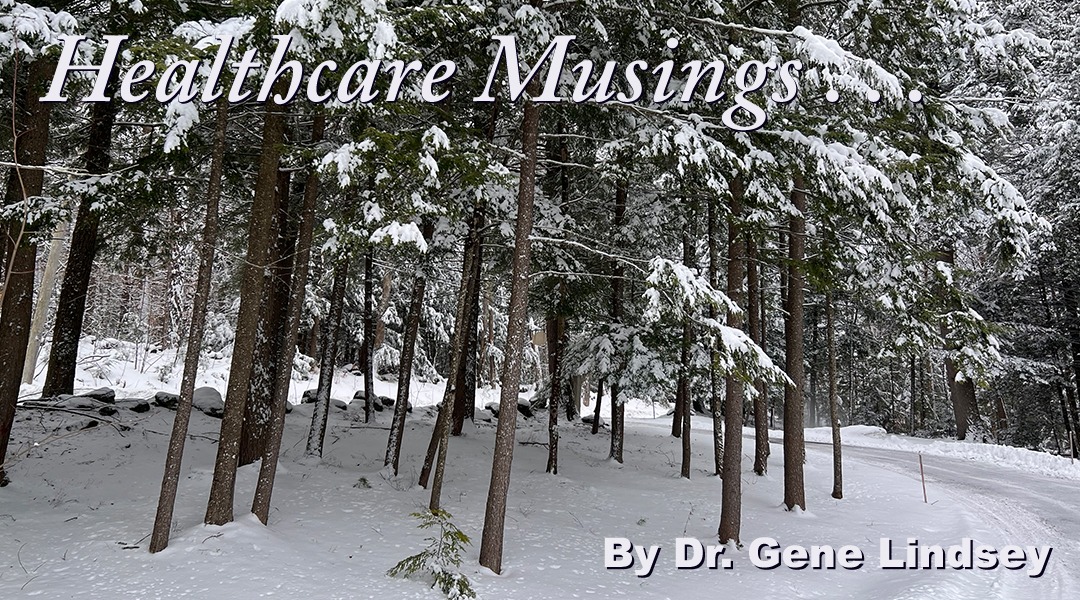
The header for today’s letter was taken as I headed out for a walk on Monday morning. We have had snow cover since early December, and we have gotten it the way I like it in doses of 1 to 4 inches, but never with a paralyzing “dump” of a foot or more. A little snow freshens up the scene like a new coat of paint.
The high temperature for Sunday will be four, and it won’t reach 20 degrees for more than a week. A real dump of snow is predicted to begin sometime late Sunday afternoon, about the time I hope that the Patriots will be polishing off the Broncos in Denver. We will see.
Wherever you are this weekend, and whatever you are doing, I hope that our biggest concern will be the weather, and not some bizarre statement or world-rattling action by our president.
Be well,
Gene