January 9, 2026
Dear Interested Readers,
In the Midst of Chaos We Can Focus On Community
Should we say that 2026 is off to a strange start? Our president is now “running” Venezuela. There is adventure on the high seas as we “capture” oil freighters with cargos of oil worth hundreds of millions of dollars, and we continue to blow up fast boats allegedly carrying drugs. The war in Ukraine that was supposed to end on January 22, 2025, continues. Life remains marginal in Gaza.
Here at home, there is significant disagreement between Robert Kennedy Jr.’s vaccine recommendations and those of prominent pediatricians and public health experts, even as we experience increases in measles and the flu. As of January 1, the cost of healthcare for most of us has gone up a lot. Everyone is about to realize that even the well-insured will see a large increase in their healthcare costs in 2026. Millions will find their health insurance from the ACA’s marketplace unaffordable as subsidies expire. Many American children will experience hunger as a daily reality as SNAP benefits shrink. Others will just be cold because of diminished funds for fuel subsidies. I fear we haven’t adequately anticipated the impact on care delivery, especially in rural and underserved urban communities, as shrinking populations of covered Americans threaten the financial health of many hospitals and practices that serve marginalized populations.
With so much happening to confuse us, things get even stranger as we learn of more “strategic” imperatives for our national defense, like adding Greenland as a jewel in the crown of our president. So much is happening; it is hard to maintain concern about the gilding of the White House and the construction of a ballroom that belongs in Las Vegas or Florida, not where there once was an appropriate public structure. JFK has been pushed to second billing at the national performance center named for him, as our showman-in-chief struts the stage and does awkward dances to prove he can be a better MC than Colbert or Kimmel. In this new world, a greasy haired second rate former weekend newsman turned political sycophant who likes to play soldier can seriously harass a distinguished retired combat pilot and astronaut who is a sitting US Senator because he said the truth. Things are strange these days.
Having our cities overrun by men carrying guns and wearing masks looking for people with tattoos and darker skin is something that once only a gifted writer could make seem plausible in a dystopian novel. Now we can see video on the evening news of ICE thugs killing a woman in Minnesota who is an American citizen without a doubt, and the mother of three small children. She died in a storm of gunfire after dropping a child off at school. Ironically, the grizzly scene was just a few blocks from where George Floyd was murdered in 2020. Perhaps all of these events, which would have been hard to believe before the riot at the Capitol five years ago, will distract us from the possibility that Congress has work to do if we are going to avoid another government shutdown toward the end of this month.
For the past few years, I have begun the year by being “on call” for one of the local non-profits where I donate some of my time and money. My phone has been ringing more than usual this first week of 2026. People are having their electricity cut off because they can’t pay their electric bills. No one seems to have received their fuel allotments from the agency that determines their federally funded subsidy. These CAP (community action program) allotments, small federally funded grants for fuel assistance administered at the state and county level to help poor people with bills for propane, heating oil, wood, and electricity, have been delayed as a function of the fact that the “One Big Beautiful Bill” has reduced the money given to states to administer the program. Simultaneously, the documentation required has increased. As a result, people are sitting in the cold. Wednesday, the temperature hit 33, the first time we have been above freezing since an ice storm put many people in the dark more than a week ago. As one of the strange realities of global warming, this winter has started colder, icier, and snowier than in recent winters. It has also started with greater uncertainty about the assistance to improve the Social Determinants of Health that the poor might expect from a government unconcerned about their well-being, focused instead on lowering taxes for the rich and pursuing the repressive agenda of Project 2025.
Over the past few years, I have handled the annual paperwork for one of our clients, who receives about $1,400 a month from Social Security Disability and $80 a month from SNAP. In past years, he has received about $1,500 in fuel assistance each winter to purchase propane for heating and cooking. His disability is secondary to brain damage from a cerebral aneurysm that ruptured about twenty years ago. He was in a coma at Dartmouth Hitchcock for 30 days and has had cognitive difficulties since then. I completed the usual application for him for fuel assistance in September. In October, CAP asked me for several additional documents that are now required, as things have changed in the aftermath of the “One Big Beautiful Bill.” To obtain all the additional documents required, we visited the Social Security Office in Concord and obtained a new statement from his propane provider regarding his use in 2024. I was told in early November that his application was complete. In years past, the allotments have been sent to the client’s usual fuel supplier by the first of December. Since his propane tank is low, I learned this week from his propane provider that they had not yet received his allotment. I called CAP to find out if his application was complete and why the distribution of funds had been delayed. After close to an hour of listening to annoying Muzak, I was connected to an agent who confirmed that the application was complete and in order, but had not been processed. I was advised that it would take another 3 or 4 weeks for the funds to be credited to his fuel provider. He is not the exception. Kearsarge Neighborhood Partners has a budget for fuel assistance, which I manage. We have already purchased propane, fuel oil, and kerosene (the more expensive heating fuel for mobile homes) for several clients who are still waiting for their CAP allotment. In fact, I personally know of only one CAP client so far who has gotten her allotment. She is a single mom with five children under ten who called CAP with threats of a rant on Facebook if she did not get her allotment.
I don’t know what is happening in other places, and the good news is that my community has a relatively small number of individuals and families who live in poverty. I shudder to think about the hardships faced by individuals in communities that don’t have the philanthropic spirit or financial means we do. More than twenty years ago leaders of the area’s churches realized that people would go from church to church asking for help, and decided to pool their resources to provide more effective support for the needy in the community by forming a “consortium” which they named Kearsarge Regional Ecumenical Ministries (KREM), since New Hampshire has a very tattered and antiquated welfare system left over from the nineteenth century that is town-based. We are the “Live Free or Die” state with no state income tax or sales tax. I was not living here then, but I applaud the foresight of the churches.
Not long after moving to New London, I became active in KREM as a representative of my church. It has been a rewarding and educational experience. KREM’s mission is to address financial emergencies. As you may know, 60% of American families live paycheck to paycheck and struggle to pay an unexpected $400 bill. It did not take long to realize that we were “rescuing” many of the same families again and again. The situation was very similar to what medical providers call “frequent flyers,” people who, by necessity, get most of their care in emergency rooms.
Several of us began to ask what might happen if we could form productive relationships to address the individual and collective issues in our community that resulted in the chronic needs of “frequent flyers.” About that time, we became aware of the concept of “Weavers,” initiated by David Brooks at the Aspen Institute. Brooks traveled the country identifying nonprofit community groups that came together to address many of the issues of poverty and the Social Determinants of Health in their communities. At the same time, several of us became aware of a community-based program called “Seeking Shalom,” produced by the Lupten Center and Focused Community Strategies in Atlanta. We studied the curriculum together. About the same time, Brooks published his book The Second Mountain: The Quest for a Moral Life (2019). The book is highly autobiographical and closely aligned with Brooks’ personal journey from great success to despair and back again. His thoughts about community, which inspired his “Weavers” work at the Aspen Institute, are well described in Part Five, which he entitled “Community.” I have referenced the book many times since I first wrote about it in June 2019.
Somewhere in the mix between “Seeking Shalom,” a perceived need for a way to address the chronic needs of many in our community, the realization that we also had personal needs that required a productive outlet, and advise we got from some source that has been lost in memory, we began to have meetings to explore what we could do to address the unmet needs in our community. We learned that successful efforts began with a period of “contemplation” before moving to “action.” The meetings were held in our living room, with often more than 20 participants. The meetings were “no guilt” no expectation exploration of ideas. Our timing was great; by the time COVID shut down our community in March 2020, we were ready to move from contemplation to action. Kearsarge Neighborhood Partners (KNP) was launched into a community with old needs and new challenges from the pandemic. Now, after over five years, the work is more diversified. We counsel individuals. We financially support the efforts of other like-minded organizations. We host conferences, like “Bridges Out of Poverty,” which attracted more than 200 concerned neighbors last fall. We buy fuel for people who have exhausted their CAP allotment or have not yet received it. We have given away more than 20 cars to families without the means to get to work, the grocery store, or one of our food pantries. It is hard to live in a small town or rural setting without a car. We deliver food from the food pantry to those who are disabled and can’t get out. We provide rides to those with appointments who have no transportation. In the summer, we cut grass for neighbors who are disabled. In the winter, we remove snow. We accept wood from donors and buy wood, which we then deliver on request to those who need it as their only source of heat, or to augment their fuel use to save money. Our goal is to do for our neighbors what they can’t do for themselves.
There have been some big wins, like helping a family get tax refunds and the veterans’ benefits they were due. They no longer live in a camper. They are now homeowners and have a small business doing cleaning and small carpentry jobs. Our goal is to only do what a neighbor can’t do for themselves. Confidentiality is a priority. There is no judgment. Many of those who have received help have become volunteers to offer help for others. We are a vital part of our community, helping where needed and advocating for what needs to be done. Because of gifts to us, we are able to support other organizations in pursuing their missions and goals. Now there are more than 100 volunteers providing thousands of hours of support to “neighbors.” Our interests and efforts have continued to expand. One benefit for our volunteers is the camaraderie they experience working together, helping neighbors, participating in planning and communication committees, and gathering frequently for social functions to celebrate the work we do. We are not “bowling alone.”
We have a HIPAA-compliant record and communication system that tracks our work and notifies volunteers of opportunities they can choose to do. Every volunteer has security clearance. We have two part-time staff members who function as internal and external coordinators.
What has been most important to me is that I feel that I am working in my community to improve the Social Determinants of Health, which is the best way to address the angst generated by dysfunction in Washington and the concerns about the future of our democracy and the health of the nation. I have found my “second mountain.” I believe that anyone who cares about our collective future can protest the current injustices, but I also believe there is more satisfaction and perhaps more benefit in finding ways to mitigate those injustices for your neighbors while we wait for elections that might begin the repair of our country in ways that can return it to the path toward greatness from which it has recently taken a wrong turn. It is a personal blessing to work with others to find a way to make a difference in someone’s life, a neighbor’s life in your community.
I hope that sometime in the next few years, some sort of miracle will occur and the nation will heal. Organizing to help our neighbors feels to me like a way to move closer and sooner to that moment of new hope. I believe that the deep divide in our nation that is so obvious to all, and seems to be of short-term benefit for some, will pass. I never imagined that a conservative like Liz Cheney and I could agree on much, but I share her belief that:
“To my Republican colleagues who are defending the indefensible: There will come a day when Donald Trump is gone, but your dishonor will remain”.
On the other side of the ledger, I do believe their will be honor and a sense of satisfaction for those who help their neighbors survive these difficult times and help us get back on the road toward our lofty foundng principle of everyone’s right to pursue happiness, and I would add health. The next election is still ten months away, and even if the Democrats take back the House, it will only be the first step on a long road of national recovery. My suggestion, based on personal experience, is that a good way to spend time while waiting for better days to come is for you to reach out to others in your community and begin exploring ways to improve the lives of those near you who might need your care. I can report from personal experience that it will temporarily distract you from the angst coming from our uncertain world while it provides benefit to you and those you help. As a bonus, you will gain much joy from the relationships that will evolve as you weave with others to seek shalom in your community. The lives that you improve will include your own.
Late Addendum:
After completing my revisions to this letter this morning, I did what I do on most Friday mornings. I went to the New York Times opinion section, hoping that David Brooks had posted yet another wise essay suggesting how we might survive these difficult days. I was not disappointed. I am not going to annotate his entire column with my own “amens,” but I will add a couple of comments, and I do suggest that you take a few minutes to review his offering and advice. His piece is entitled, “The Sins of the Moderates.” It was posted at an unexpected time of 5:02 AM this morning, so it is very fresh advice.
In the article, Brooks suggests reading George Packer’s latest novel about an ethical physician in a difficult place at a difficult time. I am ordering my copy now. He also quoted Reinhold Niebuhr, a well-known mid-twentieth-century theologian who blended his theology with concepts of community. I am also ordering Niebuhr’s book, which is more than 70 years old.
The gist of the article, in case you don’t read it, is that as “norm ” respecting liberals, we are ill-equipped to engage with the raw forces that confront us coming from the authoritarians who have seized control of our world and don’t respect the order that evolved between 1945 and the end of the twentieth century. We are too passive and a little too concerned about our own situation in a time of social unraveling. I will give you the last couple of paragraphs that seem to me to call for a deep passion in our efforts to combat the deterioration we see in “community” around us. Brooks writes:
Outrage over these trends should cause moderates to be immoderate. It should generate what Niebuhr called, in another work, “a sublime madness in the soul” — the kind of madness that arises from a fervent commitment to liberal ideas and institutions that constitute the decent drapery of a civilized life. “Nothing but such madness will do battle with malignant power and ‘spiritual wickedness in high places,’” he wrote.
Mankind has been able to reconstitute new social orders after periods of savagery — after the 17th-century wars of religion, after the 20th-century world wars. Now that task lies before us again, and everybody who is active in community and public life has a role.
I bolded those last few words because my self-criticism of today’s letter is that it lacks the passion for preservation of values that Niebuhr and Brooks advocate. We must be as passionate in our efforts to preserve community as the darker forces around us are in their efforts to undermine the social norms and respect for human rights that seem so virtuous and productive to us. We must be aggressively positive as “children of light” (Niebuhr’s term) as we face the destructive aggressiveness, like ICE’s shooting of the innocent mother in Minneapolis, which is the manifestation of the “children of darkness.” We must realize that we are in a conflict, and a vigorous and spirited defense begins in the communities where we live.
Heat Wave
Our long period of sub-freezing weather is temporarily over. We hit 34 on Wednesday, 38 yesterday, and the weather forecast for today suggests that it will be near 40 by the time this letter hits your inbox. We are into a typical “January thaw.” Winter is far from over, and it will take weeks of temperatures that top 50 before the two feet of ice on the lake melts, but I can walk without putting on long johns, double gloves, and two layers of jackets. The January thaw just lets us warm up temporarily before the next round of ice and snow.
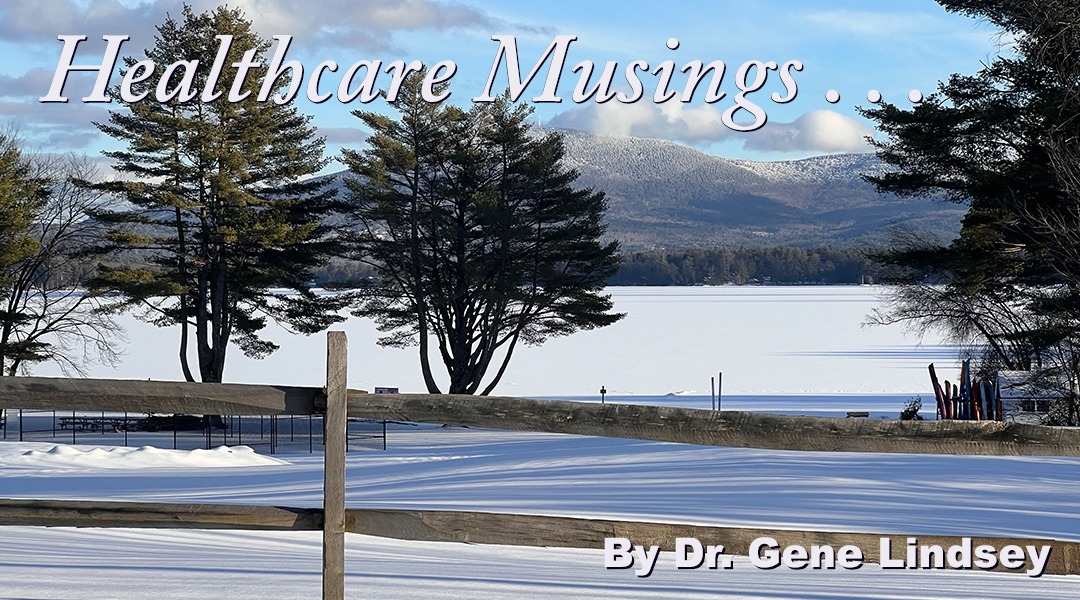
The picture that I have used for the header for this letter is taken from the other side of my town, just in front of the Inn at Pleasant Lake, which is a great place to have a wedding or a romantic gourmet meal that costs more than it would take to feed a family of four for more than a week. In the picture, we are looking down the length of the lake at Mount Kearsarge, which gives our region its name.
As I reported in a letter a few years ago, Kearsarge is the mountain in the old standard “When the Moon Comes Over the Mountain,” which was Kate Smith’s trademark song. Kate Smith often sang “God Bless America” for the Philadelphia Flyers hockey team, and is reportedly “the fat lady” who inspired the saying, “It ain’t over till the fat lady sings.” My wife and I were enjoying an evening cruise on Pleasant Lake a few years ago with friends in a restored antique (1910) electric boat, on a lovely August evening, when a full moon peeked over Mt. Kearsarge. Our friend then boasted that the same scene was the inspiration for “When the Moon Comes Over the Mountain.” I checked it out, and he was right. If you ask Google AI about the song, it says:
“When the Moon Comes Over the Mountain,” co-written by Harry Woods, was inspired by the view of Mount Kearsarge from New London, New Hampshire.
The song, published in 1931 and famous as singer Kate Smith’s signature tune, is a direct result of the view from the New London area. Local lore, supported by historical accounts, indicates that the vista of the full moon rising over Mount Kearsarge (sometimes spelled “Kearsage” or “Kersarge” locally) was the specific inspiration for the lyrics and title.
One account describes Kate Smith visiting a home in the town around 1930 and seeing the vista from right outside, which prompted the song’s creation. The town of New London, situated between Mount Kearsarge and Lake Sunapee, is known for this specific scenic view.
Thinking about that August moon coming over the mountain adds a little warmth to an otherwise cold day. It is a beautiful view at any time of the year. In my healthier days, I would walk around the lake with a friend. It is a nice six-mile stroll. There are also great hiking trails along the brook that feeds the lake.
Whether it is warm or cold, a weekend walk around a lake, on a trail in the woods, or just down a country road would be a good warm-up for the first playoff game of the revitalized New England Patriots, which will keep many people up on Sunday night. I hope that whatever you have planned for the weekend includes a little time outdoors.
Be well,
Gene