November 28, 2025
Dear Interested Readers,
Thoughts at Thanksgiving About Nursing and All That I Am Thankful for and Concerned About in Our Fragile System of Care
I have much for which to be thankful. Today, my belly is still a little stretched from the fabulous meal we shared yesterday with my oldest and youngest sons and their families. Three of my five grandchildren were present to remind me that, for a little while anyway, there will be people on the planet who I hope will remember me fondly when I’m gone. One of those three grandchildren won’t be born until next May. I am told that we are expecting another grandson.
It boggles my mind to think that if these grandchildren live until they are my age, it will be well into the 22nd Century. If somehow in a few years we recover from our president’s attack on healthcare, through the cruel and misdirected efforts of his administration to Make America Great Again and if through his overall approach to undermining the norms of our society, we don’t experience a slide back into a second “Dark Ages” as occurred after the fall of Rome because of its own international cruelty and decadence, it is possible that by 2100 our national life expectancy could be more than 100 years. If that is the case, all of my grandchildren and yours have a real possibility of becoming centurians. That should make us all thankful and motivate us to resist any further decline in our collective national health. Then again, if MAGA remains the dominant political philosophy for the next few decades, they may have shortened our collective life expectancy to that of a third-world country where people die in their fifties and sixties, as was the fate of one of my grandfathers, who was born in 1889, or worse, like my one of my grandmothers who had several siblilings die of childhood diphtheria and rheumatic heart disease that we can now prevent with vaccinations and antibiotics. Who knows, we may be on track to have large numbers of children join the workforce, as another grandfather did when he went to work in a South Carolina textile mill at age 9.
I am thankful that so many people are engaged in resisting the decline of our democracy and of our science. I am especially grateful for the several million healthcare professionals who keep our frequently torpedoed ship of healthcare afloat amid the constant attacks of those who consider health a commodity purchasable only by those who can afford it, and don’t see it as a human right or, at a minimum, as a collective national competitive benefit.
This week, I learned of yet another senseless attack by the current administration on healthcare and some of its most essential and critical professionals. My wife, who was a dedicated ICU nurse, cath lab nurse, and family liaison for patients having cardiac surgery at the Brigham, and eventually a nurse practitioner in a program that cared for our military veterans with congestive heart failure at the West Roxbury VA Hospital in Boston, told me, to my surprise, that as a result of the One Big Beautiful Bill and the Trump administration’s efforts to do away with the Department of Education, Nursing and other health care professions have lost their classification as “professions”, which will result in drastic cuts in the money available for professional educational loans and “forgiveness” programs at a time when we despritely need more nurses.
Renée Graham, who writes an op ed column in the Boston Globe, explains the problem in an article entitled “Trump administration wants to downgrade the professional status of nursing graduate programs: An Education Department change could limit loan access for potential nursing grad students.”
She begins her column with her mother’s end-of-life experience and the role she observed nurses playing in her mother’s care.
During my mother’s hospital stays in the last year of her life, I would arrive when visiting hours began and stay until they ended. Throughout those long days, a doctor never once entered her room.
But the nurses were never far away.
It was the nurses who did everything to take care of my mother. They even found time to offer me solace when I felt overwhelmed by what inevitably lay ahead.
Anyone who has spent time in a hospital, either as a patient or a visitor, knows that nurses are as professional as they are critical. But the Trump administration wants to change that.
Add nursing to the list of concerns where our bombastic president just doesn’t “get it.”
In President Trump’s oxymoronically named “One Big Beautiful Bill’’ is a proposal for the Department of Education to strip nursing — and a host of other professions — of professional degree status.
That would limit how much graduate students in nursing could get in student loans and cut off access to loan forgiveness programs, raising fears that these changes could deter people from entering a field that’s already suffering shortages.
Like Ms. Graham and my wife, I was flabbergasted when I learned of this senseless evolving “MAGA” strategy. Does the president not realize that we need to attract more, not fewer, intelligent and empathetic candidates to nursing and other healthcare professions, such as physical therapists, social workers, audiologists, nurse practitioners, and physician assistants?
Ms. Graham quotes Katie Murphy, who is the president of the Massachusetts Nurses Association.”
“This is a profession where people are not coming from wealth, and we need to be able to obtain loans to further our education…People need to tap into loans…So this is really concerning.’’
Graham goes on to explain that unless a degree program is designated to be for “professional training,” a student’s ability to get loans is cut by more than half from $50,000 a year to $20,500 a year. Currently, the overall limit is $200,000, but after “professional” status is lost, it will be $100,000.
Graham points out that becoming a nurse is an attractive path out of poverty for many young people from economically disadvantaged families. The Massachusetts Nurses Association Board of Directors issued a statement saying:
“…reclassification is not a technical adjustment. Rather it is a direct attack on the healthcare workforce and the future of patient care.
To arbitrarily strip professional status from nursing and healthcare professional degrees is an insult to every person who delivers lifesaving care and a blow to the healthcare system that depends on us…’’
Graham again quotes Murphy, who has been a nurse for over 50 years and works as a critical care nurse at the Brigham in Boston, as she explains how the move will hurt patients as well as the nursing profession:
“We’re trying to attract more and more people and we’re trying to attract a more diverse complement of people that are entering this profession,’’ Murphy said. She also mentioned that since patients have better health outcomes when they have a cultural bond with their health provider, “we need to have access to these federal loans.’’
Perhaps the president does not understand the critical role of nursing in delivering high-quality, cost-effective healthcare. Does he not know that nurses do much more than change bandages and help elderly patients with their toileting needs? Does he realize that Nurse Practitioners and Physician Assistants provide much of the nation’s primary care, and that certified nurse anesthetists are critical to surgery? He may not know that the roles played by non-physician medical professionals are even more necessary in rural and small-town America, where many MAGA supporters live and get their healthcare. Graham even wonders if he is unaware that on May 6, National Nurses Day, his White House issued a proclamation that read:
“…nurses reflect the character of America and epitomize the inexhaustible capacity of the human spirit.’’
I can’t imagine my own healthcare without nurses and other “non-physician” providers of healthcare. During several recent hospitalizations, I rarely saw “the doctor.” I saw thoughtful, responsive nurses, NPs, and PAs. Much of my pre-op and post-op care during three significant operations was provided by NPs and PAs. I assume that the doctor was there when I was under anesthesia.
Many of the excellent nurses who provided care for me were traveling nurses. Rural hospitals are highly dependent on this costly source of nursing professionals due to the severe nursing shortage we now face and the difficulty of attracting young professionals from urban environments. The current nursing shortage adds tens of millions of dollars to the cost structure of rural and small-town hospitals. I served for over ten years on the board of The Guthrie Clinic, an excellent health care system with six hospitals and numerous outpatient facilities, serving the small towns and cities in the southern tier of central New York and the northern tier of central Pennsylvania. I saw firsthand the millions of dollars in increased costs added to the system’s budget as we searched for enough nurses to staff the clinics and hospitals of this critical system of care in communities that I assume voted in significant majorities for President Trump. Because of my experience at Guthrie, I am concerned that the challenge of finding enough nurses to staff the system adequately will become much greater in the years following the implementation of this foolhardy and disastrous policy by this misdirected administration.
I get much of my primary care from an NP. The idea that these healthcare professionals aren’t professionals is an enigma to me. I view the whole concept as another example of how fragile what we have developed over the last eighty years is to the Dunning-Kruger effect, a cognitive bias held by many people who are not as gifted as they think they are. These people don’t know what they don’t know, or they overestimate their own abilities. The flip side is that most gifted people underestimate their abilities. Unfortunately, we get an almost daily demonstration of the combination of Trump’s narcissistic sociopathy and his overestimation of his own abilities. What is sad is that he probably doesn’t even realize or care about the damage he is doing to patient care, the future of medical science, and the nation’s future health.
During this Thanksgiving season, I am thankful for those who built the system of care that we have, even though there is still much that needs improvement. I am also very grateful for those who are resisting further losses and those who are doing their best working in a system of care that seems to be challenged even more with each passing day or unveiled MAGA policy.
I Have No Interest in Black Friday and Cyber Monday
I can’t imagine anything less appealing to me than joining the frenzy of bargain hunting on the day after Thanksgiving. I do understand that much of our economy depends on consumer purchases, that much of our consumer spending occurs during the holidays, and that much of the holiday spending happens on either Black Friday or Cyber Monday. Back when I was a dad, trying to make sure Christmas wishes were fulfilled, I did most of my shopping in the last few days before Christmas. The origin of the frenzy I experienced was more from concern that, at the last minute, shelves would be empty, and I would not fulfill a son’s wish than that I would fail to get a bargain.
I feel that the large majority of Americans don’t really know how thankful we should be for what the previous generations have bequeathed us. We don’t have an abundance problem. There is more than enough strength in our economy to positively address the social determinants of health for everyone. What we have is a distribution problem. More than sixty years ago, Dr. Martin Luther King, Jr said:
“There is nothing new about poverty. What is new, however, is that we now have the resources to get rid of it”.
A real “One Big Beautiful Bill” would be a piece of legislation that abolished poverty and ensured that everyone had adequate food, shelter, healthcare, transportation, access to education, and the opportunity for meaningful employment. I am hopeful that someday that bill will be passed and our distribution problem will be solved. I am thankful for those trying to achieve that goal, even if their daily progress is now measured by losses they have prevented rather than progress toward the goal.
This year, in our personal abundance and as a reflection of our declining stamina, my wife and I have elected to bring in our Thanksgiving dinner for ourselves and visiting family. The choice was driven in part by our guests’ diverse dietary preferences and tolerances. The meal, in all its variations, was ordered by my wife from the New London Inn, which has been feeding people and sitting just off our town green since 1798.
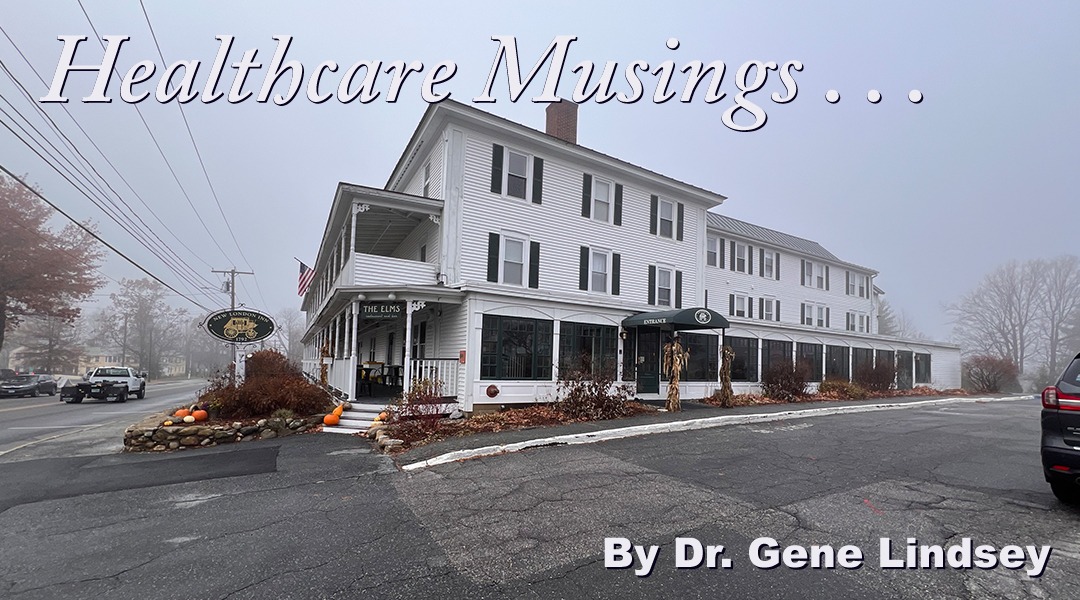
We were told to pick up the meal midday on Wednesday. Wednesday was a very foggy day in New London, New Hampshire. I could not see very far into the fog over the lake. As we drove away from the lake into town to get our food, the fog seemed to increase. Today’s header is not a very imposing picture of the New London Inn because of the fog, but fog is better than snow or heavy rain for all the travelers on the road during the holiday season.
Wherever you are, and whatever your holiday weather, I hope that you will enjoy a very pleasant weekend with family and or friends.
Be well,
Gene