November 13, 2026
Dear Interested Readers,
Affordability, Accountability, Empathy
In the aftermath of last week’s election, pundits and politicians have filled Sunday morning news programs, podcasts, and the print and Internet avenues of journalism with speculation about what Democrats will do with their huge majorities in Congress and their capture of both legislative and executive control of many state governments. The analysis seems to be what can Congress do to lower costs now in immediate response to the “affordability” issue which was fundamental to their victory, and should those efforts compete for time and attention with the hearings and actions required to hold the Trump administration “accountable” for their various “high crimes and misdemeanors.”
Some seem to imply that both efforts are complementary, and others suggest that without focus and a unitary vision of how to use their vision, Democrats will waste their opportunity to lead through a combination of weak leadership and infighting over objectives between factions on the far left and those whose alignment on issues is more representative of the slightly center-right majority of the nation. This coming together toward the “middle,” the restraint to minimize cultural issues that create division, and the president’s profound ineptitude, lack of empathy, and abuse of office produced the opportunity that now challenges Democrats.
My reading of the various opinions is that one of the greatest sources of ambiguity as to what might happen over the next two years and further into the 2028 elections is whether or not Democrats will continue to restrain themselves from a focus on divisive cultural issues and, through some strategy or exercise of good judgment, stay aligned on a unifying effort to improve “affordability,” including universal affordable healthcare for all Americans, while judiciously pursuing hearings and actions that hold Trump and his underlings accountable for their corruption.
Beyond addressing the energy costs created by the ill-advised and possibly illegal war with Iran and taking steps to minimize the impact of the tariffs, the one step that can most quickly improve affordability is to reduce what people are now being asked to pay for their healthcare. It is good to remember that “charges” and “costs” are not the same thing. We do need to reduce the actual cost of healthcare by redesigning our system of care, but that would require a president who is engaged in the effort, plus even larger majorities in Congress or the elimination of the filibuster. Even though designing and passing what might follow the ACA could take several more elections and years, we can, using the strength of the government, quickly find ways to reduce what is charged for that care. The now-extinct subsidies to the ACA marketplace are the perfect example of reducing the charge people pay for coverage even before the hard work of reducing the cost of care is initiated.
The Democrats who were elected last week seem to share a consensus that, even before a major overhaul of our healthcare, something must be done to restore the coverage lost by millions due to the failure to renew support for the ACA marketplace and the cuts to Medicaid scheduled to take effect under the One Big Beautiful Bill (OBBB) after January 1, 2027. As concerning as those issues are for specific disadvantaged populations, more and more of us who pay a portion of our coverage are beginning to realize that the affordability issue of healthcare impacts everyone. Now we are in the period of the year when even middle-class consumers with employer-sponsored healthcare are receiving notices of shocking increases in their personal healthcare costs.
I hope that the new Democratic majorities will immediately begin their work to improve “affordability” with the ultimate goal of universal affordable care for everyone delivered by a more efficient system of care, but interim steps to make care affordable are needed now. I realize that what may be affordable for me may not be affordable for someone living paycheck to paycheck or already struggling to pay their rent, so ultimately a sliding scale of public support makes sense. Right now, efforts should be directed to improve affordability for those most in need. Medicare now has variable charges based on income. Those with higher incomes pay more through the Income-Related Monthly Adjustment Amount (IRMAA), a surcharge added to standard monthly premiums. Congress should begin by helping those most in need with direct subsidies, and expansion of those covered by Medicaid, plus taking advantage of much that can be done to reduce the cost of care at the margins, as discussed in last week’s letter referencing the work of Professor Zack Cooper at Yale; greater affordability for many can be achieved soon.
One of the things that puzzled me when I was trying to lead my organization’s efforts to lower the cost of care was how few of our commercially insured patients and our providers focused on, or seemed to care about, the overall cost of care. For patients, my best explanation for the observation at the time was that most of our patients had robust employer-financed insurance, in which the direct cost to them did not affect what an economist might call their “marginal propensity to consume.” The concept, as I learned it more than sixty years ago in a college economics course, was that as prices for necessities rise, the money you must spend on basic necessities of life reduces your ability to save or spend on the pleasures of life like a vacation. In terms of income, a cost increase is a significant challenge for those living paycheck to paycheck and less of a concern for those with some economic security. As affordability of necessities has declined and the cost of care has increased, more and more middle-class consumers are moving from being economically secure to finding it harder to make ends meet and even harder to save, compared to 2013, when I retired. Said explicitly, more people have recently and abruptly been awakened to the reality that access to care they have enjoyed has become so personally expensive that it is finally eroding their lifestyles and impacting their economic security.
The rising economic burden of healthcare costs is evident across all age groups. Younger adult Americans trying to establish careers see healthcare costs and other affordability issues forcing them to realize they may never own a home. Older Americans in or approaching retirement are looking at the need to work longer or give up many of the hopes they had for a satisfying retirement. Perhaps the group most significantly impacted by the affordability issue in general, and by the healthcare-driven component of those increases, is the very young. We owe the young who will implement our collective future a good education. I benefited greatly from the willingness of my community and state to provide publicly funded, accessible, high-quality education. I benefited even more from federal financial assistance when in medical school.
The fear of raising property taxes or taxes in general by adequately supporting education with public funding darkens the future for generations to come and those who selfishly and unwisely resist paying for education now. From an egocentric or selfish point of view, we are making a collective error of huge proportions. If you are in your 30s or 40s, you would be wise to realize that someone who is in a poor and underfunded school system now may in the future be your doctor, nurse, lawyer, or the scientist who could make a discovery that will lengthen your life, or an engineer who could design a product that will be of great benefit to you and all of us. Depending on decisions about funding education and healthcare, things could be much better in ten or twenty years, or worse. Not investing in education now is one of the most efficient ways to compromise the social determinants of health in the very near future.
A few paragraphs earlier, I wrote: “One of the things that puzzled me most when I was trying to lead my organization’s efforts to lower the cost of care was how few patients and providers focused on, or seemed to care about, the overall cost of care.” Now that I have partially explained why I think large segments of the population have not been measurably concerned about the affordability of healthcare until now, I should not forget the apathy toward healthcare costs among many providers, both within and outside my practice.
I started writing this letter in late February 2008. We were in the run-up to the presidential election, and soon-to-be-elected Barack Obama was making access to care, the denial of care because of a preexisting condition, and the overall cost of care prominent issues in his campaign. I was hopeful for his success, and indeed hope was a major theme of his campaign. I was also aware that the recent success of expanding access to care in Massachusetts had done nothing to lower the cost of care. I was convinced by others, including Don Berwick, a former colleague, that providers play a central role in lowering healthcare costs. I soon discovered that many physicians understood that unnecessary testing, medications like antibiotics for a viral illness, and the unnecessary use of more expensive emergency services when an office visit would have been better care all added to the cost of care. I was disappointed to discover that even though they were aware that how they practiced added unnecessary expense to the cost of care, they were not motivated to join the work of lowering the cost of care because it would require them to change how they practiced.
In an effort to convince my colleagues that they needed to lead the effort to lower our costs, and that our costs could not come down if we did not change, I latched onto the concept, promoted by Dr. Ed Murphy, CEO of Carilion Clinic in Virginia, that the biggest factor in the cost of care was “the doctor’s pen.” The response I got from many of my colleagues was that they were too busy practicing amid operational insufficiencies or reluctant to invest the time to have conversations with patients explaining why the drug, test, or procedure the patient wanted would add no value. On more than one occasion, I heard that lowering the cost of care was not their responsibility. Their job was to practice, and they valued their clinical autonomy over efforts to discern “best practices” or disappoint patients by not bowing to requests even if fulfilling the request would unnecessarily add to the cost of care.
My colleagues were salaried and, secondarily, vulnerable to our financial success, but that did little to get them involved in the work needed to reduce our costs. Doctors in private practice are like small businesses where anything they do or order can be a source of revenue. Because of financial self-interest in a fee-for-service system, doctors in private practice often see little benefit and lack financial incentives to participate in programs that might lower healthcare costs.
So, we are now arriving at the destination of the road that we have been traveling. The cost of care for those who “are satisfied” with their care is going up enough to get their attention. The pain of healthcare’s costs is now touching patients and providers in ways they haven’t experienced before. Even those like me who have financially been able to accept rising costs with a sense of inevitability one feels with an approaching “nor’easter” are now asking themselves how much more they can take. I hope that upward spread of financial pain will finally motivate efforts to practice in ways that lower the cost of care.
My wife and I enjoy Federal Retirees’ Blue Cross coverage because she worked as a cardiac nurse practitioner at the West Roxbury VA Hospital for the last eight years of her career. We like our coverage, for which we currently pay about $890 a month, but our premium for this coming year is going up by an additional $1014.24 a year. Those numbers don’t tell the whole story because the deductibles and other expenses buried in the overall costs are also going up. The annual deductible for us is increasing from $12,000 to $14,000. Other charges are also increasing. Do the math: in one year our costs are increasing over 15%.
Our experience is not unique. The cost of insurance for the ministers, support staff, and their families at my church, where I am the moderator, is also going up by 15%. The cost for our town’s employees and the teachers in our school district will also increase. Will the increase in premiums be paid by the employees or by the town and school district? It is political suicide in New Hampshire to advocate for the need to raise taxes. It is hard to reduce salaries. Increased healthcare costs will mean that class sizes in our schools will increase or some other mission-critical activity will be cut.
Many individuals and families in our town will experience similar increases in the cost of their care this year. The cost of their care will either reduce the wage increases their employers can offer or, if they are business owners, reduce their business income. The shoppers at our local businesses, like restaurants and the nearby ski slopes, or our charities that depend on donations nearby, may discover that increased healthcare costs have, in turn, created new financial challenges that are spreading like a virus. Increasing healthcare costs compromise all aspects of our economy.
When I was a healthcare CEO in Massachusetts, I would give speeches about the necessity of doing the work to lower the cost of care. I knew the work would not be easy, even though every legislative session brought a new bill from the state house aimed at reducing the cost of care. I had two lines that I used in my speeches that didn’t seem to have the impact that I desired. The first was, “We live in the most expensive healthcare environment in the universe.”
Indeed, healthcare in America was and is the most expensive of any country in the world, and Massachusetts had the most expensive care of any state in America. I expanded the concept to the universe because I doubted the existence of extraterrestrial life, and if there are more advanced life forms out there, they surely also have more efficient healthcare.
My other comment was that the citizens of our state were crying for relief and help from the state’s medical providers, using the state legislature as a megaphone. Between 2005 and 2012, there was a new state law introduced every legislative session to lower the cost of care. The effort was laudable, but the result was disappointing. A front-page article in the Boston Globe this week was testimony to the failure of those efforts. The article was entitled “Healthcare Premiums Climb 38% Since ’19.” If you read the article, you will learn that the 38% figure was just the increase from 2019 to 2025. The cost of health insurance for an “average” family in Massachusetts reached $30,000 last year. That’s an average. For 10% of families, 2025 costs exceeded $41,000, and healthcare costs exceeded housing costs in Western Massachusetts.
I find insights in history. Over almost 19 years of writing these letters, I have frequently referenced the long history of efforts to improve the nation’s health, dating back at least to Teddy Roosevelt and the Progressive Era, a reaction to a previous “Gilded Age.” One of the references that has taught me the most is a wonderful book published in 2009 by Dr. David Rosenthal and Professor James Morone, The Heart of Power: Health and Politics in the Oval Office. On other occasions, I have referenced The Social Transformation of American Medicine: The Rise of a Sovereign Profession and the Making of a Vast Industry, written by Princeton Professor Paul Starr in 1982. One of my favorite references is the very insightful 2017 book by Dr. Elisabeth Rosenthal, An American Sickness: How Healthcare Became Big Business and How You Can Take It Back. Also included in past letters when it first came out were insights from America’s Bitter Pill: Money, Politics, Backroom Deals, and the Fight to Fix Our Broken Healthcare System by Steven Brill. To my delight, I recently discovered that these four references were the essential sources for a terrific program on the NPR podcast “Throughline.”
The program was originally aired in 2020, and I did not hear it then. It was recently rebroadcast, and I recommend it to anyone who wants a deeper understanding of how our complex and dysfunctional system of care has evolved. It highlights the resistance of physicians, the healthcare industry, and special interests like labor unions to improving care and controlling its costs. It is a reality that if we are going to succeed in the future, we must build that success on knowledge of how we failed in the past. The program is an excellent primer for the work that must be done if we care about the health of every American. Of interest to me was that the program includes interviews with Professors Morone and Starr that are worth hearing. I recommend it to you as a worthwhile investment of your time.
To my delight, yesterday I discovered that “Throughline” has added more to the story this week in a 32-minute segment titled “Origins of the Affordable Care Act.” What it reveals is yet another moment when the defeat of the quest for universal coverage was “snatched from the jaws of victory.” The podcast describes how Ted Kennedy and Richard Nixon, in the shadow of the Watergate scandal, came surprisingly close in 1974 to producing something even more progressive than the ACA. Kennedy reportedly grieved the failure for the rest of his life. This history is further evidence that the road ahead to universal access to care is, and always has been, a rocky and perilous one, with the status quo waiting to ambush the effort. “Throughline” borrowed the segment from another podcast. In the introduction, they write:
Today on the show, we have a story about healthcare from our friends over at GBH News. Mitt and Ted, hosted by Ian Coss, tells the story of how Mitt Romney and Ted Kennedy began their political careers on very different sides of the healthcare debate, but for a short while, worked together to pass a law that provided healthcare to everyone in Massachusetts. Their work eventually paved the way for what became the Affordable Care Act. We bring you Part One of their series, which takes us all the way back to the Nixon era.
To the concerns about affordability and accountability, I would like to add the reality of empathy as the most important source of energy for the work to be done. If our attempts to improve affordability are driven only by self-interest, or if our desire for accountability is only a desire for revenge against those who have harmed us, then my guess is that our problems will go unsolved and our misery will persist and grow as our society undergoes further, inevitable decline. In his 2020 book, Healing Politics: A Doctor’s Journey into the Heart of Our Political Epidemic, Senator-elect Dr. Abdul El-Sayed postulated that an epidemic of uncertainty is a root cause of our political divisions. He went on to build a case for political policies founded on empathy as the only likely solution to the mess we are experiencing. I agree. Back 60 years ago in the mid-sixties, Dr. King announced, “Of all the forms of inequality, injustice in health is the most shocking and the most inhuman because it often results in physical death.” [1, 2] He also asserted that, even then, back in the mid-sixties, as a nation we had more than enough wealth to abolish poverty, but we haven’t. Is our failure a manifestation of a lack of empathy for our neighbors?
Hubert Humphry, a warrior for progressive policies, was driven by a deep empathy for all his neighbors. On the wall of the building that houses our Department of Health and Human Services, named for him, a quote from one of his speeches is carved on a wall near the entrance. Vice President Humphrey said: “The moral test of government is how that government treats those who are in the dawn of life, the children; those who are in the twilight of life, the elderly; and those who are in the shadows of life, the sick, the needy, and the handicapped.” [1]
To me, that quote is aligned with this moment. It sounds to me like a quote that calls for empathy. I believe that most of the recently elected Democratic senators referenced the need for greater empathy in our public policy to improve affordability and the lives of every American. Some didn’t use the word, but the intent was there. I also believe that without empathy, we will bend to the self-interests of the moment and fail to protect our future. Trump could never make America great with his hateful and self-interested policies, but America can become even greater than it once was before Trump capitalized on our divisions for his own benefit. To regain lost greatness and become greater through a renewed pursuit of our founding objectives, America needs to pursue affordability by including every American, implementing policies grounded in the empathy necessary to extend ourselves for the benefit of all our “neighbors.” The importance of empathy was explicitly stated or implicitly implied by so many of the new leaders elected last Tuesday.
To ensure that we never again go down a path that threatens our Constitution and the rule of law, our empathy must be combined with a fair but determined process of accountability which is likely to reveal evidence that points to the rampant pursuit of self-interest that has undermined the progress we have painfully made over the last 250 years. The road ahead will not be easy, but I am full of hope that the journey toward a healthier America has begun.
I’m Happy In The Late Afternoon Light
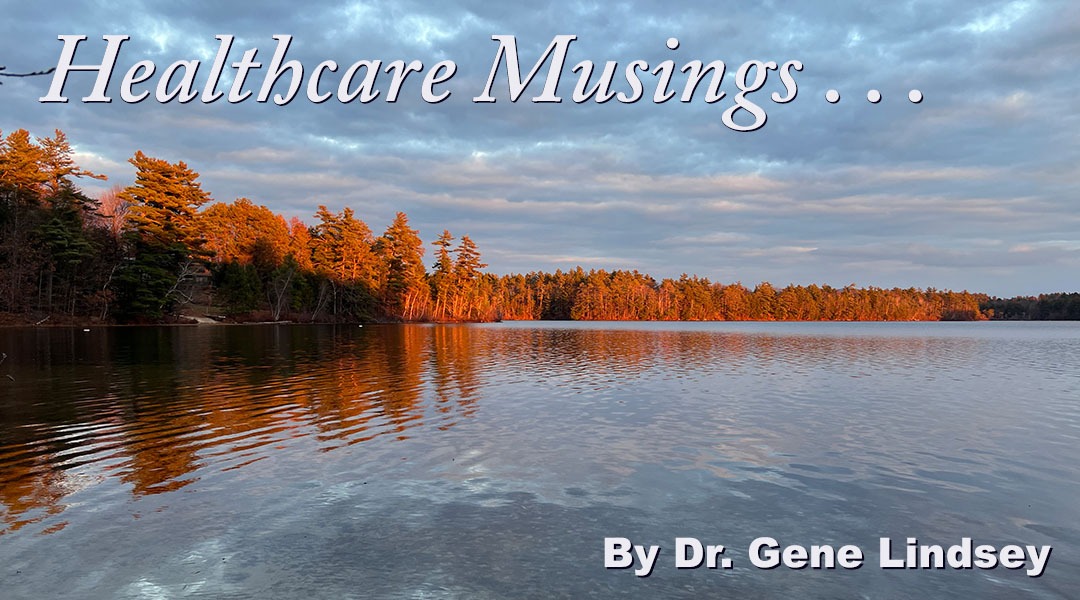
The weather here has been damp and chilly for most of the week. On Tuesday afternoon, I began my walk under a heavy cloud cover, but to my surprise, as I continued, the sky began to clear. This time of year, in the hour before sunset, the sun is low, and light seems to stream in horizontally under the cloud cover from the side rather than from a vertical position above. As I rounded a corner about a mile and a half away, I could see the lake through the woods that lay between me and it. This spot is where I sometimes stop because a wide path or an old narrow road runs through the white pines and beech trees about 50 yards down to the shore, where, in the summer, someone who does not live on the lake has a small pier and a swim float. I followed the wide path or narrow road down to the water’s edge, where I took the picture that I am using as the header for this letter.
All the beautiful colors of early fall are gone. The deciduous trees are mostly bare. As I like to say, their leaves are brown and down, except for the beech trees and some oaks, which don’t drop their leaves. The beech leaves just turn a golden brown and flutter in any breeze until they are pushed off in the spring by new leaves.
What I saw, and want to share with you, is that although all the reds and yellows of a few weeks ago are gone, in the late afternoon light everything is a golden delight. Even though it is late afternoon and in about half an hour it will be pitch-black dark, in the waning moments of the afternoon the world we see can be as inspiring as a sunrise.
I admit that since the election, my perception of the world has been altered. I have been floating more than walking. Since last week’s election, I may be seeing beauty in scenes that are, in reality, quite mundane. If that is true, I don’t want it to end any time soon. If my perception of the world around me is altered by the euphoria induced by the election, it was boosted once again on Wednesday when Scott Colom was declared the new senator from Mississippi. I may go into orbit when Mary Petola is finally declared the winner in Alaska.
I hope that two years from now we will look back on this time as the beginning of something with a future, sustained by cooperation and fostering a new spirit of community. I hope that you are also on a post-election high! There is a lot of work ahead.
Be well,
Gene