November 6, 2026
Dear Interested Readers
A Night To Savor! Now, What Comes Next For Healthcare?
I couldn’t believe my eyes and ears when, at 8:10 PM EST, just ten minutes after the last New Hampshire poll closed, John Sununu conceded defeat to our new senator, Chris Pappas. It was just the beginning of an unbelievable night. There were other big pleasures during the evening, as Dr. Annie Andrews won in South Carolina, James Talarico won in Texas, and Roy Cooper won by a landslide in North Carolina. I went to bed with Jackson, Brown, El-Sayed, Hamilton, and Turek leading, and woke up to the knowledge that all of them had won, and that Mary Peltola in Alaska and Scott Colom in Mississippi were in virtual ties that could take weeks to resolve, but with a very good chance of adding to the Democratic landslide. No matter how Alaska and Mississippi are settled, there will be at least 54 Democratic seats in the Senate, along with a huge Democratic majority in the House. NBC News predicts that when all of the close House elections are resolved, the Democrats will have 259 seats, giving them a huge 83-seat majority.
The damage to the Republican Party extends to state and local elections. In my state, Democrats will control the legislature with veto-proof majorities and all five seats on our unique entity, the Executive Council, which must approve all judicial appointments, highway construction, and most state contracts. Our Republican governor will be on a short leash for the next two years.
There are many significant questions following the election. Will there eventually be a backlash from Trump? Was the election an expression of the majority’s confidence in Democrats’ ability to address affordability and healthcare issues facing most Americans, or a repudiation of the president’s self-centered policies that enrich him, his family, his most loyal supporters, and his billionaire sycophants?
In the immediate aftermath of the election, J.D. Vance is beginning his separation process from the president by saying the defeat was all about the war with Iran. In my opinion, Mr. Vance is the president’s best protection against impeachment. Vance has different, but potentially worse, character flaws, and he is smarter. Don’t forget that he alleged that Haitian immigrants were stealing cats and dogs to eat, and he just endorsed Vivek Ramaswamy’s use of a horrible ad against Ohio Governor-elect Amy Acton.
The central question for me and others, following this huge election victory that touched the entire nation, is what should Democrats do with the opportunity voters have given them. Should there be Congressional investigations into the political corruption that seems rampant among those close to the president? Is it worth trying to impeach the president or any of his cabinet members? Sure, but that will be a slow process with plenty of opportunity for those being investigated to resist. Should the Senate cancel the filibuster? What are the immediate steps Congress can take to improve “affordability?”
Are there “negotiations” with the president that might make it possible to pass laws to improve affordability without him using his veto? The president is self-centered and quite transactional. Maybe the threat of another impeachment process would soften his resistance. What can Congress do to reverse his oppressive tariffs? Does Congress have the ability to extract us from the war in Iran? Is there anything Congress can do to oppose the president’s concessions to Russia and support Ukraine? How should our relationship with Israel change?
For the readers of this letter and for the majority of Americans, a subset of the affordability issue is the cost of healthcare and how to immediately reverse the damage being done to the educational, scientific, and administrative aspects of our very damaged, increasingly expensive, and dysfunctional system of care. My guess is that between now and the convening of the new Congress in January, we will see a lot of speculation about these issues and others. Be ready to accept the reality that the best use of the moment is probably to lay the foundation for real improvement after capturing the presidency in the next election in 2028.
Prior to the election, healthcare affordability issues were rising to the top of the list of “kitchen table” concerns that culminated in the rejection of Trump’s leadership and what will hopefully be the resurgence of a politically responsible and purged Republican Party that abides by accepted political “norms” and doesn’t tolerate the cruelties of the last two years. We do need ethical right-of-center thinkers to help solve the complex problems that worry us all. That said, I would not grieve any loss of influence or demise of the MAGA or MAHA components of the Republican Party.
As the Republican Party analyzes what went wrong, I hope that some of the party stalwarts who do follow norms and respect the Constitution will emerge from their silence. Not all Republicans are MAGA enthusiasts, and some, I hope, can see the wisdom behind finding alternative fuel sources in an effort to protect our shared environment. Ironically, many historians are beginning to view President Nixon and his environmental and foreign policies as progressive, despite his abuses of office that forced his resignation. We should use this moment to offer Republicans an opportunity to participate in solving the affordability crisis and efforts to regain the international respect that Trump has trashed. I miss the efforts of Liz Cheney, Adam Kinzinger, and even Mitt Romney.
If you are a regular reader of these notes, you know that one of the movements that most concerns me for the future of our democracy is the Christian Nationalist movement. I was raised in a religiously conservative family where, despite a focus on evangelical efforts, there was a strong belief in the separation of church and state as a component of individual liberty and agency. That said, I have no problem with people who have a strong faith or who are religious leaders participating in politics as long as they are not trying to use their office to force their religious views on others or to undermine the freedom of religion for those of a different faith. One remarkable aspect of this election has been the number of clergy elected to national office. I asked Google for a list:
- Adam Hamilton: Founding pastor of Church of the Resurrection (United Methodist) in Kansas City, who won a U.S. Senate seat in Kansas by defeating Republican incumbent Roger Marshall, according to Baptist News Global. [1]
- James Talarico: A Presbyterian seminarian who won a U.S. Senate seat in Texas, as reported by Baptist News Global. [1]
- Sarah Trone Garriott: A Lutheran minister, hospital chaplain, and state senator who won Iowa’s 3rd Congressional District in the U.S. House, defeating Republican incumbent Zach Nunn, as detailed by Voz.us and Baptist News Global. [1, 2]
- Frederick Haynes III: Pastor of Friendship-West Baptist Church in Dallas who won Texas’s 30th Congressional District in the U.S. House against Republican Everett Jackson, as noted by Voz.us. [1]
- LaKesha Womack: An ordained deacon and minister of the African Methodist Episcopal Zion Church who won North Carolina’s 14th Congressional District in the U.S. House, unseating Republican incumbent Tim Moore, as reported by Voz.us and Baptist News Global. [1, 2]
- Lindsay James: A Presbyterian minister and state legislator who won a seat in Iowa’s 2nd Congressional District in the U.S. House, defeating Republican Joe Mitchell, according to Voz.us. [1]
It is also noteworthy that Abdul El-Sayed speaks of the importance of empathy in his religious life and of his participation in his local mosque.
Prior to this election, there were no Democratic Senators who were physicians. Now there are two. Dr. Abdul El-Sayed and Dr. Annie Andrews. Twenty medical professionals and scientists were elected as Democrats to the Senate, House, or to state governorships on Tuesday. Scientific American has compiled a list that also includes the five Republicans elected from the scientific and medical professions. My hope is that those five Republicans with medical and scientific knowledge might be part of a bipartisan effort to improve the health of all Americans.
On election day, prior to any certainty about the outcome, but with the prediction that Democrats would at a minimum regain control of the House, The New York Times published a guest opinion piece entitled You’re About to Pay Even More for Health Care written by Dr. Zack Cooper, a Ph.D. healthcare economist at Yale. He begins his piece:
American voters say affordability is their top concern. The rising cost of health care is one of the main reasons life feels so expensive right now — and it’s about to get worse.
Open enrollment began this week, and people buying coverage through the individual market are seeing premiums that are up about 13 percent on average — and that’s after they increased by 26 percent last year. Employer-sponsored coverage is expected to be up 10 percent, coming in at more than $10,000 per person per year.
High out-of-pocket costs are already keeping Americans from getting the care they need. Rising health care costs are also an immense drag on the national budget and contribute to the growing debt that’s fueling inflation and putting the federal government on shaky fiscal footing.
None of that is a revelation to the readers of this letter, and, obviously, the majority of voters were feeling the impact of healthcare costs on Tuesday, even if they did not fully understand why their healthcare costs were skyrocketing. You don’t need to be a meteorologist, understand the physics of tornadoes, or even be in one to fear a storm. Similarly, you don’t have to get sick to understand the rapid increase in healthcare costs or the decrease in access to care. All you need to do is see how much more you are asked to pay this year than last year, or be told that your PCP is booking appointments in May 2027 when you call for an appointment. Dr. Cooper seeks to get under the covers of these problems and make some suggestions. I have bolded a few of his points because I agree with his assertions.
When politicians in Washington talk about fixing health care, they’re quick to talk about sweeping, one-shot solutions. One example is Medicare for All, which is front and center in the Michigan Senate race. Regardless of the midterm results, neither party is likely to have the margins to pass such broad reforms. Indeed, comprehensive health care reform is unlikely to be on the docket until after the next general election in 2028, at the earliest. And even if it passed, it could take years to carry out. We need to find ways to curb the costs that are hurting people today.
The emphasis on big health reform can give a false impression that there is one health system in the United States, with one problem that only comprehensive reform can fix. It’s not. Focusing on silver bullets understates the complexity of the health system.
I have written about the dysfunctional complexity of our system in the past and again in the run-up to this election. Dr. Cooper throws in some numbers to emphasize the staggering amount of money we spend on our dysfunctional system, which we likely won’t be able to begin redesigning until Democrats control both the presidency and Congress, as was the case in 2009, when the ACA was introduced.
We have a $5.5 trillion system of systems — Medicare, Medicaid, commercial insurance and the Veterans Health Administration — each with its own failures and inefficiencies. If it were a country, the U.S. health sector would be the third-largest economy in the world, in dollar terms. And dissatisfaction with the system does not necessarily mean Americans want their own coverage replaced: 65 percent rate theirs as good or excellent. Any sweeping reform will have to lower costs while convincing people that it will preserve or improve the care and coverage they have now.
The logic I use to counter the fear of loss when a progressive proposal is made comes from the old saw, “Be not the first by whom the new is tried, nor the last to put the old aside.” The wisdom comes from the 18th-century British poet Alexander Pope in his 1711 poem “An Essay on Criticism.” The poem also contains many other pithy aphorisms.
There is a tension between “FOMO,” the fear of missing out, and the fear of loss from being “conned” by a politician that I believe constitutes one of his biggest barriers to improving healthcare. Change leading to improvement will be hard, even as the current reality becomes intolerable for the majority. There is little chance of much change with a president willing to veto, perhaps out of resentment and anger, any fundamental changes in how our care is financed or delivered. Considering the realities of the moment, Dr. Cooper continues:
An alternative way to think about the genesis of high health care costs is that they are a function of dozens of discrete inefficiencies and small pockets of greed that add up to hundreds of billions of dollars in waste. The solution to high health care costs, using that view, looks more like plumbing — fixing the leaky pipes raising health care costs — and less like highbrow architecture designing a new building from scratch. This isn’t a disagreement about the scale of the problem; rather it’s a distinct approach to fixing it.
He is right. We have known since the beginning of this century that waste constitutes at least a third of healthcare costs. The percentage of unnecessary expense rises when you add corporate greed and provider burnout to the explanation for the high costs of our system of care. I think most clinicians are aware of at least some of the dysfunction and waste in our current system, but I know from experience that it is hard to recruit them for efforts to reduce waste. Efforts like the “Choosing Wisely” campaign of the American Board of Internal Medicine have been made, but they take precious clinician time and energy to implement, as compliance often requires lengthy conversations with patients and families amid an overbooked practice session.
So, Dr. Cooper is suggesting that until 2029 at the earliest we do the hard work of striving for incremental improvements in efficiency and waste elimination, which was the strategy I tried to lead as a healthcare CEO. He continues:
Recently, my team at the Health Care Affordability Lab at Yale asked health care experts to identify evidence-based interventions that could save a percent or so of health care spending without harming the quality of care. A few weeks ago, we posted what we found via a project called the 1 Percent Steps for Health Care Reform. It turns out that savings from a series of discrete changes can add up. We describe 23 targeted interventions that could save as much as $400 billion annually — approximately 8 percent of U.S. health care spending.
You might respond to his suggestion with another aphorism, saying it sounds like “a long run for a short slide!” Another reflexive thought might be “the juice isn’t worth the squeeze!” In my attempt to introduce cost-saving reforms in our organization, I encountered people who just refused to participate and said, “I am overworked and have better things to do taking care of my patients.” They were right in the moment; I sympathized and would calm myself with a simple definition of work: “activity against resistance.” I think that Dr. Cooper knows that selling his idea won’t be easy. It will meet resistance, but he is full of ideas that should be considered.
Many of the reforms are wonkish and technocratic. Most states have separate insurance markets for small businesses and for individuals. Michael Dickstein of New York University found that bringing the two markets together, which Maine and a handful of other states have done, could lower premiums by reducing administrative costs and expanding the pool of insured people. Doing so could save about $500 annually per household and upward of $8 billion annually for the federal government.
Some reforms are remarkably simple. Flu season is here, and health officials recommend that children 6 months and older get vaccinated, yet about 50 percent don’t. A big reason is convenience, according to Michael Anderson of the University of California, Berkeley. The flu shot comes out around September each year. He found that vaccination rates are higher among children with fall birthdays, since they can easily get a flu shot during their annual checkup. In turn, spending on vaccinated children is vastly lower during flu season. He estimates that getting all children ages 2 to 5 vaccinated for the flu, in part by encouraging more families to get their children vaccinated in retail pharmacies, would cut doctor visits and emergency room trips, and save approximately $500 million annually.
Approaching the resistance to vaccinations will take more than the exercise of reason; it will probably require the removal of the Secretary of Health and Human Services, Robert F. Kennedy, Jr., which would be a worthwhile effort for the new Congress and for Democrats as we await the potential for bigger improvements following the 2028 presidential elections. After reviewing a few more ideas, Dr. Cooper asks:
So why don’t reforms like these get passed more regularly?
He then answers his own question.
Partly, it’s that these sorts of reforms are not inspiring on the stump, so they don’t generate huge interest from lawmakers. Then there’s the sharp political asymmetry. While there are interest groups galore representing stakeholders in the health care system, there’s no real constituency for efficiency pushing for these targeted interventions. In contrast, every dollar of wasteful health care spending is a dollar of revenue for people and companies that don’t want to see their income go down and can lobby to thwart change.
Self-interest is not necessarily corruption, but failing to prioritize the general public’s interests over one’s personal or corporate interests has contributed to the costs we all bear and helps explain the public anger that arises from those costs. Unfettered self-interest, lacking empathy for others, explains much of the outcome of Tuesday’s vote. The self-interests of insurers, institutions, and exhausted clinicians have and will continue to hamper efforts to institute improvements that could make a difference.
The opponent of Dr. Abdul El-Sayed tried to label him as a radical jihadist, which doesn’t align with the advocacy of the new senator from Michigan for empathetic public policies that reduce the uncertainties that worry so many families in America. Dr. Cooper doesn’t get into the language of empathy, and why should he when he can make sound recommendations for incremental improvements that should be part of whatever is eventually done. He doesn’t give up arguing with what Congress and aligned leadership, in and out of government, could advocate, within the existing restraints. He accepts reality and then expresses his own hope.
…the savings add up. The reforms described here would save the federal government more than the combined budget of the F.B.I. and the Centers for Disease Control and Prevention.
None of these fixes will end the big debate about American health care, which will heat up only more as the 2028 presidential race takes shape. Nor should they. We will eventually need to pair these sorts of incremental reforms with larger changes — my preferred solution is allowing people to buy into the Medicare program.
But, even as wonderful as allowing everyone to buy into Medicare might be, it doesn’t free us from the need to eliminate waste and improve care delivery.
The uncomfortable truth about comprehensive health care reform is that it is a long list of small decisions that stand to anger entrenched interest groups. Under a system like Medicare for All, policymakers would still have to decide, for example, the price for a hip replacement. Those smaller decisions are where the money is and where the fights will take place.
Focusing on achievable reforms today offers a pathway to bring real savings to Americans who are being crushed by health care costs now. It also builds the legislative muscle we’ll need to create durable larger changes when the political window for more sweeping health care reform opens.
Perhaps the current moment of celebration is somewhat like the joyful shouts and singing about “Ding-dong, the wicked witch is dead” when Dorothy’s house lands on the Wicked Witch of the East, killing her early in “The Wizard of Oz.” Despite the jubilation over the demise of the Wicked Witch of the East, the story is not over, and there are miles to go and other challenges for Dorothy and her traveling companions to overcome. Likewise, before we can repair the damage done and build a better system to improve everyone’s health, there will be many challenges. We know from our experience with the ACA that if change occurs through the forceful application of a single party, those changes will always be vulnerable to the next election. So, now, while the will of the public is quite obvious, and many voters are expressing fatigue with our deeply divided politics, it is my hope that a coalition of medical professionals from both sides of the aisle might try to work together. It is time for a bipartisan approach to the very complex issues that threaten the nation’s health.
Dorothy put on her red slippers and began the journey on the “Yellow Brick Road” with eclectic traveling companions: the Scarecrow, who wants a brain, the Tin Man, who wants a heart, and the Cowardly Lion, who longs for courage. What we need now are the brains, heart, and courage necessary from all our leaders to capitalize on our initial accomplishment. It won’t be easy. It will require the “brains” to cooperate with those with whom we have differences. We will need to continuously remind ourselves of the need for “heart” or empathy for those for whom care is denied and that might cost us some of our self-interest. There will be many moments where political and personal “courage” will be needed. But we are off to a good start. The journey has begun again, and that is a reason for celebration!
In the Afterglow of the Election, Summer Did An Encore.
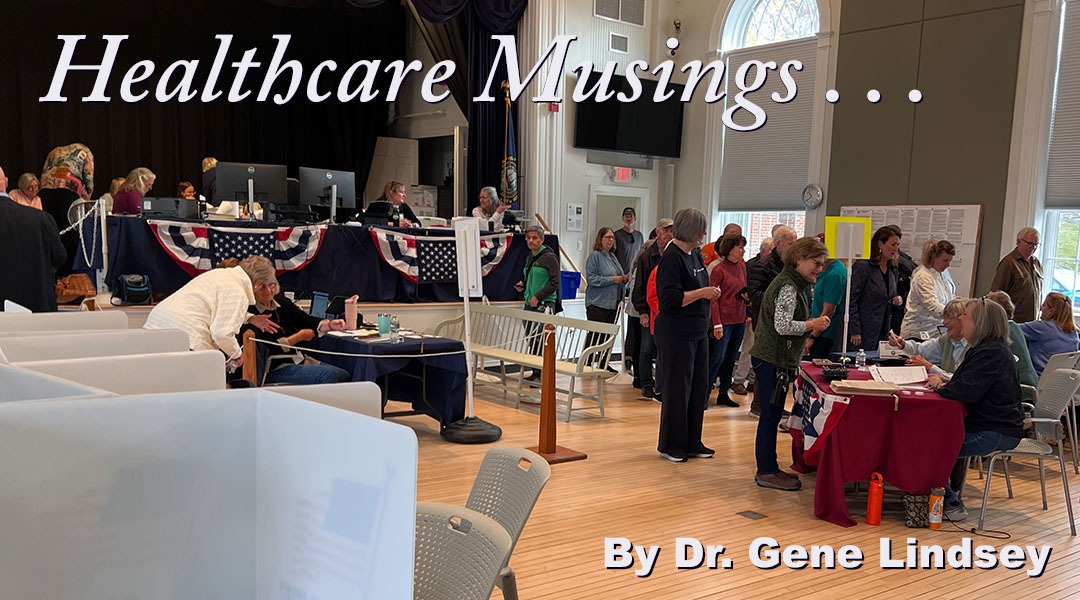
For use as a header for this letter, I had hoped to get a nice picture of election activity outside Whipple Hall, the building our town uses for local meetings and our police department, and where we vote. As in many towns in New England, there is a statue of a Civil War Soldier in front of the hall, and between the statue and the sidewalk, supporters of various candidates and ballot initiatives gather in a last-minute effort to gain a few votes from anyone undecided about how to cast their ballot.
This year there was a new wrinkle. Turning Point USA, the organization founded by the late Charlie Kirk, had a tent where I presume earnest young advocates, perhaps from nearby Colby-Sawyer College, were trying to sell their point of view. I walked on by, and since it was a dreary day, I decided to take my picture inside the hall after casting my vote. I am glad I did because I hope that the picture will remind us of what a wonderful privalege it is to be a participant in democracy.
If election day was dreary, the gorgeous fall weather on Wednesday after the election matched my upbeat mood. There are several definitions of “Indian Summer,” a term that was first used in New England in the late 1700s. There is some concern that it might be socially unacceptable as a pejorative reference to Native Americans. My working definition for the experience is a warm fall spell or day, as was true this week, with temperatures above 70 after “the first killing frost,” when the temperature falls below freezing. We had such a day on Wednesday before rain rolled in yesterday, and today is another dreary day. In Europe, they call such unseasonally warm weather “Old Wives’ Summer.” That sounds pejorative, too. Maybe I should just say that the weather on Wednesday was a perfect match for my post-election ebullience.
I am hoping that my good vibes and yours might continue as we head into winter, watching to see how the accomplishments of the moment might translate into long-term healthcare benefits for everyone.
Be well,
Gene