May 15, 2026
Dear Interested Readers,
A Sunnami of Change
My wife spends a lot of time on social media. While scrolling through Instagram this week, she came across a quote from Andrew Weinstein that sums up the disgust so many of us feel as we experience the declining intellectual function, blatant incompetence, and shameless graft that surrounds our president. Rather than make America great again, he has enriched himself, his family, and a small group of American oligarchs by appealing to the implicit biases of about a third of our fellow citizens who don’t seem to understand that he is using their support to rob them in the moment and darken the future of everybody’s children.
Even though I was extremely apprehensive about what lay ahead when he was reelected in November of 2024, in my wildest nightmares, I did not imagine the destruction he could cause us now and the threat to future generations that his policies would create. Daily, I am distraught by the looming disasters in the economy, the damage being wrought to our environment, the dismantling of our already inadequate healthcare, the undermining of medical research, the withdrawal of support to public education, the defunding of the arts, the disregard for the social determinants of health, and the abandonment of our leadership of democratic societies in the world order. There is even more. Consider the obnoxious gilding of the White House, the plans for a triumphal arch that will celebrate our downfall, and the erection of his ballroom, which will be a temple devoted to his narcissism. Oh, and then there is his pointless war in Iran.
Andrew Weinstien may not be known to you, but he is not a “lunatic radical of the left” as the president so kindly refers to many of the people who oppose him. He is a leader in the #Resistance movement, but he was once affiliated with Newt Gingrich. Google AI describes him:
Andrew Weinstein is a prominent civic advocate, attorney, and former U.S. Public Delegate to the United Nations who frequently acts as a vocal critic of the Trump administration. He is well-known for writing sharp political commentary, often contributing to outlets like Time magazine and The Hill, and sharing commentary that is widely circulated by grassroots anti-Trump groups. Weinstein has a background in Republican politics, having served as a spokesperson for former House Speaker Newt Gingrich and as director of media relations for the 1996 Dole/Kemp presidential campaign. Despite his GOP roots, he emerged as a strong critic of Donald Trump, frequently penning critiques regarding the administration’s policies, including efforts to defund the arts.
The quote that caught my wife’s eye on Instagram also appeared on the Facebook page of “The Trump Resistance Movement (TRM).” For your convenience, here is the quote:
“We are past the point of political disagreement. We are witnessing a catastrophic collision between unchecked narcissism and obvious neurological decay. It is the most dangerous intersection in American history: a man with the absolute power of the Presidency and the absolute cognitive failure of a person no longer tethered to reality.”
I do agree with the opinion that the president is our immediate problem, but he is also the unfortunate outcome of a much deeper, chronic problem in our national psyche and history. It is hard for me to imagine the current moment without considering our past and ongoing problems with racial concerns that can be witnessed in recent Supreme Court decisions or by simply reviewing the data that shows persistent inequities in access to care and outcomes in health by race in America. Could we have had Trump if he had not been preceded by Nixon, Reagan, the misadventures in Vietnam, and more than twenty years of futile war in Iraq and Afghanistan? How did Newt Gingrich’s “Contract with America” or the “Tea Party” movement set the stage for “Make America Great Again”?
Democrats have also contributed to our current concerns. Righteous indignation is not a political strategy that converts a majority of the population to a progressive agenda. Comments like “It depends on what the meaning of the word ‘is’ is,” and a “basket of deplorables,” don’t ultimately prove to win votes. I am inclined to believe that, from the perspective of fifty or one hundred years, historians will write long chapters on the strategic failures and self-defeating tendencies often present in the Democratic Party. Why? Because Democrats, in an enthusiasm for forcing our individual impressions of “rightness,” have frequently had vehement internal disagreements while we have been busy treating with great disdain those who didn’t share our worldview. The persistent internal debates within the party over how to achieve universal healthcare, and the recent discussions about how difficult progressive processes are in “blue states,” as outlined in the book Abundance by Klein and Thompson, are examples of disorganization and controversy within the Democratic Party. This is not new. We saw it almost a hundred years ago in the early 1930s when FDR was trying to rescue us from the “Great depression,” and Will Rogers wrote, “I’m not a member of any organized political party. I am a Democrat!”
I have many apprehensions about the coming mid-term elections. Primarily, I am looking forward to them and hoping that they will serve as a potential “brake” on the president’s destructive policies and actions, which bring us new surprises almost every day. I fear that there is still enough time for the sense of certain victory that many weary Democrats feel today to be blocked by the continuing attempts of Republicans in response to requests from the president to manipulate the election. Even without the president’s dirty tricks, I fear that we Democrats are perfectly capable of “snatching defeat from the jaws of victory.” What will be the final impact of the gerrymandering strategies of both parties? Will the efforts of the state legislatures, backed by recent court decisions, skew the election outcomes enough to allow Republicans to retain control of the House? Will Trump find some way out of the mess in Iran in time for gas and other prices to fall before November? Will there be some staged “national security threat” that allows him to cancel or delay elections?
I fear more political violence that might encourage some to vote for a Congress that will be even more inclined to defer to a “strongman.” In essence, will there be some manufactured reason to justify not even having an election? We have already seen that the potentially disastrous fiasco at the Washington press dinner by an unhinged man was enough to cause Republicans to call for spending a billion dollars on ”security” at Trump’s ballroom.
I was not reassured this week when I read the New York Times Editorial Board’s attempt to quantify how close we are to becoming an autocracy. The editorial was titled “The Iran War Worsens America’s Democratic Erosion.” The subtitle was, “The Autocracy Index—The editorial board tracks 12 markers of democratic erosion.” The article is mostly composed of charts quantifying the editorial board’s collective opinions on a 10-point scale from Democracy to Autocracy across multiple domains, such as stifling speech, defying the courts, bypassing Congress, persecuting political opponents, the domestic use of the military, and declaring false emergencies. The good news is that we are not at autocracy yet. According to the editors, we are well on our way, but there is still time to avoid the destination at the end of the road we are traveling. The midterms could slow or reverse the process, but Trump’s potential for creating disruptive events could accelerate the decline of our democracy. I balance my concern with the hopeful realization that, despite Victor Orban’s great effort to control the recent election in Hungary, democracy was given a second chance, with the opposition winning even in rural areas where Orban had his greatest strength. Could Democrats win in Alabama or Iowa?
I find it frustrating that there is so little an individual can do to impact what happens nationally in this moment of great concern, other than to join other voices of concern and hold on to the hope that the election will signal a turnaround in the destruction and announce the beginning of a period of national recovery. In the interim, I find some relief in contemplating what might happen if Democrats regain control of the House, and perhaps a miracle will create a Democratic victory in the Senate. It has occurred to me that even if gerrymandering delivers a Republican victory in the House, Democrats could still win the Senate, since statewide elections are not skewed by gerrymandering.
Many of us like to think that our personal resources give us some insulation from the miseries of our time, allowing us to weather further price changes or the threat of job losses due to the emergence of AI. Beyond financial resources, location can be a source of temporary personal comfort. Trust me, I feel safer in rural New Hampshire than I would in the hubbub of metropolitan Boston. But no matter our personal finances or where we happen to live, and despite all of our attempts to reassure ourselves, our lives can still be disrupted by unexpected surprises. My wife received a disturbing, totally unexpected note this week via the Epic patient portal from Atrius Health. She knew that the PCP she had seen for 40 years was retiring. My wife has been a patient of the practice at Harvard Community Health Plan and its legacy organizations since the early 70s. After we moved to Wellesley in 1982, she moved from the office in Kenmore Square and her PCP of about ten years to the recently opened Wellesley office of HCHP. The care she received was so good that since we moved full-time to New Hampshire at the end of 2014, she has continued to make the 200-mile round trip to Wellesley to see her beloved PCP.
She had accepted her trusted PCP’s suggestion, who was retiring, to see a nurse practitioner as her new PCP. The recommended NP had worked with her PCP, and my wife had been reassured that she could accept the transfer of her care, confident that all would be well. That confidence was completely destroyed by a cryptic note sent to her via the patient portal stating that the woman who was to assume her care was leaving the practice. That would have been bad news, but the text got worse. Not only was the NP leaving the practice, but there was no NP or MD at the Wellesley Office, where my wife has gotten care since 1982, who could see her. She was advised to seek care elsewhere.
For several decades, I have been concerned about patient access, growing panel sizes, the work environment for clinicians, and our shortage of doctors and nurses. If you doubt that, search this website. Ironically, I was always writing in defense of others. Though I was concerned for others, I always felt that I could protect my patients and adjust my practice options to personally avoid burnout or moral injury. I assumed my leadership roles by convincing my colleagues that I could protect them in the hostile, competitive environment of Eastern Massachusetts. Somehow, I never considered the possibility that the turbulent issues in healthcare could directly affect my family in a way we could not easily manage.
My wife has decided to look for a new PCP in New Hampshire. That is not an easy task in a rural environment. We get specialty care at the Dartmouth Hitchcock Medical Center, thirty miles away. A few years ago, Dartmouth put a temporary freeze on all of its primary care practices. That freeze has lifted, and some new PCPs and midlevel clinicians have been added to the rosters of the medical center and its affiliated hospitals and clinics, like our local New London Hospital, but access remains a concern, and it appears that many of the options are “newly minted” NPs. I primarily see an NP in Wellesley who practices as part of a team with my primary care provider. My wife was a nurse practitioner, so we have no objection to getting care from a midlevel clinician, but as my wife’s recent experience suggested, even that option is becoming increasingly difficult to exercise.
Just as Trump is best viewed as a manifestation of a chronic problem with a long gestation, so too do our current access-to-care problems, even for those with excellent coverage, have a long history. Since the late 70s, we have not been training enough doctors. Our attempts to find a solution have included recruiting foreign-trained doctors from many other countries and utilizing more independent practice mid-level clinicians. Some patients with means have sought relief by paying more and joining concierge practices. We have added too many patients to already crowded schedules. Many options have been tried, but as our population ages and there are greater opportunities to extend life with new meds and better chronic disease management, our access problems seem to be exhausting our solutions. I would expect that others have had a similar problem to my wife’s recent experience.
Perhaps, and with some hope, AI may be what rescues us. Over the next few weeks, I plan to use these notes to further explore how we got to this moment, concerns that I have had since at least the mid-80s, and then review potential solutions. I welcome any ideas that you might send me directly by email at drgenelindsey@gmail.com or through the comment window of this website.
Embracing the Gloom
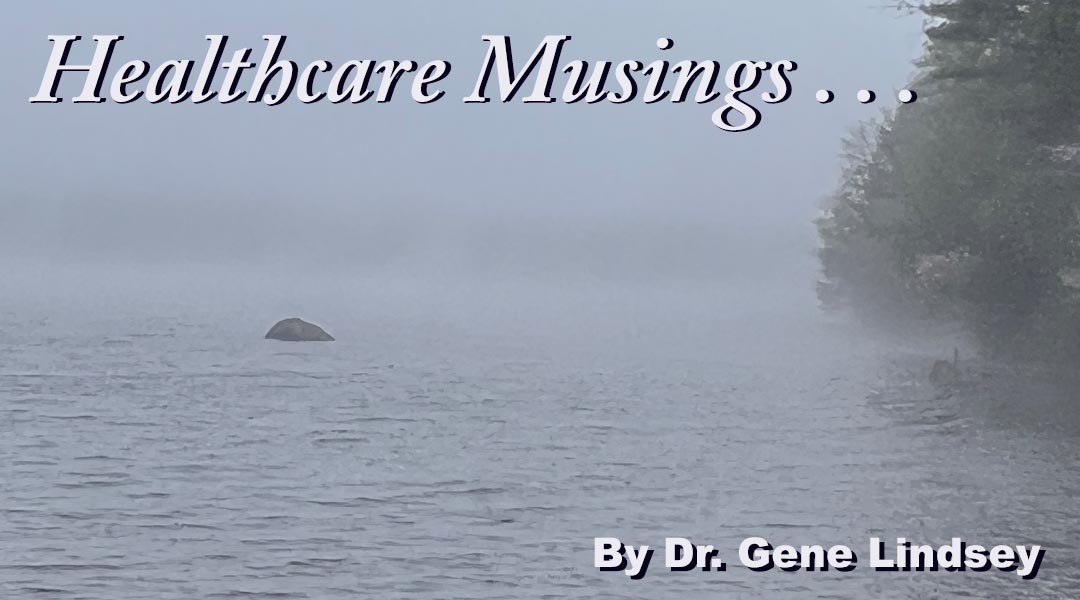
As the picture that is today’s header implies, spring isn’t making much headway here in New Hampshire. Looking across the lake, it is sometimes hard to see the opposite shore. I have never understood how a day in the mid forties in May can feel colder than a day in the low twenties in January. But it can.
Our local weatherman has been trying to alleviate universal despair by bravely suggesting that the rain that has washed out most of our week might end by Saturday and not return until at least next Wednesday. To add to our anticipation and help us endure a few more gloomy days, he promises we will see the thermometer rise to over 70, maybe even 80, in some places next week. I hope that he is right.
I feel bad about much of the heartland when I hear of their wildfires, floods, and tornadoes. My cold, wet spring may be the flip side of their experience. My implicit biases flood me with thoughts that make me ashamed of myself, since the voters in many of these red states elected a president who seems to discount the reality that turbulent weather is a product of the global warming that he may be enhancing in time, as he has used executive orders to cancel much of our effort to move to non-carbon sources of energy. He loved to proclaim “Drill, baby, drill” at his political rallies and even in his inaugural address. Is there any doubt that in his transactional world, he has delivered on his promise to petroleum executives of a clear road forward if they would contribute a billion dollars to his election campaign?
Rapid transitions seem to be a new reality in our weather experience. Cold, wet weather can be replaced immediately by hot, dry days. In fact, we are getting predictions of late summer scorchers from an enhanced “El Niño” or “Super El Niño” event this summer.
Maybe I should embrace the gloom and this chilly, wet weather and enjoy it. I have always thought that it was easier for me to put on another layer of clothes than to try to get cool by taking things off. Wherever you might be, make the most of the weather you have, because in these times it is hard to know for sure what may be coming your way. We do live in very uncertain times, but…hang on to hope.
Be well,
Gene