April 3, 2026
Dear Interested Readers,
Moral Injury and Burnout: Different, But Both Challenge The Future Of Healthcare
In 2005, I was 60 years old and beginning to think about when I might retire. I was very busy practicing full-time in the outpatient offices of four of our health centers: Kenmore, West Roxbury, Braintree, and Wellesley. Simultaneously, I was participating in the on-call night and weekend coverage schedule for our cardiology group and taking my regular turn on the rounding and teaching call schedule for our cardiology admissions at the Brigham. Beyond my practice activities, I was chairman of the boards of Atrius Health and Harvard Vanguard Medical Associates. I enjoyed what I was doing, but I was beginning to get a little tired. All of my children were either out of school and working, or would soon be. So, soon, the job of supporting them was to be completed. I was beginning to think about retiring.
Despite all the work, my growing sense of fatigue, and the idea that it was time for my wife and me to begin planning for the next phase of our lives, I still enjoyed being part of our practice’s response to the challenges we faced as we tried to survive and improve in a very competitive market. I particularly enjoyed the group-wide meetings we regularly held to discuss compensation policies, work-life issues, new technology investments, or to celebrate high-performing, fully committed members of the group. There was still a little bit of the pioneer, ground-breaking camaraderie that was present when I came on board thirty years earlier. Our enthusiasm for innovation had been revitalized with a new spirit of independence when, in 1998, I was part of the leadership that took the physicians who were practicing in the health centers that had been part of the original Harvard Community Health Plan out of Harvard Pilgrim Health Care to form the independent 501 (c) (3) Harvard Vanguard Medical Associates. We had barely left our exclusive relationship with Harvard Pilgrim in time to survive the challenge posed by their mismanagement, which had put them in receivership.
A lot had happened over the previous seven years. During much of the time, we had been on the doorstep of financial failure. At the depth of our difficulty in late 1999 and the first few months of 2000, the auditors, looking at our financial records for the previous year, had announced that we were “not a going concern.” We had less than a week of “cash on hand.” Rather than call a priest for our last rites or lawyers to draw up documents for bankruptcy or reorganization, we hired a dynamic young CEO, Ken Paulus, who revitalized us financially with his enthusiasm, good business judgment, and the creative idea of joining forces with several suburban medical groups that were also having a tough time to form Atrius Health. Ken sold us and those established suburban medical practices on the idea that, through collaboration, we could improve our collective position in negotiating with payers and share the enormous overhead of Harvard Vanguard’s IT, contracting, and substantial quality infrastructure with them for less than they could do the same things for themselves since they had no automated medical records or contracting infrastructure of significance. To join us in a confederation, all of those groups had to make the difficult transition from for-profit private practices to a non-profit 501(c)(3) status like ours. That is not an easy transition, either legally or emotionally, for doctors who enjoyed the idea of being “owners.”
By spreading the fixed costs of practice over a larger patient base, we gained more effective contracting and created more robust in-house lab and diagnostic capabilities, freeing us from much of the inflated costs of ancillary services. By coordinating our activities, we were able to leverage our collective patient population of more than 600,000 patients to secure better practice relationships with the teaching and community hospitals where our physicians practiced surgery, obstetrics and gynecology, medical specialties, and the in-hospital care associated with primary care. We learned that you did not need to fill more than 50% of a hospital’s beds to be treated with respect. All you needed was for your admissions to be their “margin,” and, through that influence, to make further gains in hospital efficiency and to have better relationships with their employed staff.
Then, in 2005, as our momentum was growing, Ken announced he was leaving to return to his home state of Minnesota as the chief operating officer of the very large Allina Health hospital system, with the promise of possibly becoming its next CEO. While I was happy for Ken, he deserved more than we could have ever given him, I was surprised and a little terrified by what the loss of Ken would mean for our morale and the possibility of future success. By then, we had already been through two national searches for a CEO, and I was not looking forward to the arduous task of replacing a business leader who could inspire the practice enough for hundreds of healthcare professionals to set aside many of their individual concerns to pursue a collective achievement.
Sometime in the late 90s or perhaps early in the Ken Paulus era, I think it might have been at an annual awards celebration where we would have had a notable speaker like Atul Gawande (who was one of our surgeons at the time) or Don Berwick (who cut his teeth in quality and practiced pediatrics with us for many years), I was sitting at the head table and serving as the moderator of the evening when I looked out at my colleagues and realized that there were a lot of old and tired looking faces staring back at me. We had a vigorous physician recruitment program, wonderful employment benefits, and market compensation, but no program that focused on the challenges facing physicians near the end of their practice. We had been solving other problems, and we were taking the dedication and energy of our professional staff for granted.
My anxiety about our grey heads, of which I was one, increased when I asked our human resources professionals to give me a breakdown of the ages of our physicians and learned that a majority of them were over 55. One metric I had tracked over the years, as the leader of our physician group, dating back to my earliest days as an “organizational politician,” was our annual professional turnover rate. In bad times, it was over 10%. In good times, it could be below 5%. At all times, there was a committed core of physicians who I imagined would be with us until they died or dropped from exhaustion because they believed in what we were trying to do and wanted to be part of something that made a difference. I had put myself into that category and realized that at 60, my days were probably numbered by realities beyond my control. Most of our new hires were highly skilled, but they lacked the pioneer spirit of my older colleagues. There were obvious generational differences.
Nevertheless, in our recruitment efforts, we were careful to look for people who shared our values. It was still true that many of our new doctors joined us to be part of our culture of quality improvement, knowing they would be well supported in their practices. I hoped that our new hires would come to us knowing they would have a high degree of autonomy in practice and would never be morally challenged by unethical efforts to enhance our margins. What I also eventually realized after I became CEO in 2008 and began meeting personally with every new physician was that many of our best new doctors that joined our practice came to us from our local large DSH hospital system, The Boston Medical Center, composed of the former Boston City and University Hospitals, in combination with clinics in the poorer neighborhoods of Boston. We offered better compensation, a more stable environment, and the opportunity to pursue many objectives related to quality and equity in healthcare while still serving a diverse population that included some of the same disadvantaged minorities they had cared for in the less-affluent DSH system.
There were just not enough of these socially motivated physicians to fill our needs or serve the community in its entirety. When I realized that there was a dwindling pool of socially motivated physicians to replace those of us who were aging out of practice, especially in primary care, it dawned on me that healthcare had what economists and policy wonks describe as a “wicked problem.” With those observations and supporting data indicating that more than half of our active practitioners, like me, were approaching retirement, I realized we had a wicked workforce problem, and there were no obvious, easy solutions to be had.
I have written about the definition of “wicked problems” before. My search of this website shows that the title of my posting for December 11, 2018, was “Physicians and the ‘Wicked Problems’ of Healthcare.” That letter focused on physicians’ professional needs and the problem of burnout. Burnout and moral injury have become huge threats to practice in 2026. One of my first mentions of moral injury was in a letter about its impact on a colleague and a dear friend back in the early 80s. That letter was entitled “The Moral Injury of Avoidable Death” and was written in the summer of 2015. This week, I was surprised to read a Times opinion piece written by Thomas Friedman that used the term “wicked” problem in reference to the misadventure our president has brought onto us by his poorly planned and ill-considered war in Iran. We now share an international “wicked problem.” Friedman’s definition of a wicked problem appears in a piece entitled “Trump Has a Way Out of the War.” Friedman’s description is very consistent with the Wikipedia description of a wicked problem and my 2018 description. According to Friedman:
Broadly speaking, a wicked problem is defined as a problem that resists quick fixes or permanent solutions. It involves numerous interdependent variables. Outcomes are never final, just better or worse, or good enough. Every wicked problem is essentially one of a kind, meaning there is no perfect, pre-existing template for solving one. And solutions often have irreversible consequences, meaning that you cannot easily undo a decision.
Collectively, we have made many decisions over time that can’t be easily undone. Bad healthcare policy decisions have created our current professional concerns, which have led us to the precarious moment that we face now in our nation’s health. My incomplete list of those poor policy decisions and difficult to change realities in healthcare that are the origin of wicked problems include the decisions in the late 70s and early 80s not to expand or adequately fund medical education for fear of a “doctor” glut, the impact of RVUs and the RUC on practice worklife and the unfair distribution of compensation leading to the devaluation of primary care, the continuation of the predominant fee-for-service method of finance for much of practice, the dominance of commercial health insurance as the main access portal to care, and our failure to establish universal access to care. That is just a partial list of poor policy decisions and business realities in the not-too-distant past that have created the frustrating set of wicked problems currently challenging American healthcare. You probably can think of others.
That last link is from an article written by a former colleague, Zeev Neuwirth, who stresses the impact on healthcare of the “medical industrial complex.” Similar reasoning leads me to identify the “corporatization of healthcare,” as described in the New England Journal of Medicine’s ongoing series, as one of the central precipitators of the wicked problems of healthcare, even though the series never uses the term “wicked problem.” You might ask ChatGPT, Claude, or Google’s AI for their list.
I resisted asking AI for its list of wicked problems in healthcare, and I am certain that I could make my own list longer, but the intent of the verbiage above is to focus on the impact of these multiple medical problems on individual physicans as they attempt to survive in what has become a very hostile world where what they often experience creates moral injury and burnout as manifestions of what one might jusitfiably label as professional PTSD.
Physicians are resourceful. When faced with huge problems, we look for solutions. Not all of our potential solutions are beneficial to the collective and can be detrimental to the community as a whole, as they provide some relief to individual practitioners. I have viewed the issue of concierge practice as a bad solution to a wicked problem. On the downside, at a minimum, it diminishes health equity, increases out-of-pocket medical expenses, and reduces access to care in communities where care is hard to access. On the positive side, concierge practice can provide relief for burned-out physicians, greater professional independence, and freedom from the demands and moral injury that result when we put the bottom line of corporate practice ahead of patient needs and professional survival and satisfaction.
I have softened my bias against concierge practice just a little. I have recently given some credence to the idea of others that, given the choice between a burned-out doctor retiring prematurely or giving up practice for other employment or business, perhaps going into concierge practice may actually preserve some access to care. What is better, a doctor who has been burned out with a large panel of patients, seeing no one or serving no one adequately, versus a doctor seeing a reduced workload of 350-500 patients for whom they can provide good care within the limits of their residual energy and time before retirement?
A few months ago, I was surprised to read a story in my local newspaper about some local doctors who had previously worked for Dartmouth Health and were leaving to start a concierge practice. I was at least annoyed, given my bias toward focusing on the physician shortage, the challenges posed by panel sizes that, in many places, are over 3,000, and the resulting increases in difficulty patients are having in accessing care. You may have a doctor, but at least a third and perhaps half the population can’t find a PCP. Exact numbers are hard to find, but a reliable 2023 survey suggested that more than 100 million Americans lacked a PCP. It’s probably much worse now, since in the interim, nothing has happened to suggest improvement in that grim statistic, and the work lives of many healthcare providers continue to deteriorate.
One of my faithful readers sent me a link this week to an article entitled “Moral distress in physicians: New study measures prevalence, offers interventions.”The article provides an AMA definition of “moral distress”.
The American Medical Association has defined moral distress in medicine as the negative emotional response and psychological distress that occurs when clinicians know the ethically correct action to take but feel powerless to act on it due to internal or external constraints.
The article references a recent study published in JAMA Network Open involving about 5,700 doctors and over 3,500 other healthcare providers, who were evaluated using the Moral Distress Thermometer and the Maslach Burnout Inventory. Over 39% of physicians were diagnosed by the tools as having moral distress. I don’t think that you need the numbers to know that we have a “wicked problem.”
I was surprised last week to see another front-page article in The Valley News about a doctor opening a concierge practice. The piece was entitled “Woodstock primary care doctor strikes out on her own.” Articles of local interest, like the controversies at town meetings, house fires, local politicians behaving badly, and the like, are front-page stories in small-town journalism. Once a week, we have an interesting obituary on the front page that reads like a short story. National news is a secondary priority, with more print devoted to high school sports than policy issues or national politics. The article that caught my eye began:
After nearly 20 years as an internal medicine doctor at a clinic, Lorissa Segal is striking out on her own.
Segal was set to see her last patients at the Dartmouth Health-run Ottauquechee Health Center in Woodstock Friday and will begin seeing patients at a new private practice in the old Sunset Farm building on Maxham Meadow Way on Tuesday.
So, what was the reason for this change in practice venue? Woodstock is about as “high-end” as Vermont gets. Dr. Segal was quoted:
“I love primary care and I wanted to create something where I would be able to stay in this town and continue to take care of the community here,” Segal, 48, said in a recent interview.
At the Woodstock clinic where Segal, of Barnard, has worked since 2008, she said there has been pressure to complete appointments more quickly and to devote more time on complicated billing paperwork. The clinic has lost its “close-knit family feel” over the years, she said. She has been thinking about making a change “slowly over the last several years.”
“It’s a difficult career. It can be hectic and busy and all-consuming,” Segal said.
Things change even in idyllic central Vermont, where you can feel close to a bygone era. If you have never been to Woodstock, you are missing out on something neat. My wife and I often go there to shop around, get a great meal, or just enjoy the ride there and back as an outing on a pretty fall day. But, Dr. Segal testifies that even in such a comfortable environment, working in an excellent system of care, like Dartmouth Health, there are healthcare problems:
At DH’s clinic, Segal sees about 1,100 patients. In private practice, she plans to see 350 patients, which she hopes will give her more time to spend with each encounter, offer flexibility with scheduling, allow her to connect with subspecialists and provide a higher quality health care.
Her private practice can also ensure Segal’s patients always see her, rather than a physician’s assistant or nurse practitioner because she has a full schedule.
The next point is interesting, and the way Dr. Segal expressed it began to soften my knee-jerk objections to her decisions.
“A healthy provider is the best kind of provider,” Segal said. “I think this new practice will allow me to practice in a way that I want to, which is to really spend time with patients and that allows me to take care of them and continue to work in this field.”
The article continues with a quote from a Dartmouth Health manager about preparations for Dr. Segal’s departure. Then it returns to explaining the situation from Dr. Segal’s point of view:
Segal said she has watched as the changing nature of the job has forced many of her colleagues into early retirement or other fields, she said. She hopes that switching to a smaller, private practice will help her to avoid her own burnout and stay in Woodstock for many more years.
Segal is the latest in a line of Upper Valley health care providers transitioning from large academic medical systems to non-traditional primary care practices.
The article then lists the names of several other clinicians, including nurse practitioners who have left Dartmouth for similar reasons and have done what Dr. Segal plans to do. Well, that does add weight to the idea that a practice of 350 is better than having Dr. Segal switch careers and become a real estate agent. After naming names, the article continues:
The phenomenon seems to be a “gradual trend” emerging around Vermont as providers become overwhelmed by large patient panels, paperwork and a desire to get back “that personal touch in medicine,” Vermont Medical Society Executive Director Jessa Barnard said Monday.
The shift is understandable, Barnard said, given that providers are spending more and more time on paperwork and are increasingly “overburdened.”
Transitioning to a direct primary care or similar model “means that the patients who are able to access that kind of care probably get very good care and a lot of personal attention.”
That sounds reasonable. What else can an overworked, burned-out, and possibly morally injured clinician do? But, then there is a downside:
But, she said, there are potential pitfalls.
“We certainly can see the attraction, but then the concern is, first of all, there wouldn’t be enough clinicians if all providers did this and not everyone can afford it, so you would start to see access limited,” Barnard said.
It is a wicked problem. What is good for Dr. Segal is part of a growing problem for patients in Vermont. The article continues, reporting that Dr. Segal will focus on the care of women in her new practice. She is especially interested in reproductive and menopause care, areas where she believes her medical school training 20 years ago was inadequate. At the end of the article, we learn that there is a company supporting her transition:
Segal’s new practice is affiliated with MDVIP, a Florida-based company that partners with independent primary care providers to offer membership-based care.
Segal will accept private insurance, Medicare and Medicaid to cover standard preventative and sick visits and services.
I looked up MDIVP on the internet. They have an attractive website. A Wikipedia article on MDIVP raises a few questions in my mind and locates it front and center in the context of private equity’s invasion of healthcare. It sets concierge fees of $2,500-$5,000 per year for about 1,300 doctors, of which it takes a generous share, as it provides managerial and marketing support to doctors like Dr. Segal. My response was a shrug of the shoulders as I realized that corporatization in healthcare extends to concierge care. Our cup runneth over with wicked problems in healthcare. As I try to generate some positive feelings about having Dr. Segal move from 1100 patients to 350, I am not so sure about what her experience will be. One thing I know for sure is that care in central Vermont will be a little harder to find for those without some significant disposable income.
Reflections By A Waterfall
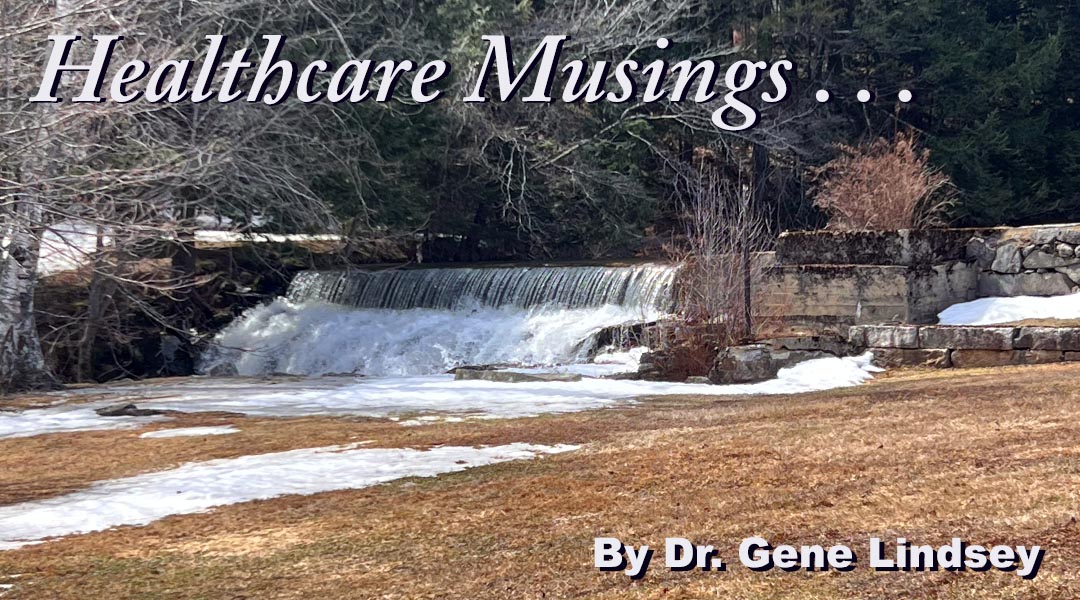
One or twice a month, I go across town for a very vigorous therapeutic massage. My rapidly crumbling infrastructure gets some temporary relief, and the conversations I have with the very skilled woman whose educated hands can find every source of tension in my misused muscles and joints are as therapeutic as the Freudian analysis I once had for many years in my early thirties. Her office is in her home, which is just a few yards from the scene in today’s header.
It’s hard to believe that a town of less than 5000, like New London, has two zip codes and two post offices. 03257 is the ZIP code on my side of town near Little Lake Sunapee, where I live, and 03233 is for the neighborhood called Elkins, once called Scytheville, that sits around Pleasant Lake near the foot of Mount Keasarge on the other side of town. The stone work and roaring waterfall you see in the picture are just about all that remains of the nineteenth-century industrial community called Scytheville.
Before and after the Civil War, many of the agricultural blades used for harvesting crops in America were produced by machinery that tapped the energy of this falling water a few yards downstream from Pleasant Lake. I read somewhere that during the Civil War, the scythe works produced many of the bayonets and swords used by Union forces. I have wondered if some of my rebel ancestors, who died in the Civil War at the hands of a Yankee soldier, died from a blade that was made in Scytheville. According to my mother, whose hobby was genealogy, there were many, many sons on both sides of my ancestry who gave their all for a lost and evil cause.
In the late 1880s, the world had changed, and industry in Scytheville died as huge farm machinery was developed in the Midwest by companies like McCormick. In 1896, after the industry had gone, the community’s name was changed to Elkins, and what had once been a thriving industrial area was given over to camps and high-end lakefront properties. In years past, I enjoyed walking or jogging around Elkins and Pleasant Lake. The trip around the lake and through the old village is a challenging six-mile journey that is now beyond my capability on foot. Perhaps this summer, I will do it on my bicycle.
The movement of history and its hidden stories interests me. Like the end of winter, history is a reminder that “this too will pass.” I doubt I will be around when today’s current “wicked problems” in healthcare are the subject of interesting historical reviews. I already feel more like a spectator than a participant. Perhaps I will get the opportunity to see what happens from a perch in the “Bardo.” I do so want to see how this chapter in our ongoing healthcare saga is closed. As I wait, I plan to enjoy the further emergence of spring this weekend, stay up to date with our astronauts as they circle the moon, and try to avoid further distress by not thinking about the clown defiling our White House. I suggest that you do the same!
Be well,
Gene