October 9, 2026
Dear Interested Readers,
“Medicare-for-All” Is An Active Issue
Many of you who have been thinking about universal healthcare for a long time probably accept that the ACA (Obamacare) was inspired by the 2005 Massachusetts Healthcare law, affectionately known as Romneycare. Probably not as many of you know that Romney’s plan was inspired by theoretical work that originated in the late 80s at the right-leaning, Republican-aligned Heritage Foundation. If you scroll down in that link, you can read:
In March 2010, the Obama administration introduced a health insurance mandate in the Affordable Care Act (ACA), also known as Obamacare, which the foundation supported in its October 1989 study, “Assuring Affordable Health Care for All Americans”.[45] In 2006, the mandate proposed in the Heritage Foundation study was incorporated into Massachusetts governor Mitt Romney‘s health care plan, known as “Romneycare,” for Massachusetts.[46] The foundation subsequently opposed the Affordable Care Act.[9]
Many people today associate the phrase “Medicare-for-All” with Bernie Sanders’ 2016 presidential campaign, but that is not quite right. The term “Medicare” became a reality in 1965, and, as you know, it offered not quite universal health insurance to Americans aged 65 and older. But the first presentation of the idea of government providing healthcare to everyone came from Teddy Roosevelt and his Progressive Party in 1912. That idea predates the establishment of a national income tax in 1913 and the right for women to vote, which came with the ratification of the 19th Amendment in 1920.
For those of you who aren’t history buffs, or are not old enough to have any personal knowledge of the Republican Party before Ronald Reagan, you might be surprised to learn that there were still liberals and progressive thinkers of sorts in the Republican Party as late as the seventies. Senator Jacob Javits of New York was one of those center-to-slightly-left Republicans, and in 1970 he proposed a national healthcare program that The New York Times dubbed “Medicare-for-All.” In the last link we read:
In April, he [Javits] introduced the National Health Insurance and Health Services Improvement Act, which would have gradually expanded health insurance coverage to all Americans. “Medicare For All is Asked by Javits,” read the New York Times headline. He found support from several like-minded Republicans.
The point I am trying to make is that many Americans, especially progressive Americans, have long yearned for government-sponsored healthcare. The effort goes back a lot further than Bernie Sanders’ 2016 presidential campaign. The idea of government-provided universal access to healthcare is an old idea. It stands to reason that it would be unlikely to talk about a “Medicare-for-All” approach to universal access until after 1965, when we got Medicare for those over 65. But it did not take until 2016 for the name to arise.
It is clear that the question of healthcare as a “universal right” and the responsibility of the government versus “healthcare as a commodity” that is the responsibility of the individual is back on the ballot for 2026, and how to provide government-sponsored healthcare will definitely be an issue in the Democratic Presidential primary elections in 2028, and almost as likely to be one of the top two or three issues in the general election in 2028. If it isn’t clear to you yet, many Democrats accept that health care is a right and the responsibility of the nation. In recent years, many Republicans seem to see health care as a commodity and an issue of personal responsibility. In our society where business interests are protected, and a well-financed minority can easily block progress, it can take decades, and sometimes more than a hundred years, for the majority opinion in the populace to become the law of the land.
My letter last week’s letter focused on the Democrats’ chance to win control of the Senate in November’s election and took an in-depth look at Dr. Abdul El-Sayed, the progressive Democratic candidate for Michigan’s open Senate seat this year. In the past, Dr. El-Sayed has been an advisor to Senator Sanders, and now he is making Medicare-for-All a key policy issue in his bid for the open Senate seat in Michigan.
I was excited about his views after enjoying his 2020 book, which suggested that all Americans were suffering from an epidemic of insecurity. He proposed empathetic public policy and the rebuilding of all aspects of our infrastructure as the treatment for this national epidemic. A major part of his concept of empathetic public policy was Medicare-for-All.
I am now deep into Medicare for All: A Citizen’s Guide, a 2021 book coauthored by Dr. El-Sayed and Dr. Micah Johnson, an HMS grad, Rhodes Scholar, former Brigham resident, and now in practice at the Brigham. The book has two forewords. One was written by Bernie Sanders and the other by progressive Congresswoman Pramila Jayapal. I requested that Google Gemini write me a succinct overview to share with you:
Medicare for All: A Citizen’s Guide is a 2021 book written by Abdul El-Sayed and Micah Johnson (with forewords by Bernie Sanders and Pramila Jayapal). It provides a policy analysis and practical roadmap for enacting a single-payer universal healthcare system in the United States. [1]
Core Themes and Structure
- Diagnosis of the American Healthcare System: The book outlines the failures of the current U.S. model, noting high costs, administrative waste, health inequities, and the problem of tying health insurance to employment. [1, 2]
- Policy Design and Mechanics: It explains how a single-payer system would work in practice, transitioning traditional Medicare into a comprehensive program that covers all residents. [1, 2]
- Comprehensive Benefits: The proposal advocates for expanding Medicare to cover all necessary services—including vision, dental, and hearing—while removing premiums, copays, and deductibles. [1, 2]
- Financing and Economics: The authors examine how single-payer healthcare is funded, addressing tax shifts, payroll contributions, and the elimination of private insurance overhead and out-of-pocket costs. [1, 2, 3]
- Political Landscape and Opposition: The text evaluates the political obstacles, industry opposition from private insurers and pharmaceutical companies, and strategies for grassroots advocacy to overcome resistance. [1, 2, 3]
- Alternatives Evaluated: The book reviews other healthcare reform alternatives and critiques their deficiencies in achieving true universal coverage. [1]
This week, KFF News published polling results on healthcare ahead of the election, which is now less than a month away. In large type capital letters, their report begins:
Poll: Cost of Health Care and Gas Top Voters’ Midterm Concerns; Democrats Hold Significant Advantage on Health Care Costs and Cost of Living
That is not such a big surprise, but there is a second large type capital letter proclamation from their data which might surprise you:
Two-Thirds Favor Medicare-for-All, a New High in KFF Polling, but Support Shifts When Competing Claims from Critics and Proponents Are Heard
In the article, we get an explanation for the good-news-bad-news nature of the headline. They write:
…KFF has tracked public opinion on national health plan proposals, including Medicare-for-All, since the late 1990s.
As KFF polling has shown consistently over time, public opinion on Medicare-for-All—and on major health policy proposals generally—is highly malleable and likely to shift over the course of any public debate with competing claims from proponents and critics. The latest poll finds the share who favor a Medicare-for-All-style plan falls sharply when the public is told that it could lead to potential delays in medical tests and treatments (24% still favor), tax increases (35%), or threaten the current Medicare program (38%). On the other hand, favorable views rise to about 3 in 4 when people are told that Medicare-for-All would make health insurance “a right” (76%) or that it would eliminate premiums and cost-sharing (75%).
The statement describes the power of fear stemming from uncertainty about what is new, which gives great power to those with a financial interest in the status quo. That card has been played before by those with a vested interest in our current system. Do you remember “Harry and Louise,” the negative advertising that doomed the Clinton health plan in 1993-94?
For the entire history of the effort to implement universal government-sponsored single-payer healthcare, the combined efforts of the AMA, big pharma, and the health insurance industry have effectively used the reality that proposals for “something” better can always be countered by raising concerns about the risk of change. Drs. El-Sayed and Johnson explain in their book that because of our national wealth, it has long been theoretically possible to provide everyone with complete coverage, including drugs, eye care, dental care, and end-of-life care for those who need it, without any copays or out-of-pocket expenses. Dr.Martin Luther King, Jr. made a similar assertion in the sixties. Drs. El-Sayed and Johnson explain that taxes would rise for some, especially the wealthy, but for most Americans, any increase in taxes would be more than balanced by the elimination of their part of current premiums and out-of-pocket charges.
All the points made by KFF are reflected in a recent Washington Post op-ed by Dr. Elisabeth Rosenthal, which was reprinted this week in my local newspaper. Dr. Rosenthal was an ER doc in New York, is a former New York Times healthcare reporter, and is currently a senior KFF editor. She is the author of An American Sickness: How Healthcare Became Big Business and How You Can Take It Back (2017). Her book is one of the best descriptions of our dysfunctional system of care that I have ever read.
In her piece, she quotes Amy Finkelstein, an MIT economist who describes Medicare-for-All as a “slogan” rather than a proposal. I thought that comment was an excellent description of where we are in the journey toward healthcare for all, guaranteed and primarily funded through government-sponsored programs that use the collective power of a majority to secure a right for all. Whether healthcare is a benefit of employment that is, in fact, in lieu of higher wages or is the product of taxes, its origin will always be our collective resources. As a society, we pay the whole cost of our dysfunctional healthcare, and through our laws and regulations get to decide who gets care and who makes a profit.
The current system is not equitable; it gives enormous profits to a few while denying access to millions of Americans, and is a crippling expense to millions more. It is quickly becoming nonsustainable. Herbert Stein was a conservative economist and the Chairman of the Council of Economic Advisers under Presidents Nixon and Ford. In an offhand comment at a conference in 1986, he articulated “Stein’s Law.” He said, “If something cannot go on forever, it will stop”
I believe that our current system of care delivery and finance is failing a growing number of Americans, and we are reaching a tipping point where something must happen. The cost of our system of care is intolerable for many and unsustainable over time, even if it takes a decade or two to reach its total collapse. Most importantly, a growing number of Americans, with and without coverage, can’t get the care they want and need. Since our system can’t last forever, Stein’s Law predicts it will stop.
Dr. Rosenthal has discussed Medicare-for-All with Dr. El-Sayed. She writes:
“The most important thing is just to make Medicare whole – meaning no charge for medical care – rolling back the complexity and costs of the last 10 years,” El-Sayed told me.
His program would start off covering children and adults five years younger than the current eligibility age for Medicare and close the gap over a period, he estimates, of eight years. To ease the transition for the health care system, he would initially set the Medicare payment rates to mirror the totals doctors and hospitals receive now to avoid a “price shock” to their operations. Future increases would be limited to the rate of inflation.
The question that we will be pondering over the next few years is what will replace it. Medicare-for-All is a placeholder slogan that begs for further definition and refinement that will surely come when enough Americans say, “Enough!” Near the end of her piece, Dr. Rosenthal quotes Senator Chris Van Hollen of Maryland, who added his support to the concept of Medicare-for-All last December:
Democratic Sen. Chris Van Hollen of Maryland added his support in December. “I was listening to my constituents,” he told me. “It’s just reached the complete breaking point. Our system is unaffordable and unsustainable with premiums going up, co-pays going up and up.
I bolded the wisdom of Stein’s law as articulated by Senator Van Hollen. I don’t know if his verbiage was an intentional nod to Professor Stein, or just an expression of his wisdom and analysis. Dr. Rosenthal continues with a hint of hope for eventual change, noting that half of all physicians now favor some form of single-payer, even though the AMA remains opposed to the idea. She notes that the American College of Physicians is the second-largest physician organization and now favors Medicare-for-All. Many, including Senator Van Hollen, saw the ACA as a first step. Now it is time to build on that accomplishment.
Enjoy the Peak Color That’s Coming Before the Uncertainties That Are Sure to Follow
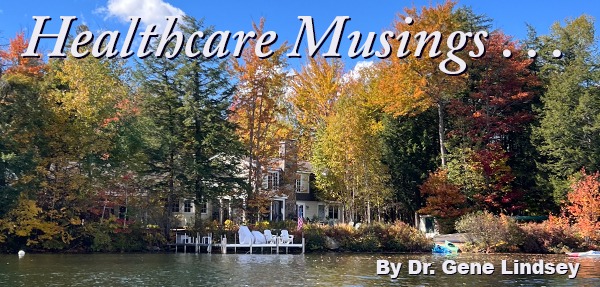
This holiday weekend is shaping up to be quite colorful. The picture in this week’s header isn’t quite “peak,” but the peak comes fast. Much of New Hampshire had a midweek freeze. I think our low temp was 33 early Wednesday morning, but since then we have enjoyed warmer weather, and I am really looking forward to the next few days.
This letter is a tiny bit shorter than most weeks. I have been busier than usual. This month I am taking calls for one of the nonprofits in our community where I have been active for several years. It is a lot like being a social worker.
I have received requests for help from people facing financial emergencies, such as a lack of heating fuel or an impending electric cutoff due to nonpayment of electric bills. My job is to interface with the client to gather details, call the supplier, and often wait listening to Muzak quite a while before ordering fuel or negotiating a minimal payment that will preserve their electrical service.
I have spoken to people who were once financially comfortable but now have five-figure debt from medical bills incurred when they lost their Medicare Advantage and couldn’t afford a Medicare “wrap around” supplement. They are a perfect example of the millions of Americans who are underinsured. I asked Google about underinsured Americans and got an answer taken primarily from data from the Commonwealth Fund, which I have previously reviewed with you, but below is Google’s summary:
- Proportion: Nearly 1 in 4 insured working-age Americans have high out-of-pocket costs and deductibles that make their coverage financially inadequate. [1]
- Source of Coverage for the Underinsured:
Another individual whom I talked to lost his family’s SNAP benefit when he was too busy trying to earn money doing odd jobs and lost track of the complicated renewal process. As a result, he lost the $700 monthly SNAP benefit that augmented his meager Social Security Disability benefit. He called our line to say he had spent his money on food and had no money to buy heating fuel and that his family was cold. He has applied for the federally funded program that provides subsidies for heating fuel, but those benefits don’t begin until December, and there will be many cold nights before December.
He lives in a mobile home, and its heating system requires a mix of diesel and kerosene for reasons I don’t understand. I was floored and almost dropped the phone when the fuel company’s agent said that delivering 100 gallons of the fuel mixture would cost $769.60. We do have an affordability problem. I doubt that 100 gallons will provide heat for this family until their fuel benefit comes in December. Furthermore, I doubt the fixed cash benefit the client will receive in December for heating will be enough to carry his family through the winter unless fuel prices fall dramatically. You can multiply the problems of this family many times over. There will be many in our community who are likely to have a very hard winter.
I am grateful for the opportunity to do these tasks because, like practicing medicine, there is great satisfaction in helping others. The work gives me an opportunity to see just how much damage Trump has done to so many of our neighbors. This moment feels like a collective moral injury. We live in a country that has enough to take care of everyone at a basic level, but we don’t. The reality encourages my wife and me to be more philanthropic. The work also gives me the opportunity to ask, how did we let things get this way?
Perhaps the fact that we are experiencing a “super El Niño” this year will be a blessing. Maybe with the warming we can expect, we won’t need as much heating oil, propane, or wood to stay warm this winter in New Hampshire. The increased cost of fuel is something many of us can absorb, but those who live paycheck to paycheck are likely to have a difficult winter. Perhaps, while we are enjoying the fall beauty, we should consider providing additional support to food pantries and charities that will see increased demand in the next few months.
Enjoy the holiday weekend. I am hoping it is followed by a period of “Indian Summer” that will be enhanced by even more vibrant fall colors.
Be well,
Gene