June 12, 2026
Dear Interested Readers,
Interesting Changes In Medical Education
If you read my letter from last Friday, you know that I was writing from Boston, where my wife and I had gone for my medical school class reunion. Our minds play tricks on us. In one moment, June 1971 seems like yesterday, and then you see something that makes it seem like ancient history.
My class’s fiftieth anniversary reunion, which should have been in June 2021, turned out to be a “virtual” event that garnered little attention. From the start of planning almost a year ago, the 55th was envisioned as a makeup event. More than six months ago, each surviving class member was asked to send in pictures and answer questions. The responses were put into a book, which was sent to each of us more than a month ago. Initially, there were 120 medical students and a few dozen dental students in my class in September 1967. Now there are about 150 surviving members of the class, including those who attended the Harvard Dental School but took the same classes during the first two years. At the start of the third year, we were joined by about 30 transfers from Dartmouth Medical School and a few from Brown, both two-year medical schools at the time. By graduation, there were about 170 of us. I was surprised to learn that, as of last December, only 20 had died over the intervening 55 years. There have been a couple of passings since December. My guess is that there will be a “hockey stick” rise in deaths over the next few years since every class member is at least 80. I am amazed by those who are still practicing, doing research, or teaching.
Originally, 120 students were admitted to the medical school class that entered in September of 1967. It is worth reviewing the class demographics. Most were graduates of Ivy League schools or of one of the “small” Ivies of New England, such as Amherst, Williams, Bowdoin, Bates, Colby, Wesleyan, and Tufts. There were a couple from Stanford and other elite universities, plus a few of us from state universities like UNC, UVa, UMass, Ole Miss, and me from South Carolina. In stark contrast to the present, there was only a token of gender and ethnic diversity. I once joked that those of us who had graduated from state universities were admitted to increase the class’s diversity.
103 class members answered the request for information. Some of the responses were quite verbose, running several pages. The shortest response was limited to a current address and email, with no photo. I was looking forward to seeing that fellow because I had spoken with him briefly when he came up to me to say hello about 15 years ago after I gave a talk at Group Health in Seattle, where he was a PCP. His absence was not my only disappointment, since only 38 people showed up for the reunion, and several of them were our dental colleagues. A couple of them had both DMD and MD degrees. I know there were other class members who wanted to attend, but couldn’t due to health reasons. I think that the last reunion I attended was in 2011. It was a one-evening affair at a Boston restaurant. This year, the event had a program packed in from early Thursday to midday Saturday.
Despite the disappointing attendance from my class, all of the events were crowded because the reunion included members of the classes of 66, 71, 76, 81, 86, 91, 96, and 2001, at least, if not also a few from 2006, 2011, 2016, and 2021. I met several interesting people from 76, the class that seemed to me to have the largest participation, and who were in the most jovial mood.
I was surprised by what I learned during the two and a half days of tours and social events. Most of my career was spent a few yards from the medical school campus at the Brigham, but strangely, except for a couple of business meetings with the dean and rare trips to the Countway Library before I retired in 2013, I had not been inside any of the gorgeous marble buildings on the quadrangle since graduation. Shortly before I retired, I attended a large meeting on some subject I can’t remember in the large amphitheater of the relatively new “Veritas” building that sits off the quadrangle on Avenue Louis Pasteur on the site of the old Boston English High School between the medical school and the Beth Israel Deaconess Hospital.
What I discovered on the tours offered was that every building on the quadrangle looked exactly the same on the outside as it did when I was a student, but was radically different inside. I was aware that there had been a new “curriculum” about every decade, but I had no idea how radically medical education had changed its architecture over the years.
During the first two years, my class had daily lectures in a very steep amphitheater in “Building C.” The lectures were pretty boring. We had labs in buildings B, D, E, and rarely on the top floor of building A, which housed administrative offices. On Saturdays during our first year, we would have a “clinic” at one of the hospitals where we sat in an amphitheater and listened while a patient who was an example of something we had recently studied was presented and interviewed by a well-known professor. A couple of them had received Nobel Prizes, which did not necessarily make them good speakers.
The professors or speakers in our classes and at the clinics often talked about their research, which was connected in some way to the proposed subject of normal or pathological anatomy, biochemistry, or physiology. Except for the Saturday “clinic” at the hospitals, the lectures were usually delivered in the dark and consisted of one “lantern slide” after another. It was a struggle to stay awake.
My class countered by assigning each lecture to one student who was charged with staying awake and taking notes, which would later be organized into a coherent presentation, mimeographed, and distributed. I once emerged from a very boring lecture about a professor’s research that seemed only tangentially connected to what I thought we were to study, and made the facetious suggestion to some of my classmates that no lecture should be given by anyone who had done work in the field over the last decade. I thought that if they couldn’t talk about their research, they might better organize and present what was supposed to be important.
There were a few in the class who refused to attend the lectures and got permission from the dean or someone to go to the Countway Library and just read about the topic being presented. They did show up for exams, and I think they passed. They all seemed bright, but who knew? We were never told our exam scores. If a student failed a test, a “pink slip” would be privately presented, requesting a meeting with some sort of academic dean. I never got one, and can only offer hearsay evidence of this fact. I was interested to learn during the reunion presentations that pass-fail versus grades have come and gone across several deans and cycles over the past 55 years. At present, they are about to start giving grades again, but the biggest change is that there are no lectures!
At the start of the first year, the majority of the class is divided into four groups of about 40 students each. There is also a group for those on a research track, and recently one for those interested in primary care. Each group of forty-plus has a permanent classroom in what was once building E, which housed the Anatomy department in my day, but has been expanded at the rear, away from the quadrangle, and is now called the Tosteson Medical Education Center. On first glance, the classrooms look more like high-tech elementary school classrooms than classrooms for medical education. The students sit at tables of four with permanently assigned partners who are their team members. The name cards on the desks that I saw testify to the great diversity that now exists, which may be more important than all the changes in the buildings and curriculum.
The night before class, the students review videos of the material they are to learn the next day. When they come to class, they are presented with cases to discuss as professors circle the room, asking and answering questions. The students are solving problems by conferring with one another, checking the Internet, using AI, and interacting with the faculty in a very dynamic process.
My class received instruction in history-taking and physical exam skills during the spring semester of the second year in preparation for the third year, during which we rotated through the basics of medicine, surgery, pediatrics, ob-gyn, and psychiatry. The principal clinical year now begins halfway through the second year, and students stay at the same hospital for most of the year, leaving only if the hospital doesn’t have obstetrics, pediatrics, or psychiatry. I see the benefit of getting to know one hospital very well, but of all the changes described, this one was the least appealing to me. I enjoyed the variety of mixing up my rotations to include every hospital affiliated with the medical school, and with each rotation, I was usually with a different set of classmates. I enjoyed some variety in both institutions and individuals.
Perhaps one of the biggest changes at the medical school is in the library. There aren’t many books there now. Many of the books that were once there are available on request from a warehouse about thirty miles west of Boston. There are still comfortable places to sit and study or just relax and read, but like everything in our lives, most things are online. In my clinical years, I probably slept more than I read on the comfortable couches of the Countway. On the library tour, the head librarian took great joy in demonstrating an electronic cadaver. It is programmed to present the anatomy and physiology of male and female patients from a variety of ages and with various conditions. There is a beating heart that can demonstrate every arrhythmia from normal sinus rhythm to ventricular fibrillation. You can do things like electronically dissect the coronary arteries and the conduction system. I assume similar operations are available in other organ systems. It was a gee-whiz moment for me.
There were varieties in the tours given. I took several, but the one my wife and I enjoyed most was given by Edward M. Hundert, class of 1982, who served as dean for medical education from 2014 to 2023, when many of the current academic programs were initiated. He is a former Rhodes Scholar and, at one time, was President of Case Western Reserve and Dean of the Medical School at the University of Rochester. Other than having been the dean for medical education, he is a bioethicist and has been the Daniel D. Federman, M.D. Distinguished Professor in Residence of Global Health and Social Medicine. He is a delightfully entertaining speaker and a great tour guide who seems to know everything there is to know about the medical school’s history. The story I liked best was his explanation for why the medical school is built out of beautiful gray-white marble rather than the red brick of the Harvard buildings in Cambridge.
The Harvard Medical School quadrangle was built beginning in 1904 and opened for classes in 1906. At the same time, the New York Public Library was being built. The plan was for the New York Public Library to be a marble structure, and it is. Originally, the marble for the Library in New York was coming from a quarry in Vermont. After all the stones were quarried, cut, and ready to be delivered to New York, the library’s architect decided he did not like the marble’s color and canceled the delivery.
The president of Harvard when the medical school was built was Charles William Eliot, who, over the forty years of his tenure as president (1869-1909), transformed Harvard from a small regional college into an internationally famous research university. He apparently was involved in everything. Dr. Hundert described him as a true “polymath.” One of Dr. Eliot’s diverse interests was architecture. When he heard that the New York Public Library was canceling its marble order, he dashed to Vermont, where he purchased all the marble for a song. What the campus tours revealed to me was that the only thing at the medical school that hasn’t changed over the last 55 years is the marble on the outside of the buildings. There is now even a parking garage floating on pontoons under the lawn of the very beautiful quadrangle. It seems that when they dug up the lawn to bury the parking garage, they discovered an underground river. Most amazingly, construction began the day after the graduation ceremonies on the lawn and was completed, even with accommodations for the surprise river, in time to restore the lawn, trees, and shrubs for the graduation the following year.
As much as I enjoyed the tours and the social events with my classmates, the two high points of the reunion for me were a “Back to Class” event in the Tosteson Medical Education Center, old building E, which still has an amphitheater for occasional use. My memories of the building in its previous form are dominated by the smell of formaldehyde and many moments with three classmates whose surnames also began with “L,” We dissected a cadaver. together. I don’t remember how I discovered that she had lived in New Hampshire, died of breast cancer at about 50, and was named Winifred Ham. I have thanked her for her generosity in death many times over the last 59 years. I am told that, despite the electronic device in the Countway Library, all the students still have an experience with a cadaver.
I had forgotten how steep the rows in the amphitheaters were, and how little leg room there was. Staying awake was no problem as we had a 90-minute “clinic” presented by an incredibly accomplished woman who is a leader in geriatric research. I guess it was appropriate, since all of my classmates are in their early 80s (I can’t believe some are still working), and the members of the class of 66 are in their mid-to-upper 80s. I actually learned a lot from her presentation, which was built around a case study that gave us a little of the flavor of how the teaching is presented now as a case-based flow. It was an attempt to recreate for us a sense of how teaching occurred in those classrooms I described. We got the talk that would have been a video seen the night before class, and then the case study with the audience asking questions and making comments.
The absolute highlight of the reunion was a 90-minute seminar delivered to all attendees from all classes after the “State of the School Address” by Dean George Daily, class of 91. The seminar was entitled ” Reimagining Global Health.” It could have been entitled an autopsy of Public Health and Global Health after its murder by Donald Trump. The seminar was chaired by Vikram Patel, the Paul Farmer Professor and Chair of Global Health and Social Medicine. After a moving speech, an outstanding panel answered questions from Professor Patel. The panalist included:
- Atul Gawande, MD, ‘95, MPH ‘99, former USAID director of Global Health
- Louise Ivers, MD, MPH ‘05, Faculty Director Harvard Global Health Institute
- Joseph Rhatigan, MD ‘92, Chief of Global Health Equity, Brigham and Women’s Hospital
- Pardis Sabeti, MD ‘06, Professor, Harvard University and T.H. Chan School of Public Health
- Rochelle Walensky, MD, MPH ‘01, 19th Director of the CDC
The presentation was both sad and somewhat hopeful as it reviewed the healthcare losses at home and abroad from the policies of a president who doesn’t understand the damage he has done to the infrastructure of the world’s efforts to control disease and promote health. Estimates now suggest that there have already been many hundreds of thousands of deaths in the wake of our departure from the WHO and the dismantling of the healthcare programs of USAID, which were led by Dr. Gawande during the Biden administration. It is predicted that as many as 14 million will die unnecessarily by 2030. These are the outcomes of the actions of the world’s first trillionaire and the leader of our kleptocracy. These current and future deaths were avoidable and have been precipitated by the ignorance, arrogance, and general incompetence of the people who now control the destiny of critical programs. The small upside has been that some of the critical research projects in infectious diseases conducted by clinicians like Dr. Sabeti are now being supported by unexpected philanthropic support. There is no way to replace most of the Global Health infrastructure our leader has dismantled, but it could be worse.
I was happy that after the seminar, my class had a luncheon in one of the Countway conference rooms, where we were charmed by Dr. Hundert’s presentation and enjoyed five-minute project presentations from five classmates. One retired surgeon is carving wooden birds and knitting sweaters with marine motifs, all without patterns. Another surgeon who is semi-retired is working on short animations. One classmate who appeared in the text of Michael Polin’s recent book on consciousness is still practicing psychiatry at Stanford and presented his self-help app for managing emotional issues with hypnosis. One of my anatomy partners, who is still doing some consulting in infectious disease, is writing a book about thinking about thinking.
It was a remarkable but exhausting experience. I reconnected with some old friends. Enjoyed hearing their concerns and thoughts about the future of practice and the difficult road ahead of us. Harvard is only one of 158 allopathic medical schools in our country, but since its establishment in 1792, with a faculty of three, it has led the way in many areas of practice and medical science. My reunion experience has convinced me that Harvard Medical School continues to advance medical science and explore ways to improve the training of those dedicated to advancing the health of all and treating disease at home and abroad.
One institution can’t provide answers to all our current challenges, but I am convinced that Harvard Medical School continues to rise to the challenge of producing remarkably talented individuals who want nothing more than working with like-minded colleagues to contribute to the ongoing effort to improve the health of all people.
It’s Been Hot, and The Wild Flowers Keep Coming
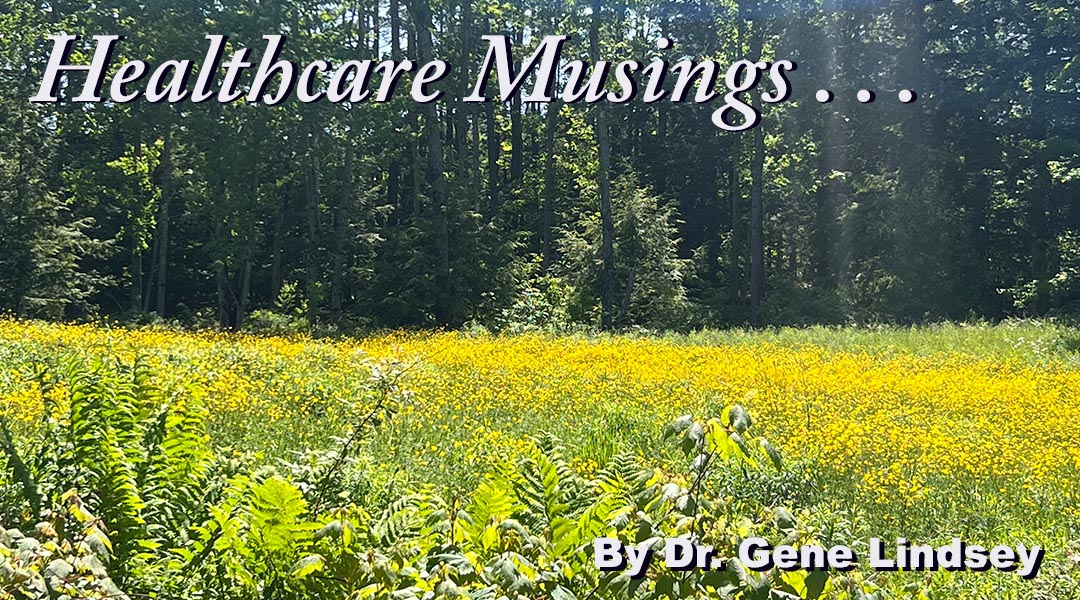
I took the picture that is the header for this letter on one of my daily walks earlier this week. The scene startled me about a third of a mile into my walk. Did this blanket of yellow appear while I was at my reunion? I have been walking past this pasture since 2008, and I had never seen it covered in tall yellow flowers. Perhaps that was because its previous owner had raised cows for slaughter on the land before he died of cancer a couple of years ago.
What you see is a sea of yellow that my nature app identifies as “meadow buttercup” or Ranunculus acris. According to Wikipedia, the local Abenaki tribes smashed the flowers and leaves and sniffed them as a treatment for headaches. The article suggests that eating the flowers can precipitate GI distress and sometimes cause ventricular fibrillation. I will just enjoy them from a distance, but they are everywhere. Having noticed them on my walk, I realized that a few of them are now invading the ferns in the flower bed around the Japanese Maple in my front yard.
The scenery on my usual walk seems to change every few days in the summer as a new crop of wildflowers arrives on a schedule I appreciate but don’t understand. I have resorted to using an app, and as of last fall, I had photographed 25 different wildflowers along the roads I walk near my home. Ranunculus acris now brings the number to 26. My efforts are limited to plants with flowers. In my process, I have not included the ferns, of which I can see there are several varieties, nor other green, leafy plants without flowers that are growing thick among the wildflowers. I inspect these plants without blossoms to determine whether or not they are poison ivy. We have had abundant rain, spurring the growth of all the vegetation. My guess is that, of my list of 26 flowering wild plants, only about 10 have arrived so far. That means I have much to anticipate!
The warmer weather this week is making the water temperature in my lake more conducive to my swims. The forecast is for muggy heat with occasional showers through the weekend, followed by a return to the high sixties and low seventies next week. 70 and dry is my favorite condition. The 10-day forecast suggests that this is the weather coming my way.
I will not say happy birthday to our fearless and thoughtless leader. He has planned his own party and needs no additional salutes. The “fighting cage” that has now turned our White House lawn into something reminiscent of the Coliseum of Rome speaks for itself. No one can offer him celebratory salutations that would exceed his own ability to praise and honor himself at our collective expense. In the world he dominates for a little longer, it is a relief to go looking for wild flowers as an antidote to the headaches, nausea, and disgust he can generate. I think I may try rubbing and sniffing the petals and leaves of the meadow buttercup, following the Abenaki example. Perhaps, besides helping with headaches, the fragrance might diminish the symptoms of my Trump derangement syndrome.
Be well,
Gene