April 10, 2026
Dear Interested Readers,
Dental Care Is Not Equitable
My wife and I spend a lot of money on our dental care. This year, we canceled our so-called dental insurance that we were buying through her Federal Employee Retirement Benefit because she calculated that the premiums exceeded the reimbursement we received. My wife keeps very accurate financial records. Between January 1, 2020, and December 31, 2025, we spent over $43, 000 on dental bills. Last year was the biggest hit so far at $19,740.
In preparation for my total knee replacement in December 2024, I needed the extraction of several teeth. I have three dentists: a periodontist/ implant surgeon in Concord, and my general dentist and his colleague, here in New London. Between them, in the year before my surgery, they had removed four chronically inflamed teeth, including the right half of a four-tooth frontal bridge, which had been originally installed in 1976 and was supported by my infected right front molar. I also lost an upper right molar and an upper left wisdom tooth in preparation for my knee surgery.
The 2025 expense included replacing the two front teeth with implants. The work was completed just before Thanksgiving 2025, so that, for more than a year between October 2024 and November 2025, I looked like someone who had been hit in the mouth with a hockey puck. The temporary replacements, which I was given, or rather bought, at great expense, were uncomfortable and had to be removed for eating, so despite my wife’s complaints that I looked like a toothless hick, I only wore the appliances for an occasional picture.
Since last Thanksgiving, my wife has no longer been embarrassed to be seen in public with me. But 2026 will be another expensive year because I am still in the process of getting the implant for the upper right molar that I lost, and I still need frequent visits to prevent further loss of teeth due to chronic periodontal disease. I am not complaining because I value my teeth for both their functional and cosmetic benefits.
With my recent dental history, you might think that I have neglected my dental health. There is a common bias in our society that suggests that people who have obviously poor teeth are negligent, or perhaps have a psychiatric or drug problem. Often, they are extremely self-conscious, have low self-esteem, and, at a practical level, may have difficulty getting jobs that require interacting with customers. In my case, the opposite is true. My parents took me to the dentist regularly, and for most of my life, I have brushed my teeth twice daily. As an adult, I have been a vigorous “flosser” and use a Waterpik twice daily.
The primary explanation for my lifelong dental problems is my genetic dental history. I was born with the absence of my lateral incisors. Those are the two teeth next to the two big upper front teeth. The condition occurs in about 2% of the population, with a slight skew toward females.
Until I was about 16, I was delighted with the resulting gap between my two front teeth. My friends admired me because I learned to shoot an accurate eight-foot stream of water through the gap between those two front teeth. I was the “Spitter Supreme.” When I read Chaucer’s Canterbury Tales in college, I felt a kinship with the Wife of Bath. You might remember that Chaucer described her as having a gap between her front teeth. I confirmed this with Google’s AI. When I asked for details, it responded:
Yes, the Wife of Bath (Alisoun) in Geoffrey Chaucer’s The Canterbury Tales is explicitly described as having gapped teeth, or being “gat-tothed”. In the General Prologue, she is described as having wide-set front teeth, which in medieval physiognomy symbolized a bold, sensual, and lustful nature.
- Significance: The gap-tooth was associated with Saint Venus’s seal, implying she was amorous and passionate.
- Her Claim: The Wife of Bath herself mentions her gap-tooth in her prologue, suggesting it suited her and was part of her nature.
- Appearance: Besides her teeth, she is portrayed as bold, wealthy, and wearing red stockings.
Chaucer’s positive portrayal of the gap-toothed wife, with a hint of sexual mystery, was interesting and good for my ego, but by the time I was reading Chaucer as a college freshman in 1963, I was in the process of losing my gap, but I was well on my way to future dental problems. My parents became aware of my teenage embarrassment about my gap and took me to an orthodontist during my last year in high school. The orthodontist was able to pull the two front teeth together with discreet braces at the gum line. He made more space for artificial lateral incisors by pulling what should have been my third tooth (canines) on either side back far enough to create adequate space for artificial lateral incisors.
During my freshman year, before my orthodontic repair was complete, and about the time I learned about the Wife of Bath, I took a hit to the face at football practice from a teammate’s helmet that clipped off my right front tooth a few millimeters from the gum line. The injury occurred despite my wearing a mouth guard. Until the tooth was capped during my sophomore year, I was “Fang” with one tooth occupying the space of four.
Since I was going to continue playing football and might get a fixed bridge knocked out, my orthodontist suggested that, instead of a fixed four-tooth front bridge, he should make me a dental plate with the two lateral incisors that I could “leave in the locker room.” The plate was comfortable, and I wore it until 1976. I could push my teeth out with my tongue to amuse my children. I did not realize that for those 13 years, the plate was “packing food” into the space between my gums and my teeth, creating a problem that would last the rest of my life.
After the damage was done, I was advised to replace the plate with a four-tooth front bridge suspended from my two front teeth. I made an appointment on Patriots Day in 1976, which I had off, for a dentist to begin work on the bridge. The dentist’s office was in Brookline at Coolidge Corner, where the route of the Boston Marathon takes a sharp turn onto Beacon Street at mile 22.
I had never bothered to watch the marathon even though I had been in Boston since 1967. I was always working in the hospital. By 1976, I was practicing internal medicine and cardiology at Harvard Community Health Plan, further down Beacon Street in Kenmore Square. Since our offices were closed for the holiday except for emergencies, and I was not on call that day, I thought I was lucky to get an appointment at a convenient time. I was totally unaware of the marathon’s route, and when I went into the office, there was only typical holiday traffic where Commonwealth Avenue and Beacon Street intersect in Cleveland Circle.
When I came out a few hours later after a lengthy appointment, I was confronted by a huge crowd lining both sides of the street, cheering a river of exhausted runners coming down the hill on Commonwealth Avenue from around the Chestnut Hill Reservoir, making the sharp left turn onto Beacon Street at Cleveland Square just in front of the building where my dentist had his office.
Unable to easily get through the crowd to my car, I joined the mass and watched, amazed by the effort I saw on the faces of the exhausted runners. The 1976 marathon, where temperatures on the road exceeded 100, was probably the hottest Boston Marathon ever run. It was affectionately named “The Run For the Hoses” because spectators began to spray runners with garden hoses as they ran by. 40% of the runners did not make it to the finish line. I was so inspired by the effort I saw that I began running the next morning at 6 AM, before going to work, in a poorly fitting pair of old sneakers. It was a good beginning. Over the next 30 years, I enjoyed running 50 marathons!
Getting back to my dental history, the fixed bridge served me well, but the damage was done. It was revised once, and then, after I knocked the porcelain off the front of one of the front teeth, a patient of mine, who was a dentist with coronary disease, told me he could “cap my cap.” I started seeing him in the early nineties, and it was he who began me on intensive treatment for my extensive gum disease. Over the years, I have endured many deep scalings and have been on doxycycline twice a day for over twenty-five years as management of my “chronic disease.”
This last Tuesday, I drove to Concord for my bimonthly cleaning and a follow-up on the status of the bone grafts and the recently placed foundation for the next implant I hope to have installed sometime this summer. I actually enjoy my visits. I have been very impressed by the professionalism of my periodontist and all of the dental hygienists that he employs. My favorite is a young woman named Savanah.
Savanah has a great personality and very skilled hands. We usually have intermittent conversations between the steps of the cleaning process, the x-rays, and the dentist’s evaluation. This week, we discussed our shared views on the president and his oppressive domestic agenda and foreign policy blunders. As our conversation drifted toward the high cost of healthcare, she agreed with me that it was a long-standing error to separate healthcare in general from dental care and that, as a result, many people suffer the negative impact of poor dental health on their overall health. Our conversation included her revelation that the sharp increase in the cost of her care and its negative impact on her family’s budget were causing her and her husband to consider taking the risk of dropping their health insurance for a while.
She then surprised me by saying that she had been profoundly influenced in her opinions about healthcare by a book she had been required to read while training to be a hygienist. The book detailed the disasters caused by factors dating back to the nineteenth century that had historically separated dental care from medical care. It also documented the shift in much of dentistry toward a focus on cosmetics. She suggested that I read the book. All that I got for direction was that the title was Teeth by a woman named Otto. As soon as I got home, I looked up the book. The full title is TEETH: The Story of Beauty, Inequality, and the Struggle for Oral Health in America, published in 2017. The author, Mary Otto, is an experienced and award-winning medical journalist who has written for the Washington Post.
I was most surprised to discover a 2017 New York Times review of Teeth by Sarah Jaffe, the author of Necessary Trouble: Americans in Revolt. Jaffe’s review of Mary Otto’s book is titled “The Tooth Divide: Beauty, Class and the Story of Dentistry.”
Jaffe begins with some provocative questions:
Politicians, journalists and researchers have a long-running problem when it comes to talking about class. The definitions we use are myriad and not always overlapping. Is the boundary of the middle class a college degree, a certain level of income? Perhaps a certain type of job: a teacher or a doctor versus a coal miner or factory worker? We might be missing a still more useful — and more personal — indicator, however.
This is the premise, though not so bluntly stated, of Mary Otto’s new book, “Teeth: The Story of Beauty, Inequality, and the Struggle for Oral Health in America.” The dividing line between the classes might be starkest between those who spend thousands of dollars on a gleaming smile and those who suffer and even die from preventable tooth decay.
During the years I was in practice, most of my patients were staunch members of the middle and upper classes. It was not until the latter half of my practice years that we began to see many Medicare and Medicaid patients. When we established Harvard Vanguard, we commissioned a demographic study that demonstrated to my surprise that our patients had, on average, more years of education and higher rates of graduate degrees than the general population of Massachusetts.
My practice was populated by lawyers, teachers, government employees, engineers, and many college professors from the area’s academic institutions. I enjoyed the diversity in our practice. We cared for remarkably talented individuals and their families from diverse nationalities, genders, sexual identities, and professional backgrounds. I began seeing them while they were working and followed many as they aged into retirement and end-of-life issues.
I reasoned that our skewed population was a process of selection. In our earliest days, we were considered a radical, left-leaning experiment. Other than some government and teachers’ unions, most labor union members wanted their care to be financed by established insurers like Blue Cross or perhaps Aetna. Harvard Community Health Plan was widely regarded as an experiment in socialized medicine, and many educated consumers were happy to try it. Perhaps we were a socialist organization. Jokingly, we often referred to a colleague as “Comrade.” There was some truth to the idea that we were a radical organization since Dr. Ebert’s idea was radical for the day. He was obviously seeking to move care from the hospital to the ambulatory environment and to address many of the cost and delivery issues he felt plagued American healthcare.
Suffice it to say that dental problems were not a major issue for most of our patients, and for years, our offering included a very strong dental practice because our founders believed dental health to be a significant part of a logical approach to preventive care, especially for children. A dental consult was as available to me as a consult in any other specialty.
When I moved to New Hampshire and began my work with the organizations that offer support to poorer individuals and families living on SNAP, SSDI, or by occasional seasonal employment, many of whom had never had adequate healthcare, let alone dental care, I was amazed that almost everyone of them had very poor dental hygiene. Many were edentulous, and those that were not had many black teeth and complained of frequent dental pain. I know one woman who has told me that she can’t work because her lack of teeth embarrasses her. She imagines that no one would hire her because of her appearance. As I mentioned earlier, I think it is likely that many of us have some unrecognized bias against people with obvious dental issues and may assume it is a manifestation of a character flaw. Several years ago, my wife and I saw dental decay in the children of a single mother whom we knew well, and who could not afford care. We assumed she was failing her children in some way, but we were so motivated to spare the children future distress that we paid for their dental care. But what I see in our local population exceeds the ability of an occasional individual to respond alone or for organizations of concerned people to make much of a difference, since food, housing, transportation, and other unpaid bills are an even higher priority for our charitable resources, and dental care, especially restorative dental care, is expensive. The only plausible answer to this problem is that good and equitable basic dental care is a collective responsibility. It is very likely that treating dental health as part of the totality of care everyone deserves would reduce overall healthcare costs and improve the lives of millions now and in the future.
You might counter by saying that doesn’t Medicaid offer dental benefits? Technically, yes, it does, but very few dentists will accept Medicaid reimbursement, and some states don’t offer it at all. Medicaid has no dental benefit. You can learn more about these deficiencies by clicking here. The review of Teeth goes on to describe how the author builds her case using the unnecessary death of a poor child caused by untreated dental decay.
Otto’s book begins and ends with the story of Deamonte Driver, a 12-year-old Maryland boy who died of an infection caused by one decaying tooth, and the system that failed him. In pointing out the flaws in that system, Otto takes us back through the history of dentistry and shows us how the dental profession evolved, separately from the rest of health care, into a mostly private industry that revolves almost entirely around one’s ability to pay. In other words, all of the problems with health care in America exist in the dental system, but exponentially more so.
You may have difficulty believing it, but the review author points out that even as Trump was trying to derail the ACA in 2017, tens of millions of Americans, many of whom were children, lacked care. She writes:
But on the other end of the spectrum, which stretches from a free clinic in Appalachia to the Indian Health Service in remote Alaska to a mobile clinic in Prince George’s County, Md., dental providers struggle to see all of those who cannot access regular care. One-third of white children go without dental care, Otto notes; that number is closer to one-half for black and Latino children. Forty-nine million people live in “dental professional shortage areas,” and even for those who do have benefits under public programs like Medicaid, which ostensibly covered Deamonte Driver and his siblings, it can be difficult to find a provider. The dentist treating Driver’s brother DaShawn, Otto writes, “discontinued treatments because DaShawn squirmed too much in the dental chair.” Medicare doesn’t cover routine dental services. Remote Area Medical Volunteer Corps, the charity that operated the temporary clinic in Appalachia, was begun to reach suffering people in developing countries, but wound up seeing Americans. “We have a very serious social problem that we are trying to solve with private means,” a researcher tells Otto.
Our local TV station recently ran a report about the dental program of the Remote Area Medical Volunteer Corps during its evening “magazine” program. The report showed people camping out in parking lots for several days, waiting in the hope of receiving free dental care from this remarkable organization. There are parts of our country where our citizens would probably be no worse off if they lived in a third-world country.
The reviewer then asks a question that is just as appropriate now as it was in 2017, when Trump first tried to undermine public support for healthcare by attempting to repeal the ACA.
Yet in a country where the party in power fights tooth and nail against expanding regular health care benefits, what chance do we have of publicly funded dental care?
As I said, I am just beginning the book, but I fear that even though it was written in 2017, things are not better. I will venture that the concerning issues of dental health in America have likely gotten much worse in the intervening years. From today’s position in a second Trump debacle, the article is prescient when the author writes:
The problem of oral health in America is, Otto argues, part of the larger debate about health that is likely to grow larger and nastier in the upcoming months. At the moment, our broader health care system at least tenuously operates on the belief that no one should be denied health care because of ability to pay. But dental care is still associated in our minds with cosmetic practices, with beauty and privilege. It is simultaneously frivolous, a luxury for those who can waste money, and a personal responsibility that one is harshly judged for neglecting. In this context, “Teeth” becomes more than an exploration of a two-tiered system — it is a call for sweeping, radical change.
I’ve read enough of the book to realize that its message is very appropriate for this moment, when our poor and disadvantaged population is likely to be under even more stress than it was in 2017. Poverty and financial distress are still making dental care out of reach for tens of millions of our neighbors. Many of them become ill from their poor dental health. Some even die. Others lose self-esteem over their appearance. They may fear smiling, which would reveal their poor dental health and suggest to others that they have a character flaw. The biases of others can compromise their employment opportunities. These are realities that should not exist in a nation that can squander tens of billions of dollars on needless wars and build gilded ballrooms to flatter enormous egos.
I am looking forward to my next visit with Savanah and our continuing discussion of what might make for a more equitable and healthy world.
What Happens Next Now That There May Be an Off-Ramp From an Unnecessary War?
You may be surprised that this week I did not begin with a rant against Trump and the war in Iran. I was greatly relieved when the president decided about 6:45 PM on Tuesday evening to agree to a two-week ceasefire rather than commit another war crime and “blow Iran back to the Stone Age.” I imagine that, like me, many are confused by mixed emotions. I am happy that a disaster has been avoided, but somehow I want the president to be accountable for the mess he and his collaborators have made, and for the dishonor and loss of trust in the eyes of many of our traditional allies that he has brought upon all of us. I fear that it won’t be long before this truce falls apart, or if it holds, he invents some new adventure to try to save his failing presidency and continue to distract his MAGA loyalists from their concerns about the Epstein files. I am reminded that, invariably, it usually ends badly with a sociopathic narcissist.
I am a subscriber to Paul Krugman’s daily letter. I feel compelled to share his brief post from early Wednesday morning with you. Events may change, but the points Krugman made will remain valid no matter what happens going forward. By the way, “TACO” stands for Trump Always Chickens Out. Krugman writes:
So the world’s greatest military power went to war with a poor, medievalist theocracy. It was an incredibly uneven match. Here’s are the GDPs of Iran and the United States in 2024:
Iran: 0.48 trillion
US: 28.75 trillion
Source: World Bank
Yet Iran won. The Iranian regime has emerged far stronger than it was before, controlling the Strait of Hormuz and having demonstrated its ability to inflict damage on both its neighbors and the world economy. The U.S. has emerged far weaker, having demonstrated the limitations of its military technology, its strategic ineptitude and, when push comes to shove, its cowardice.
We’ve also destroyed our moral credibility: Trump may have TACOed at the last minute, but he threatened to commit gigantic war crimes — and for all practical purposes our political and civil institutions gave him permission to do so.
How did this happen? Naturally, the Iranian Minister of War credited divine intervention, declaring that “God deserves all the glory.” His nation, he said, fought with the “protection of divine providence. A massive effort with miraculous protection.”
Well, theocrats gonna theocrat.
But I lied. That wasn’t a quote from an Iranian official. That’s what Pete Hegseth, our self-proclaimed Secretary of War, said while claiming that one of the worst strategic defeats in American history was a great victory.
There will be many analyses by military and strategic experts of the Iran debacle. But let’s not lose sight of the larger picture: We were led to disaster by the boastful ignorance of men like Trump and Hegseth — boastful ignorance made even worse by claims that God supports whatever they want to do.
With men like that running America, major disasters were just a matter of time. I’d like to think that they have been chastened by this debacle, that they have learned something. But I don’t believe that for a minute.
God help us.
To that statement, I add a respectful Amen.
Winter Makes a Brief Encore, a Loon Returns, and We Enjoy Earthrise
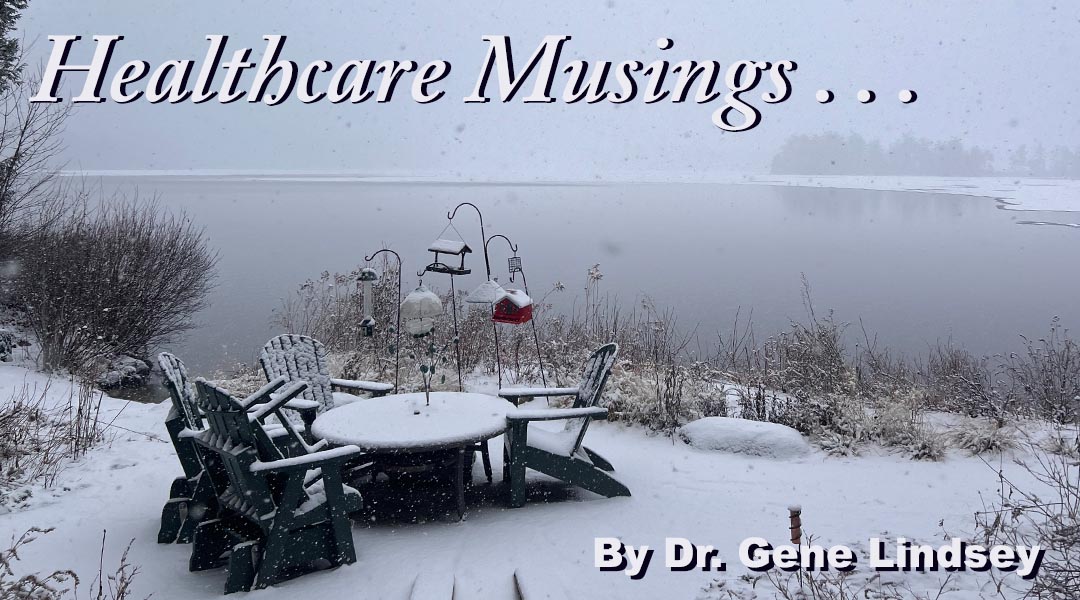
Spring is playing peekaboo with us in New Hampshire this week. Monday was a nice day, reaching 60 degrees. I could see a lot of ice-free open water on my lake, but I was still very surprised when I spotted a lonely loon near the interface between the open water and the residual ice. I bet that loon was sorry for its early arrival when the temp dipped into the mid twenties Monday night and we woke up to a couple of inches of fresh snow. The snow continued to fall until past noon. The header for today’s post was my attempt to share the scene with you. I was hoping my picture would capture the loon, but pardon my pun, he was not loony, and had probably tried to find some shelter.
The big relief from the president’s antics this week and some evidence that we can still do remarkable things has been the reports from the Artemis II flight. I particularly enjoyed seeing the container of Nutella float through the spacecraft’s cabin. Was that product placement? The crew shared their inspiring picture of “Earthrise,” and, to many, including me, it underscored the reality that we are all together flying on a wonderful ride through space. They will be home tonight.
I hope that you enjoy a big serving of spring this weekend.
Be well,
Gene